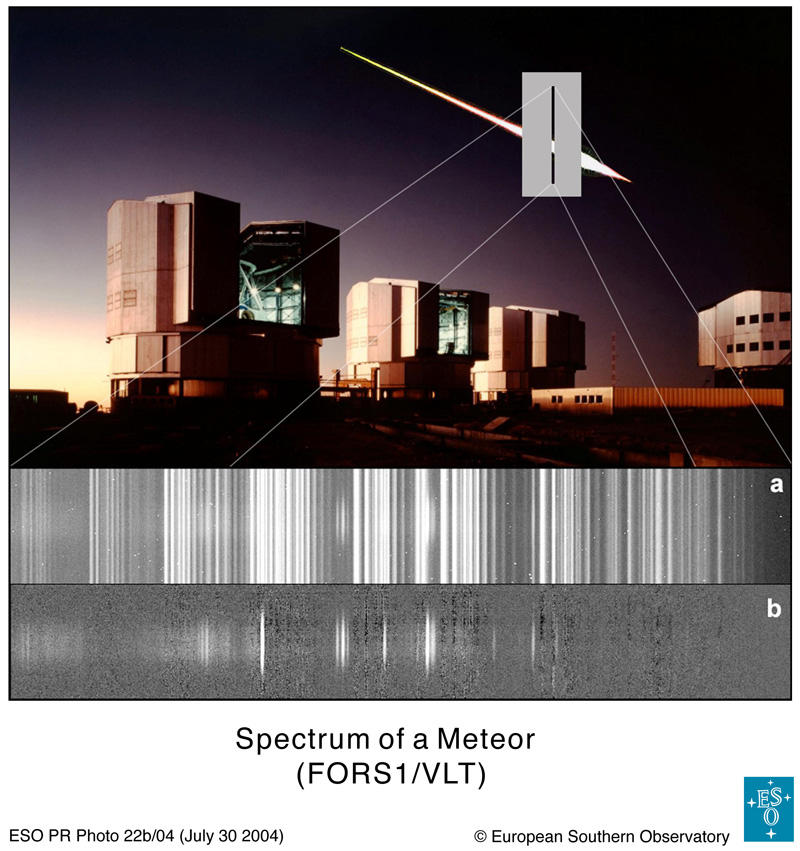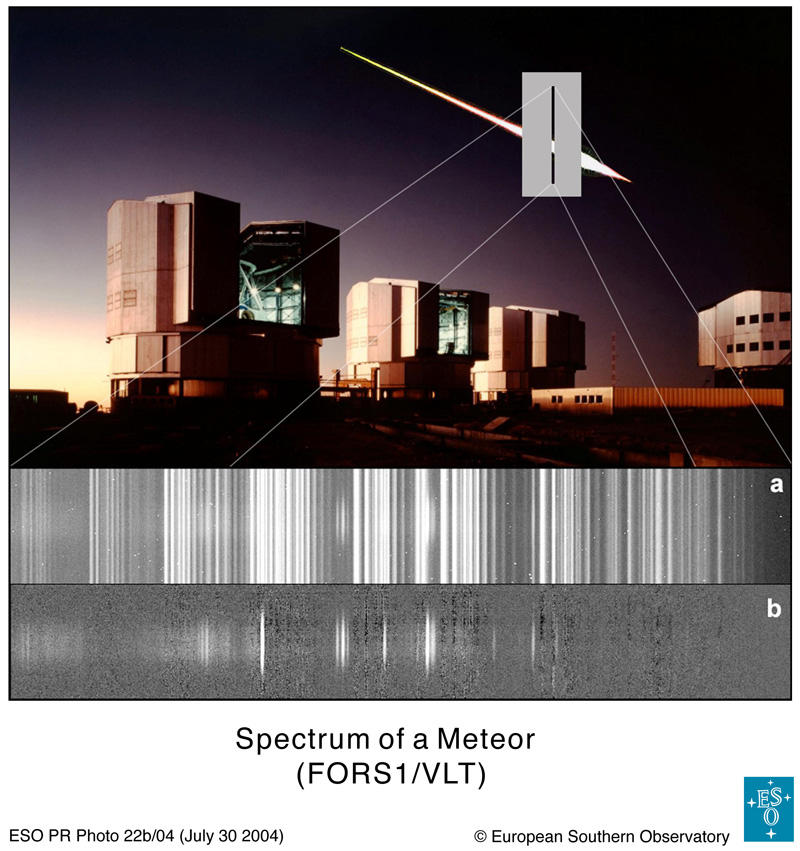
Chasing the brief flash of a meteor trail across the sky with a very large telescope is a nearly impossible task. But on May 12, 2002, astronomers got lucky, as a bright meteor chanced across the narrow slit of their spectrograph at the Paranal Observatory. At the time, the spectrograph was being used to study the light from a supernova, separating and recording the many near-infrared emission lines produced by atoms in the distant stellar explosion. Below this artistic montage of a meteor streak and Very Large Telescope units at Paranal, panel a shows the near-infrared sky background spectrum and the May 12 meteor combined. Panel b shows the emission spectrum of the meteor alone, after subtracting away the background contributions. The meteor emission is due to colliding oxygen and nitrogen atoms and molecules in the superheated air along the glowing trail at an altitude of about 100 kilometers.
Perseguir el breve destello de un rastro de meteoro a través del cielo con un telescopio muy grande es una tarea casi imposible. Pero el 12 de mayo de 2002, los astrónomos tuvieron suerte, ya que un meteoro brillante pasó por casualidad a través de la ranura estrecha de su espectrógrafo en el Observatorio Paranal. En ese momento, el espectrógrafo se estaba utilizando para estudiar la luz de una supernova, separando y registrando las muchas líneas de emisión del infrarrojo cercano producidas por átomos en la explosión estelar distante. Debajo de este montaje artístico de una estría de meteoro y unidades del Telescopio Muy Grande en Paranal, el panel a muestra el espectro del fondo del cielo infrarrojo cercano y el meteoro del 12 de mayo combinados. El panel b muestra el espectro de emisión del meteoro solo, después de restar las contribuciones del fondo. La emisión del meteoro se debe a colisiones entre átomos y moléculas de oxígeno y nitrógeno en el aire sobrecalentado a lo largo del rastro incandescente a una altitud de aproximadamente 100 kilómetros.