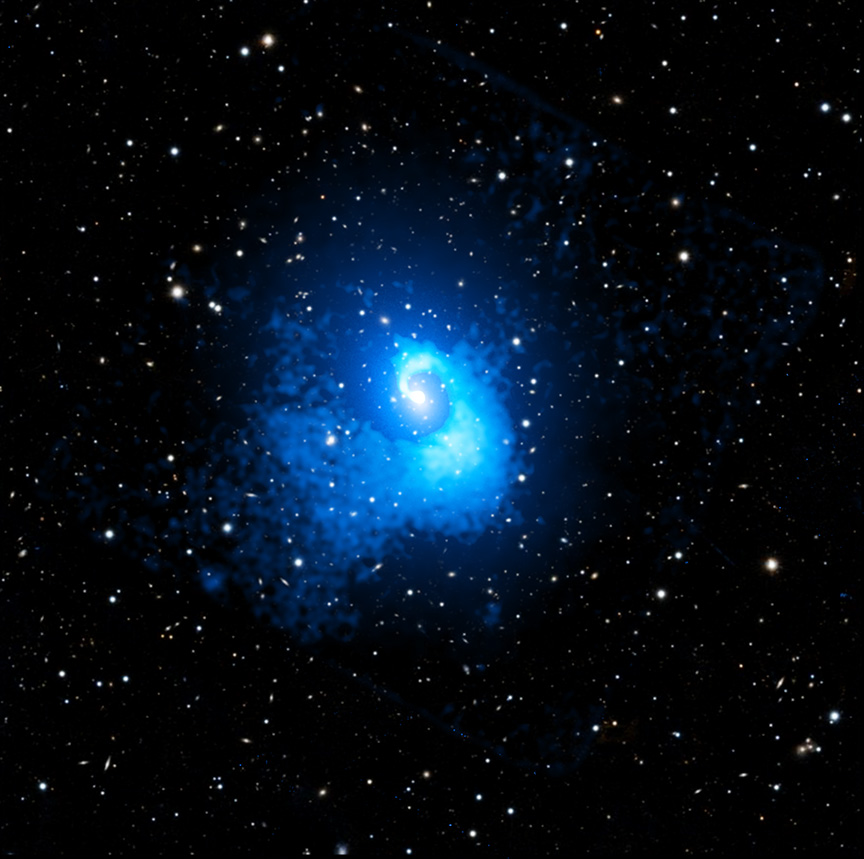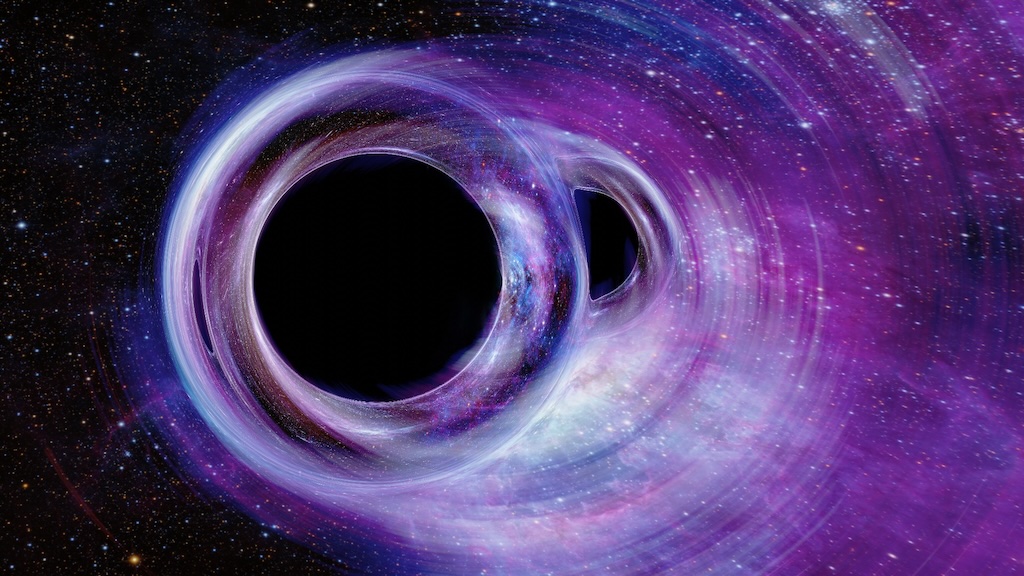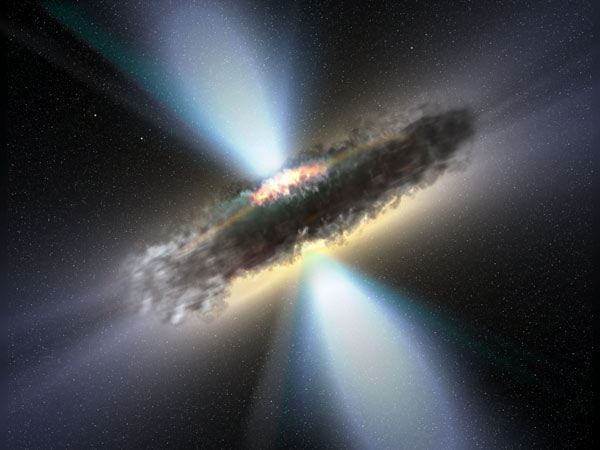
Why do some black hole surroundings appear brighter than others? In the centers of active galaxies, supermassive black holes at least thousands of times the mass of our Sun dominate. Many, called Seyfert Type I, are very bright in visible light. Others, called Seyfert Type II, are rather dim. The difference might be caused by some black holes accreting much more matter than others. Alternatively, the black holes in the center of Seyfert Type II galaxies might be obscured by a surrounding torus. To help choose between these competing hypotheses, the nearby Seyfert II galaxy NGC 4388 has been observed in X-ray light recently by many recent Earth-orbiting X-ray observatories, including CGRO, SIGMA, BeppoSAX, INTEGRAL, Chandra, and XMM-Newton. Recent data from INTEGRAL and XMM-Newton have found that the X-ray flux in some X-ray colors varies rapidly, while flux in other X-ray colors is quite steady. The constant flux and apparent absorption of very specific X-ray colors by cool iron together give evidence that the central black hole in NGC 4388 is seen through a thick torus composed of molecular gas and dust.
¿Por qué algunos entornos de agujeros negros aparecen más brillantes que otros? En los centros de galaxias activas, agujeros negros supermasivos con masas de al menos miles de veces la del Sol dominan el panorama. Muchos, llamados Seyfert Tipo I, son muy brillantes en luz visible. Otros, llamados Seyfert Tipo II, son bastante tenues. La diferencia podría ser causada porque algunos agujeros negros acumulan mucha más materia que otros. Alternativamente, los agujeros negros en el centro de galaxias Seyfert Tipo II podrían estar oscurecidos por un toro circundante. Para ayudar a elegir entre estas hipótesis competidoras, la cercana galaxia Seyfert II NGC 4388 ha sido observada recientemente en luz de rayos X por muchos observatorios de rayos X en órbita terrestre, incluyendo CGRO, SIGMA, BeppoSAX, INTEGRAL, Chandra y XMM-Newton. Datos recientes de INTEGRAL y XMM-Newton han encontrado que el flujo de rayos X en algunos colores de rayos X varía rápidamente, mientras que el flujo en otros colores de rayos X es bastante constante. El flujo constante y la absorción aparente de colores de rayos X muy específicos por hierro frío juntos proporcionan evidencia de que el agujero negro central en NGC 4388 se ve a través de un toro grueso compuesto de gas molecular y polvo.