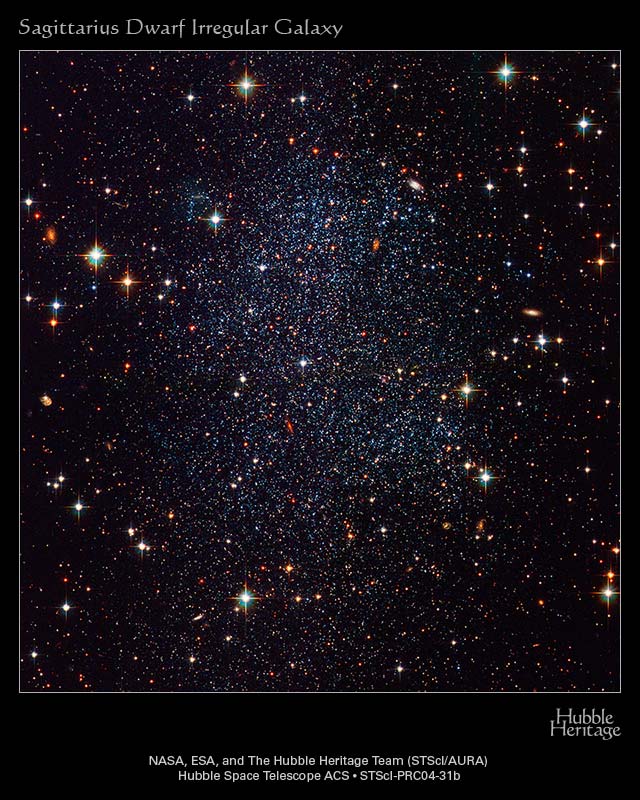
How old is this galaxy? The nearby Local Group galaxy dubbed the Sagittarius Dwarf Irregular Galaxy (SagDIG) is not only very small but also has relatively few elements more massive than helium. Now the lack of heavy elements might mean that SagDIG is very young, so that component stars had little time to create and disperse massive elements. Conversely, SagDIG's diminutive size could indicate that it formed in the early universe, being a surviving building block of modern large galaxies. The above detailed image from the Hubble Space Telescope has now resolved enough stars to solve this mystery: SagDIG is ancient. Although SagDIG does have some groups of young stars, many stars are very old, and the galaxy as a whole helps astronomers to understand how the universe evolved, and show that at least one metal-poor galaxy is almost as old as the universe. Pictured above, SagDIG spans about 1,500 light years and lies about 3.5 million light years away toward the constellation of Sagittarius.
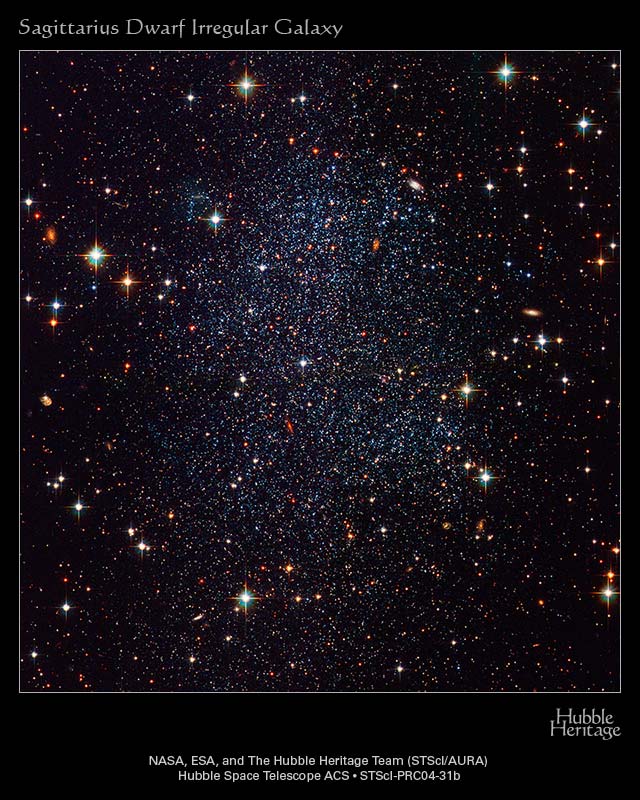
¿Cuál es la edad de esta galaxia? La cercana galaxia del Grupo Local denominada Galaxia Enana Irregular de Sagitario (SagDIG) no solo es muy pequeña, sino que también contiene relativamente pocos elementos más masivos que el helio. Ahora bien, la falta de elementos pesados podría significar que SagDIG es muy joven, de modo que sus estrellas componentes tuvieron poco tiempo para crear y dispersar elementos masivos. Por el contrario, el tamaño diminuto de SagDIG podría indicar que se formó en el universo primitivo, siendo un bloque constructor que sobrevivió de las galaxias grandes modernas. La imagen detallada anterior del Telescopio Espacial Hubble ha logrado resolver suficientes estrellas para resolver este misterio: SagDIG es antigua. Aunque SagDIG sí tiene algunos grupos de estrellas jóvenes, muchas estrellas son muy antiguas, y la galaxia en conjunto ayuda a los astrónomos a comprender cómo evolucionó el universo, demostrando que al menos una galaxia pobre en metales tiene una edad casi tan antigua como la del universo. Como se muestra arriba, SagDIG se extiende aproximadamente 1.500 años luz y se encuentra a unos 3,5 millones de años luz de distancia hacia la constelación de Sagitario.