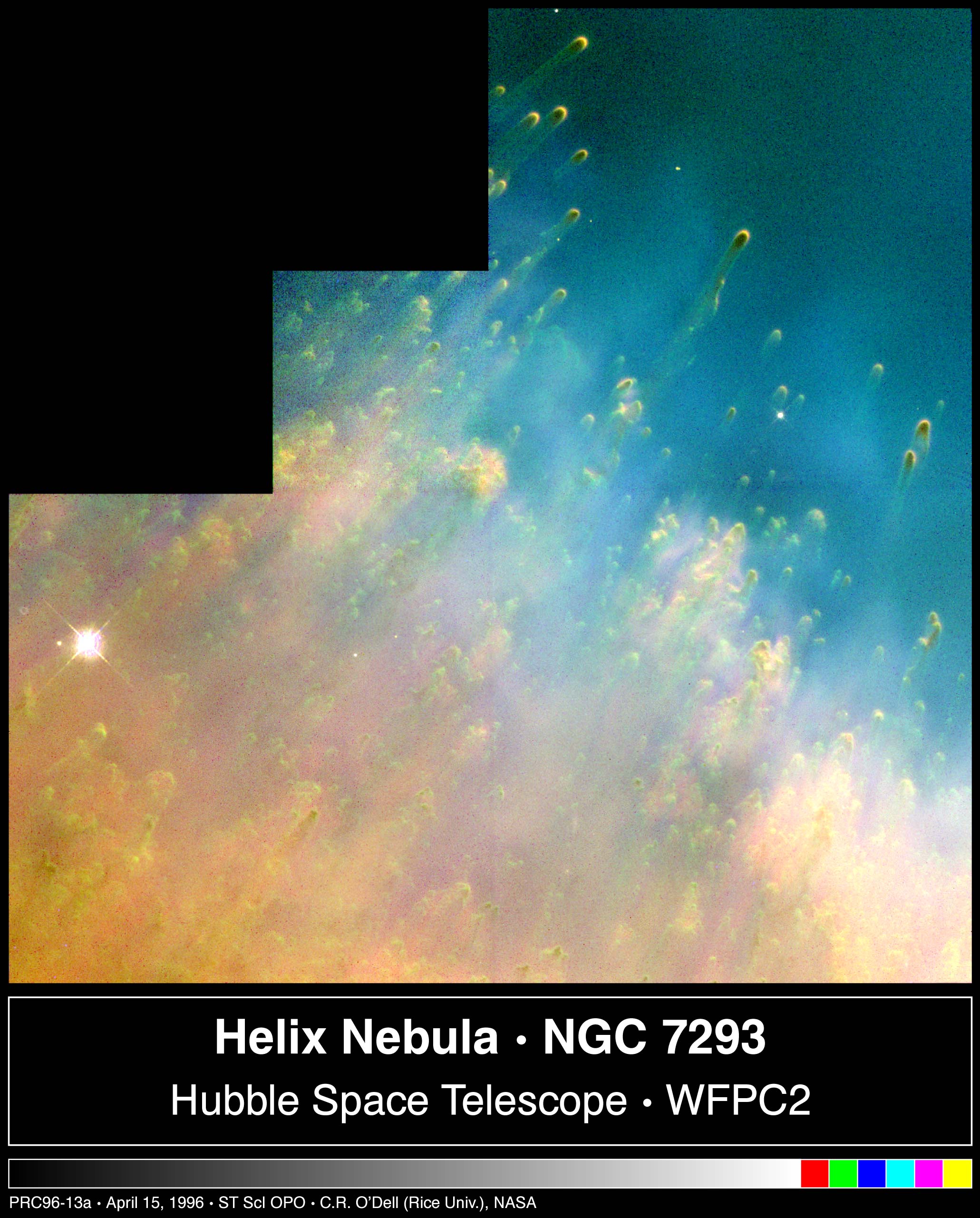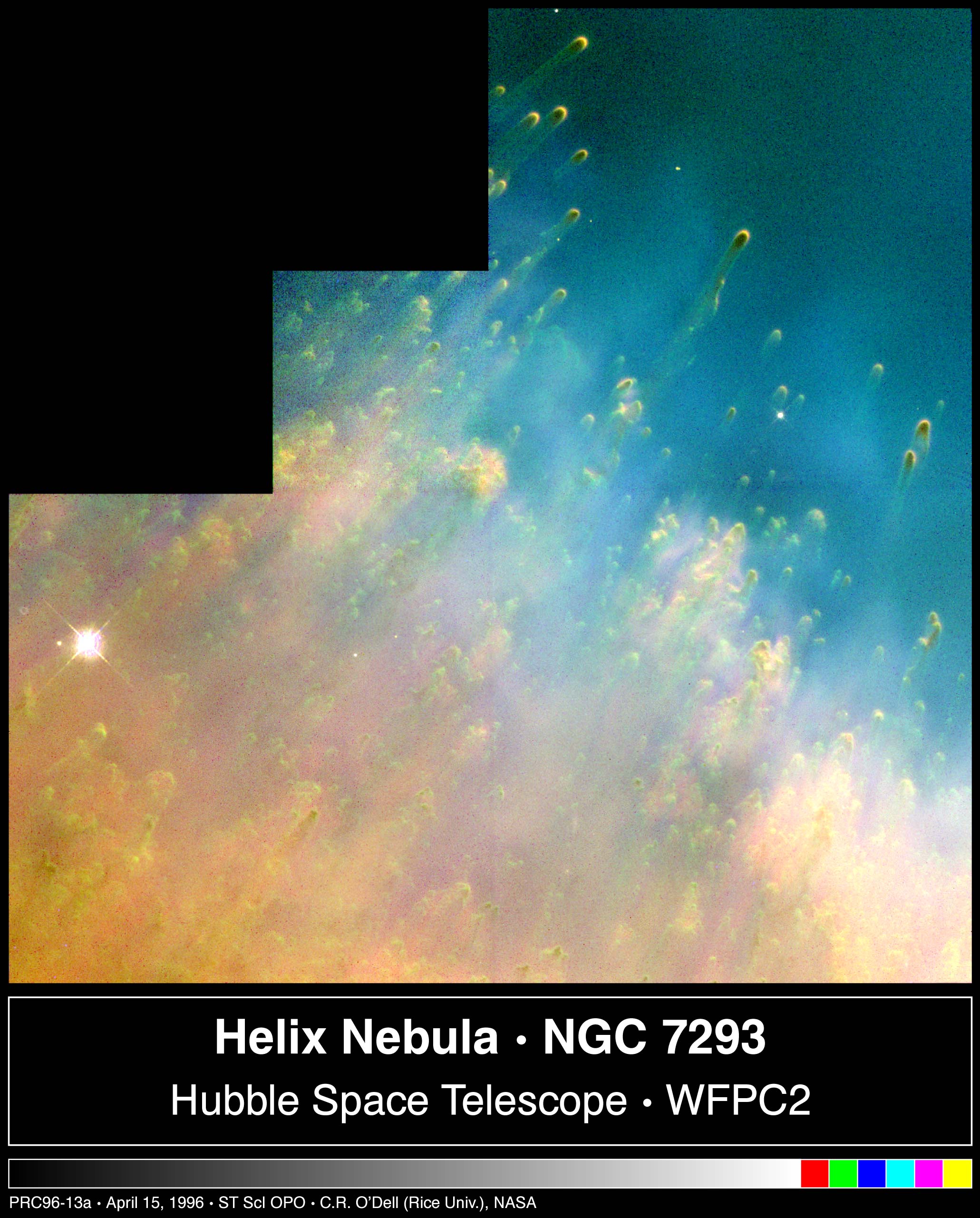
How did a star create the Helix nebula? The shapes of planetary nebula like the Helix are important because they likely hold clues to how stars like the Sun end their lives. Recent observations by the orbiting Hubble Space Telescope and the 4-meter Blanco Telescope in Chile, however, have shown the Helix is not really a simple helix. Rather, it incorporates two nearly perpendicular disks as well as arcs, shocks, and even features not well understood. Even so, many strikingly geometric symmetries remain. How a single Sun-like star created such beautiful yet geometric complexity is a topic of research. The Helix Nebula is the nearest planetary nebula to Earth, lies only about 700 light years away toward the constellation of Aquarius, and spans about 3 light-years.
¿Cómo creó una estrella la nebulosa de la Hélice? Las formas de nebulosas planetarias como la Hélice son importantes porque probablemente contienen pistas sobre cómo terminan sus vidas estrellas como nuestro Sol. Sin embargo, observaciones recientes del Telescopio Espacial Hubble en órbita y del Telescopio Blanco de 4 metros en Chile han demostrado que la Hélice no es realmente una hélice simple. En cambio, incorpora dos discos casi perpendiculares entre sí, así como arcos, ondas de choque e incluso características que aún no se comprenden bien. A pesar de ello, permanecen muchas simetrías notablemente geométricas. Cómo una única estrella similar al Sol creó una complejidad tan hermosa pero geométrica es un tema de investigación. La Nebulosa de la Hélice es la nebulosa planetaria más cercana a la Tierra, se encuentra a solo aproximadamente 700 años luz de distancia hacia la constelación de Acuario, y abarca aproximadamente 3 años luz.