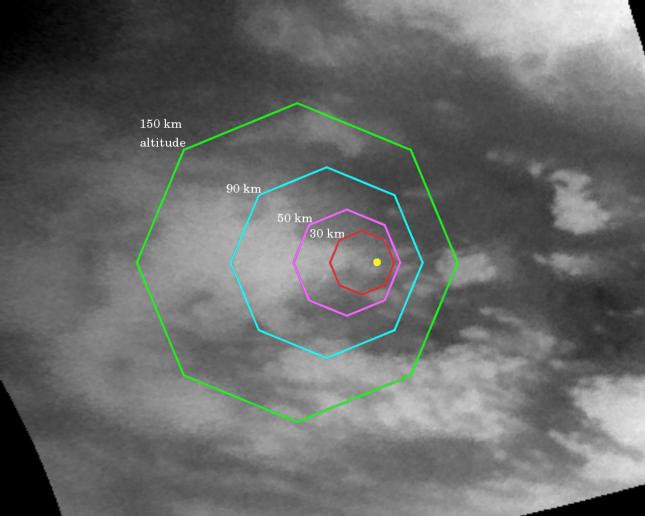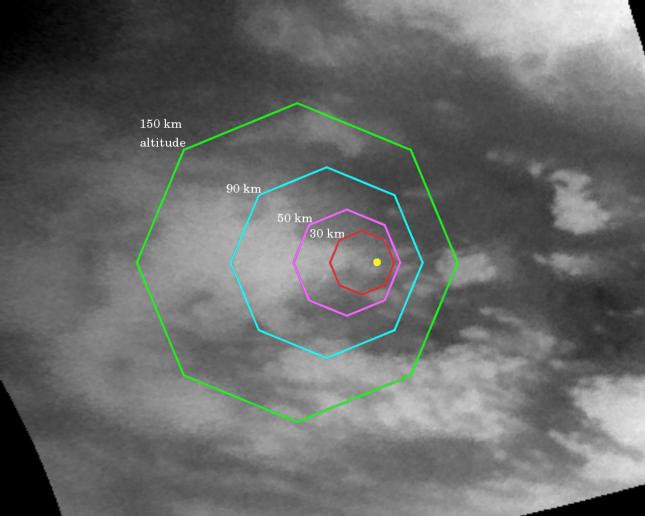
Today's descent to the surface of Titan by the European Space Agency's Huygens probe was the most distant landing ever by a spacecraft from Earth. At 10:13 UT (5:13am EST, 11:13 CET), Huygens entered the atmosphere of Saturn's large mystery moon at an altitude of 180 kilometers. Radio astronomers reported detecting signals from the probe indicating that that Huygens began to deployed a series of parachutes to control its 2 hour descent through Titan's dense atmosphere. Huygens' anticipated landing point is marked by a yellow dot in this near-infrared image from the Cassini spacecraft ... but it is not known if a solid or liquid surface awaited it. The outermost of the nested octagons is about 1,120 kilometers across. The outlines are labeled by altitude and indicate areas of coverage by Huygens' imaging instruments during the descent. News: Updates on the Huygens landing.
El descenso de hoy a la superficie de Titán por la sonda Huygens de la Agencia Espacial Europea fue el aterrizaje más distante jamás realizado por una nave espacial desde la Tierra. A las 10:13 UT (5:13 EST, 11:13 CET), Huygens entró en la atmósfera de la misteriosa luna grande de Saturno a una altitud de 180 kilómetros. Los astrónomos de radio informaron de la detección de señales de la sonda indicando que Huygens comenzó a desplegar una serie de paracaídas para controlar su descenso de 2 horas a través de la densa atmósfera de Titán. El punto de aterrizaje anticipado de Huygens está marcado por un punto amarillo en esta imagen de infrarrojo cercano de la nave espacial Cassini... pero se desconoce si le esperaba una superficie sólida o líquida. El octágono más exterior de los octágonos anidados mide aproximadamente 1.120 kilómetros de ancho. Los contornos están etiquetados por altitud e indican áreas de cobertura de los instrumentos de imagen de Huygens durante el descenso.