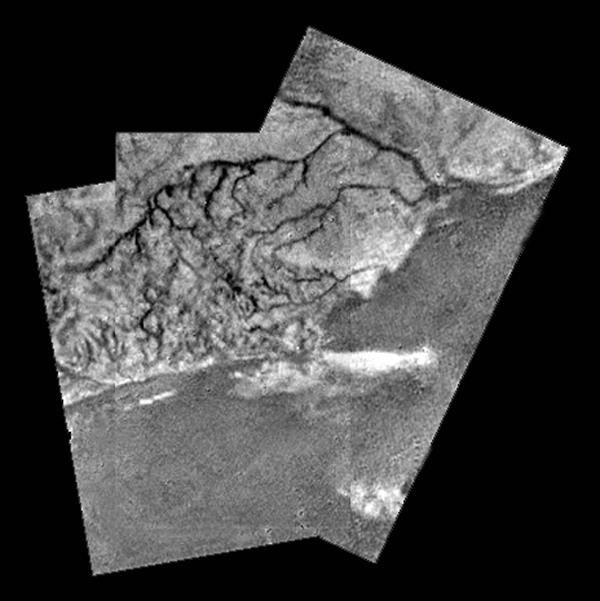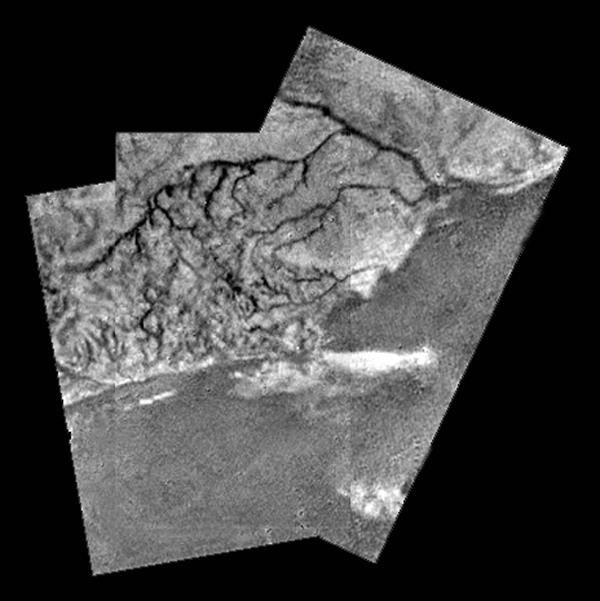
Methane rain, evaporating lakes, flowing rivers, and water ice-volcanoes all likely exist on Saturn's moon Titan, according to preliminary analyses of recent images taken by the successful Huygens lander. A snaking and branching riverbed is identified with the dark channel near the top of the above image, while a dark lakebed is identified across the image bottom. Both the riverbed and lakebed were thought to be dry at the time the image was taken but contained a flowing liquid - likely methane - in the recent past. Titan's surface was found to appear strangely similar to Earth even though it is so cold that methane flows and water freezes into rock-hard ice. Although the Huygens probe has now run out of power, the images it returned will likely be studied for decades to come. The Cassini mothership is scheduled to continue to orbit Saturn and return images for several more years.
Según análisis preliminares de imágenes recientes capturadas por la sonda Huygens, que operó exitosamente, lluvia de metano, lagos en evaporación, ríos fluyentes y volcanes de hielo de agua probablemente existen en Titán, la luna de Saturno. Se identifica un cauce fluvial sinuoso y ramificado con el canal oscuro cerca de la parte superior de la imagen anterior, mientras que un lecho lacustre oscuro se identifica en la parte inferior de la imagen. Se pensaba que tanto el cauce como el lecho lacustre estaban secos en el momento en que se tomó la imagen, pero contenían un líquido fluyente —probablemente metano— en el pasado reciente. Se encontró que la superficie de Titán aparece extrañamente similar a la de la Tierra, a pesar de ser tan fría que el metano fluye y el agua se congela en hielo duro como la roca. Aunque la sonda Huygens ya ha agotado su energía, las imágenes que devolvió probablemente serán estudiadas durante décadas. Se programó que la nave nodriza Cassini continúe orbitando Saturno y devolviendo imágenes durante varios años más.