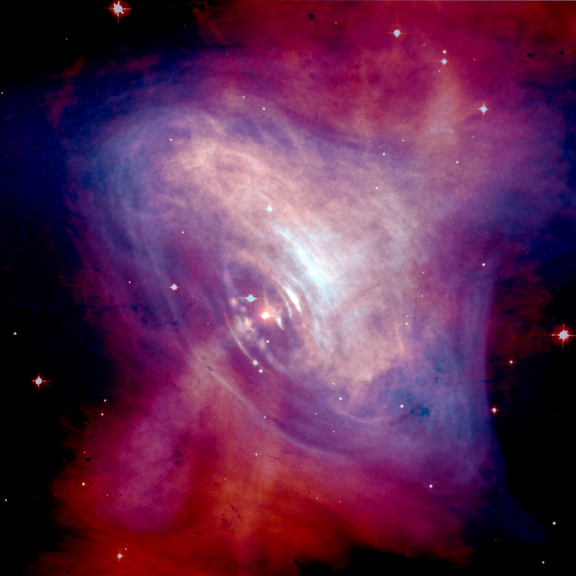
The Crab Pulsar, a city-sized, magnetized neutron star spinning 30 times a second, lies at the center of this composite image of the inner region of the well-known Crab Nebula. The spectacular picture combines optical data (red) from the Hubble Space Telescope and x-ray images (blue) from the Chandra Observatory, also used in the popular Crab Pulsar movies. Like a cosmic dynamo the pulsar powers the x-ray and optical emission from the nebula, accelerating charged particles and producing the eerie, glowing x-ray jets. Ring-like structures are x-ray emitting regions where the high energy particles slam into the nebular material. The innermost ring is about a light-year across. With more mass than the Sun and the density of an atomic nucleus, the spinning pulsar is the collapsed core of a massive star that exploded, while the nebula is the expanding remnant of the star's outer layers. The supernova explosion was witnessed in the year 1054.
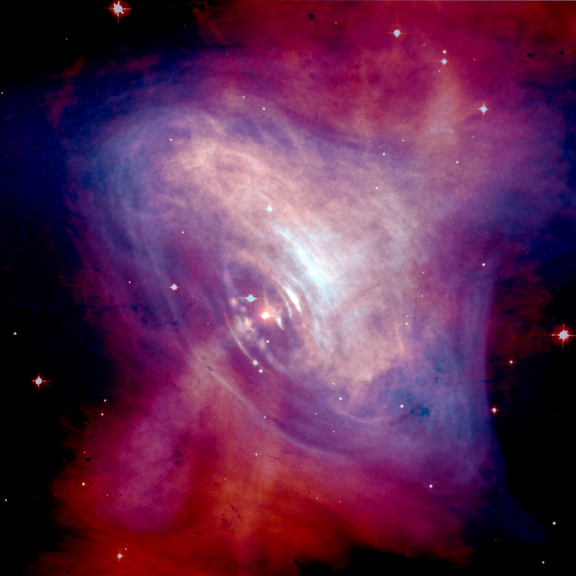
El púlsar del Cangrejo, una estrella de neutrones magnetizada del tamaño de una ciudad que gira 30 veces por segundo, se encuentra en el centro de esta imagen compuesta de la región interior de la conocida Nebulosa del Cangrejo. La imagen espectacular combina datos ópticos (rojo) del Telescopio Espacial Hubble e imágenes de rayos X (azul) del Observatorio Chandra, también utilizados en las populares películas del Púlsar del Cangrejo. Como un dínamo cósmico, el púlsar alimenta la emisión de rayos X y óptica de la nebulosa, acelerando partículas cargadas y produciendo los inquietantes chorros de rayos X luminosos. Las estructuras anulares son regiones emisoras de rayos X donde las partículas de alta energía chocan contra el material nebular. El anillo más interior tiene aproximadamente un año luz de diámetro. Con más masa que el Sol y la densidad de un núcleo atómico, el púlsar giratorio es el núcleo colapsado de una estrella masiva que explotó, mientras que la nebulosa es el remanente en expansión de las capas exteriores de la estrella. La explosión de supernova fue presenciada en el año 1054.