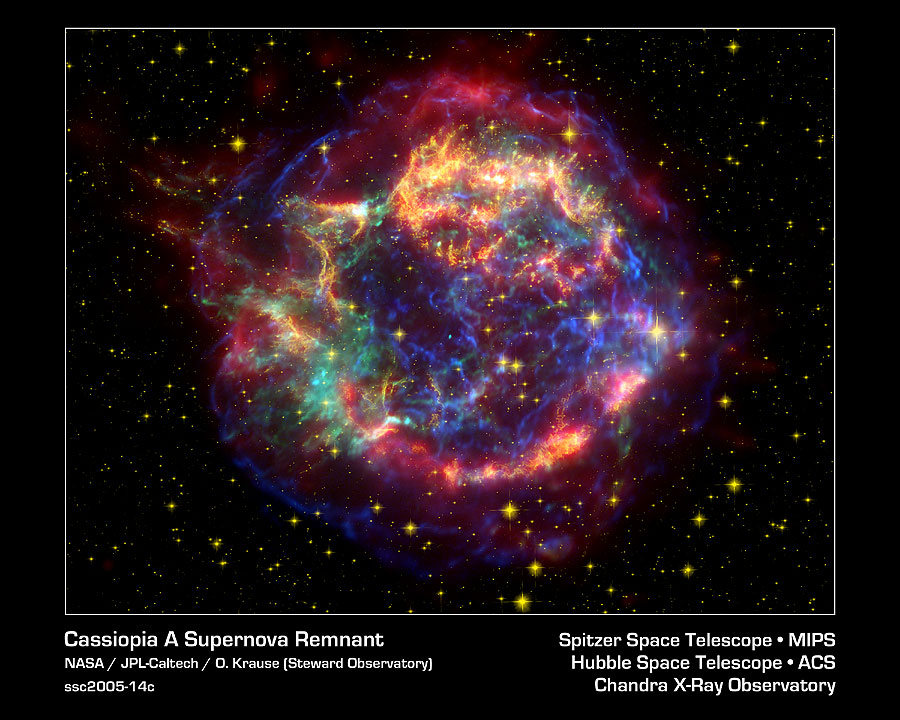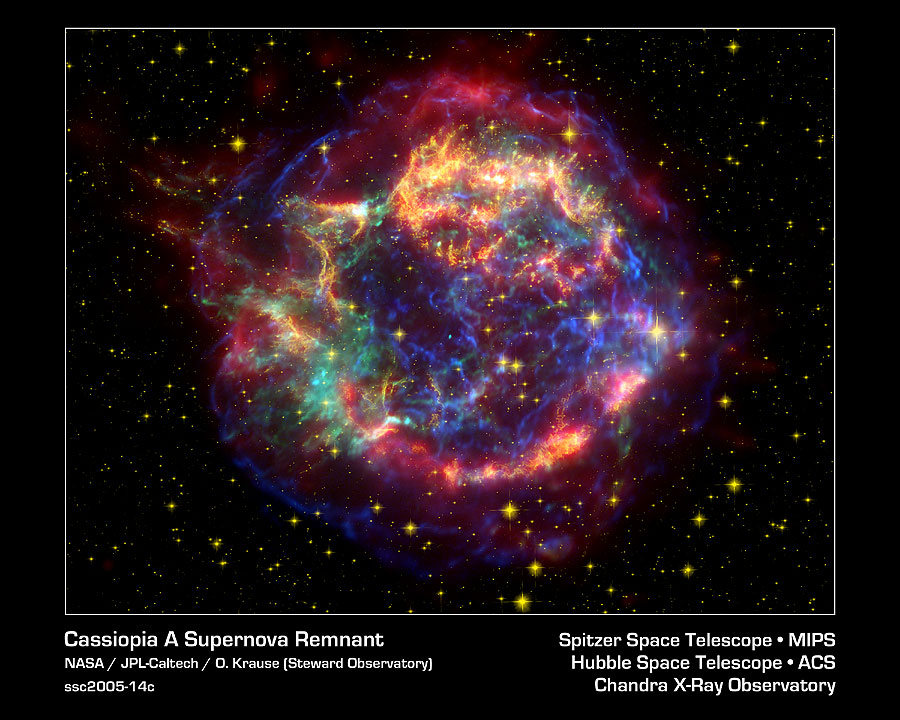
Why is the image of Cassiopeia A changing? Two images of the nearby supernova remnant taken a year apart in infrared light appear to show outward motions at tremendous speeds. This was unexpected since the supernova that created the picturesque nebula was seen 325 years ago. The reason is likely light echoes. Light from the supernova heated up distant ambient dust that is just beginning to show its glow. As time goes by, more distant dust lights up, giving the appearance of outward motion. The above image is a composite of X-ray, optical, and infrared light exposures that have been digitally combined. The infrared light image was taken by the orbiting Spitzer Space Telescope and was used in the discovery of the light echo. The portion of Cassiopeia A shown spans about 15 light years and lies 10,000 light years away toward the constellation of Cassiopeia.
¿Por qué la imagen de Cassiopeia A está cambiando? Dos imágenes del remanente de supernova cercano tomadas con un año de diferencia en luz infrarroja parecen mostrar movimientos hacia afuera a velocidades tremendas. Esto era inesperado ya que la supernova que creó la nebulosa pintoresca fue observada hace 325 años. La razón probablemente sean ecos de luz. La luz de la supernova calentó el polvo ambiente distante que apenas está comenzando a mostrar su brillo. Con el paso del tiempo, polvo más distante se ilumina, dando la apariencia de movimiento hacia afuera. La imagen anterior es un compuesto de exposiciones en luz de rayos X, óptica e infrarroja que han sido combinadas digitalmente. La imagen en luz infrarroja fue capturada por el Telescopio Espacial Spitzer en órbita y fue utilizada en el descubrimiento del eco de luz. La porción de Cassiopeia A mostrada abarca aproximadamente 15 años luz y se encuentra a 10.000 años luz de distancia hacia la constelación de Cassiopeia.