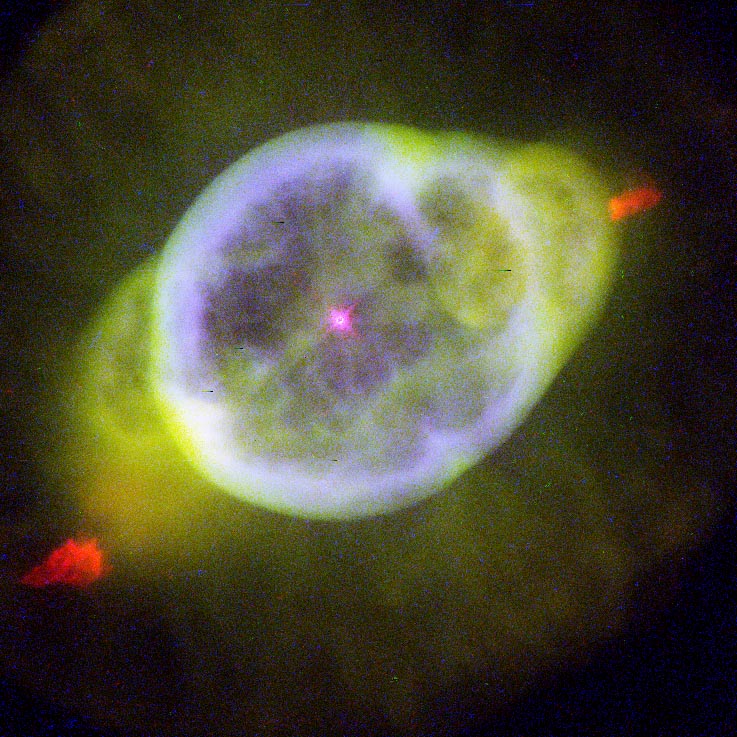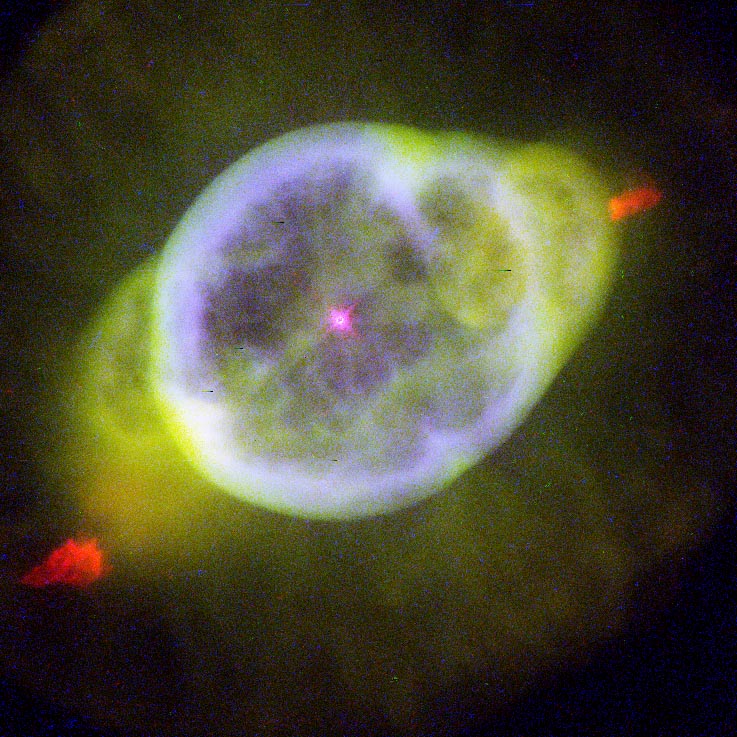
After a star like the Sun completes fusion in its core, it throws off its outer layers in a brief, beautiful cosmic display called a planetary nebula. NGC 3242 is such a planetary nebula, with the stellar remnant white dwarf star visible at the center. This nebula is sometimes called The Ghost of Jupiter for its faint, but similar appearance to our solar system's ruling gas giant planet. NGC 3242 is light-years across however, and much farther away than the measly 40 light-minutes distance to Jupiter. In fact, while watching this ghostly nebula expand over time, astronomers have estimated the distance to NGC 3242 to be about 1,400 light-years. The red FLIERs visible near the edges of the nebula are still a bit mysterious, though.
Después de que una estrella como el Sol complete la fusión en su núcleo, expulsa sus capas externas en una breve y hermosa exhibición cósmica llamada nebulosa planetaria. NGC 3242 es una nebulosa planetaria de este tipo, con la estrella enana blanca restante visible en el centro. Esta nebulosa a veces se llama El Fantasma de Júpiter por su apariencia tenue, pero similar a la del gigante gaseoso que domina nuestro sistema solar. Sin embargo, NGC 3242 tiene cientos de años luz de diámetro y está mucho más lejos que los modestos 40 minutos luz que nos separan de Júpiter. De hecho, mientras los astrónomos observan la expansión de esta nebulosa fantasmal con el tiempo, han estimado que la distancia a NGC 3242 es de aproximadamente 1.400 años luz. Los FLIERs rojos visibles cerca de los bordes de la nebulosa siguen siendo un poco misteriosos, sin embargo.