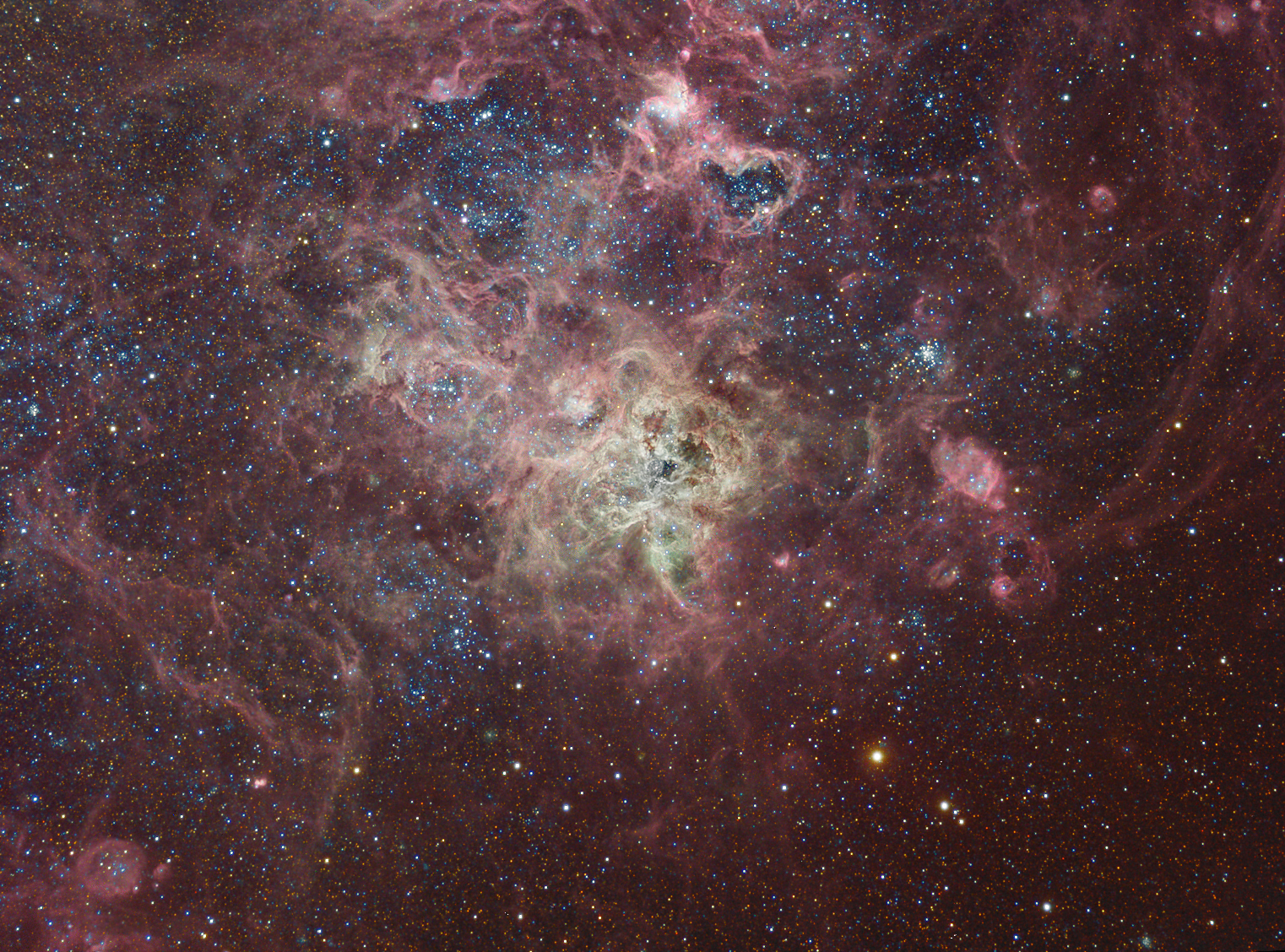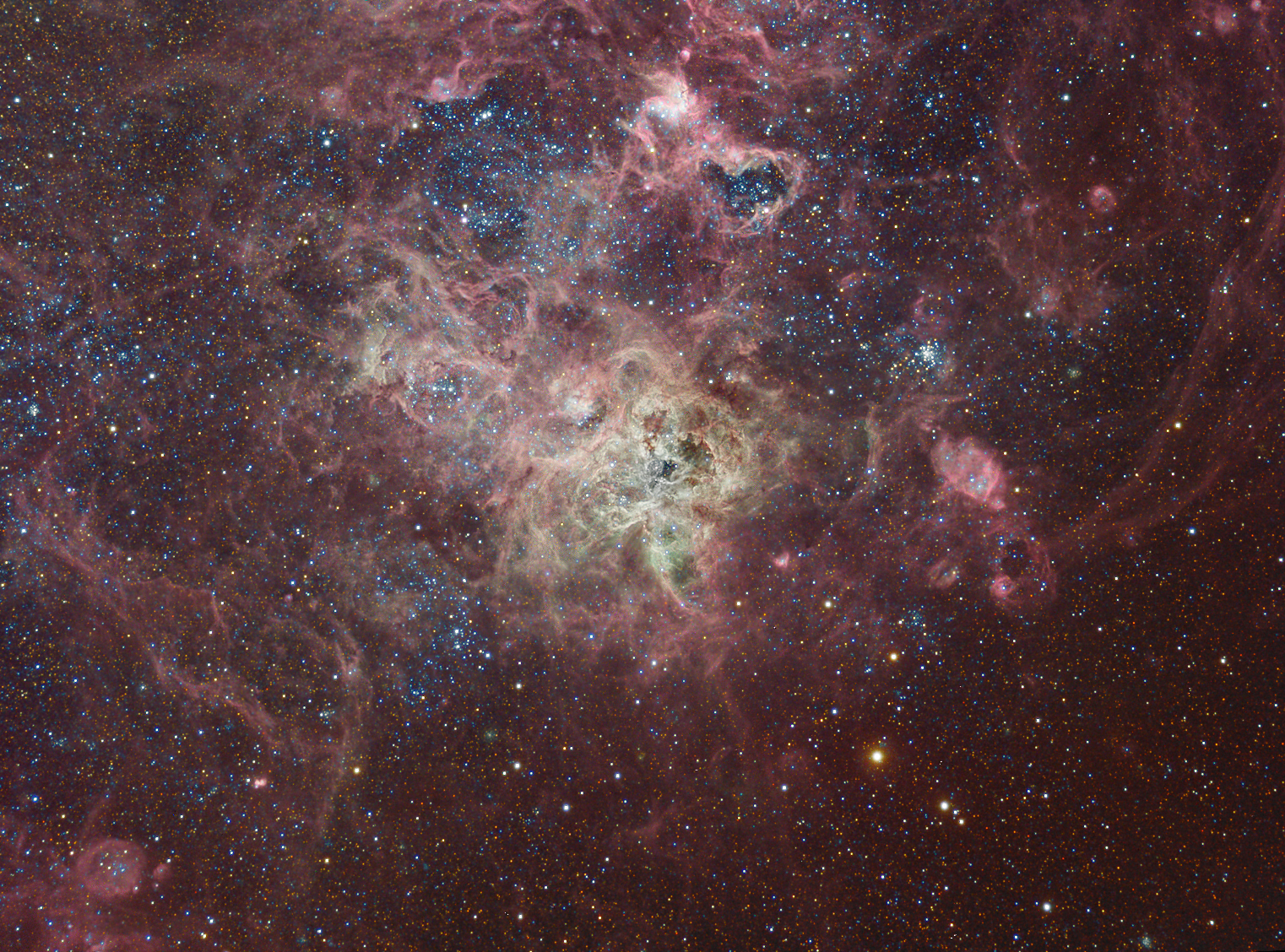
First cataloged as a star, 30 Doradus is actually an immense star forming region in nearby galaxy The Large Magellanic Cloud. The region's spidery appearance is responsible for its popular name, the Tarantula Nebula, except that this tarantula is about 1,000 light-years across, and 180,000 light-years away in the southern constellation Dorado. If the Tarantula Nebula were at the distance of the Orion Nebula (1,500 light-years), the nearest stellar nursery to Earth, it would appear to cover about 30 degrees on the sky or 60 full moons. The spindly arms of the Tarantula Nebula surround NGC 2070, a cluster that contains some of the intrinsically brightest, most massive stars known. Intriguing details of the nebula's core can be seen in this remarkable skyscape, a composite of 31 hours of exposure time. This cosmic Tarantula also lies near the site of the closest recent supernova.
Catalogada inicialmente como una estrella, 30 Doradus es en realidad una inmensa región de formación estelar en la cercana galaxia Gran Nube de Magallanes. La apariencia de telaraña de la región es responsable de su nombre popular, la Nebulosa de la Tarántula, excepto que esta tarántula tiene aproximadamente 1.000 años luz de diámetro y se encuentra a 180.000 años luz de distancia en la constelación austral Dorado. Si la Nebulosa de la Tarántula estuviera a la distancia de la Nebulosa de Orión (1.500 años luz), la guardería estelar más cercana a la Tierra, aparecería cubriendo aproximadamente 30 grados en el cielo o 60 lunas llenas. Los brazos delgados de la Nebulosa de la Tarántula rodean NGC 2070, un cúmulo que contiene algunas de las estrellas más brillantes intrínsecamente y más masivas conocidas. Se pueden observar detalles intrigantes del núcleo de la nebulosa en este notable paisaje cósmico, una composición de 31 horas de tiempo de exposición. Esta Tarántula cósmica también se encuentra cerca del sitio de la supernova más reciente más cercana.