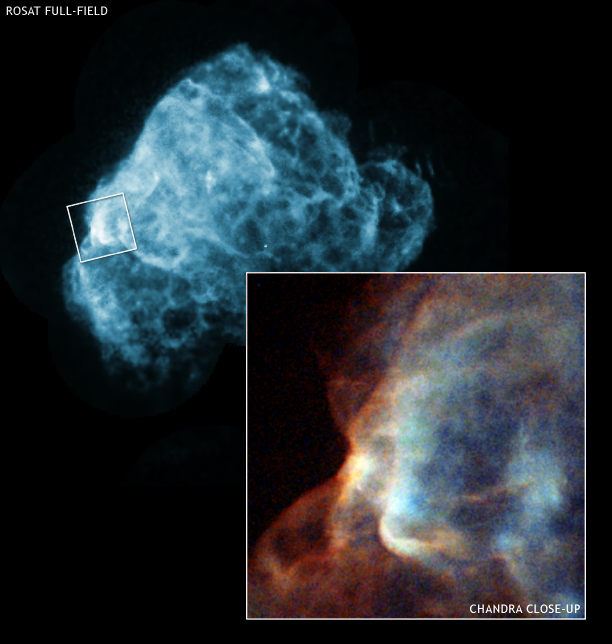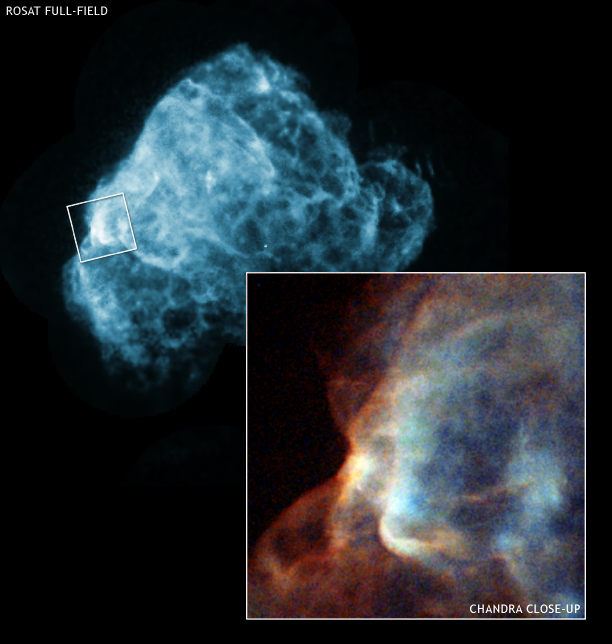
A massive star ends life as a supernova, blasting its outer layers back to interstellar space. The spectacular death explosion is initiated by the collapse of what has become an impossibly dense stellar core. Pictured is the expanding supernova remnant Puppis A - one of the brightest sources in the x-ray sky. Now seen to be about 10 light-years in diameter, light from the initial stellar explosion first reached Earth a few thousand years ago. Recorded by the Chandra Observatory's x-ray cameras, the inset view shows striking details of the strong shock wave disrupting an interstellar cloud as the shock sweeps through preexisting material. The larger field ROSAT image also captures a pinpoint source of x-rays near the remnant's center. The source is a young neutron star, the remnant of the collapsed stellar core kicked out by the explosion and moving away at about 1,000 kilometers per second.
Una estrella masiva termina su vida como supernova, expulsando sus capas externas hacia el espacio interestelar. La espectacular explosión de muerte se inicia por el colapso de lo que se ha convertido en un núcleo estelar imposiblemente denso. Se muestra el remanente de supernova en expansión Puppis A, una de las fuentes más brillantes en el cielo de rayos X. Actualmente se observa que tiene un diámetro de aproximadamente 10 años luz, y la luz de la explosión estelar inicial llegó a la Tierra hace unos pocos miles de años. Registrada por las cámaras de rayos X del Observatorio Chandra, la vista ampliada muestra detalles sorprendentes de la fuerte onda de choque que disrumpe una nube interestelar conforme la onda barre el material preexistente. La imagen más amplia del ROSAT también captura una fuente puntual de rayos X cerca del centro del remanente. La fuente es una estrella de neutrones joven, el remanente del núcleo estelar colapsado expulsado por la explosión y moviéndose a aproximadamente 1.000 kilómetros por segundo.