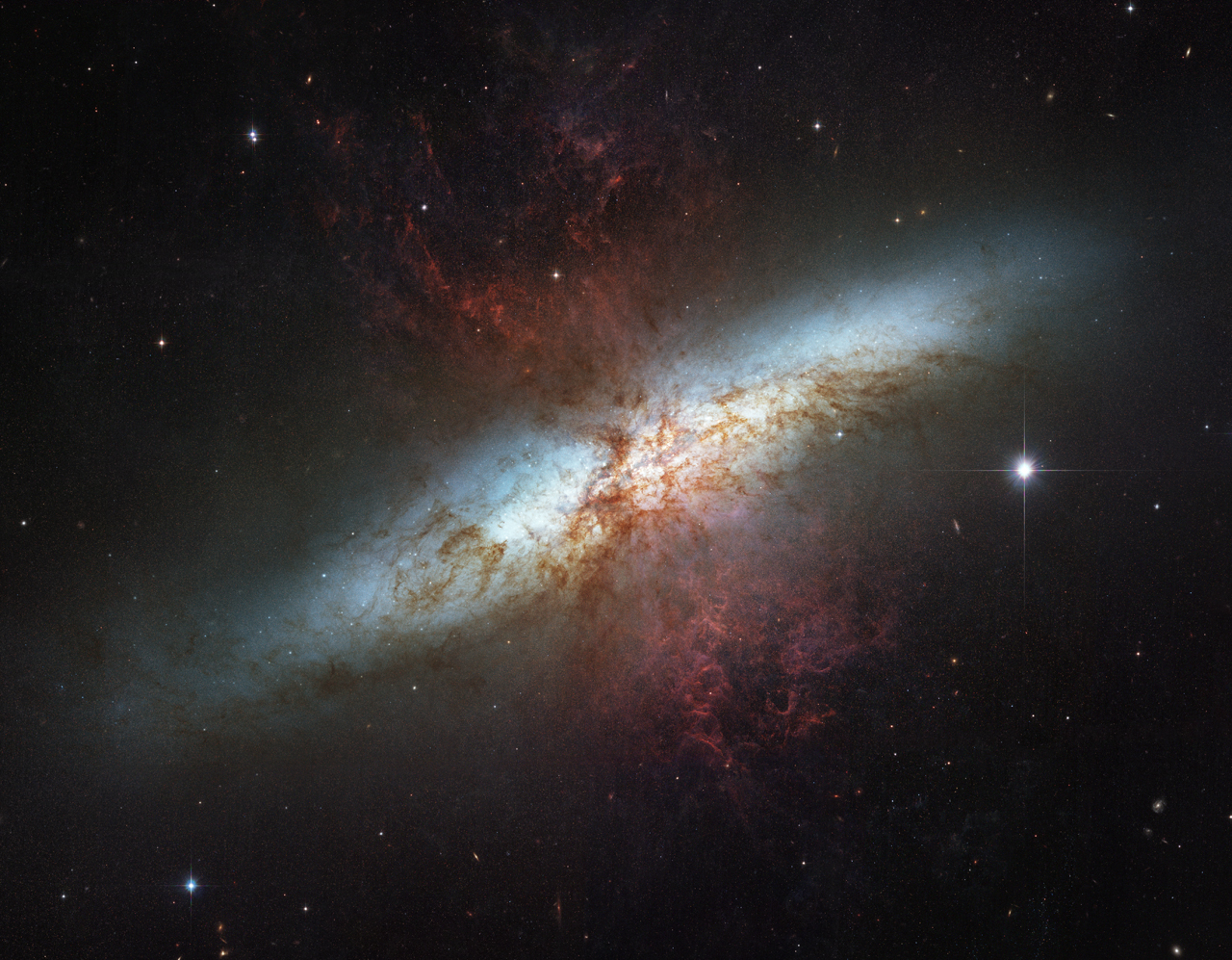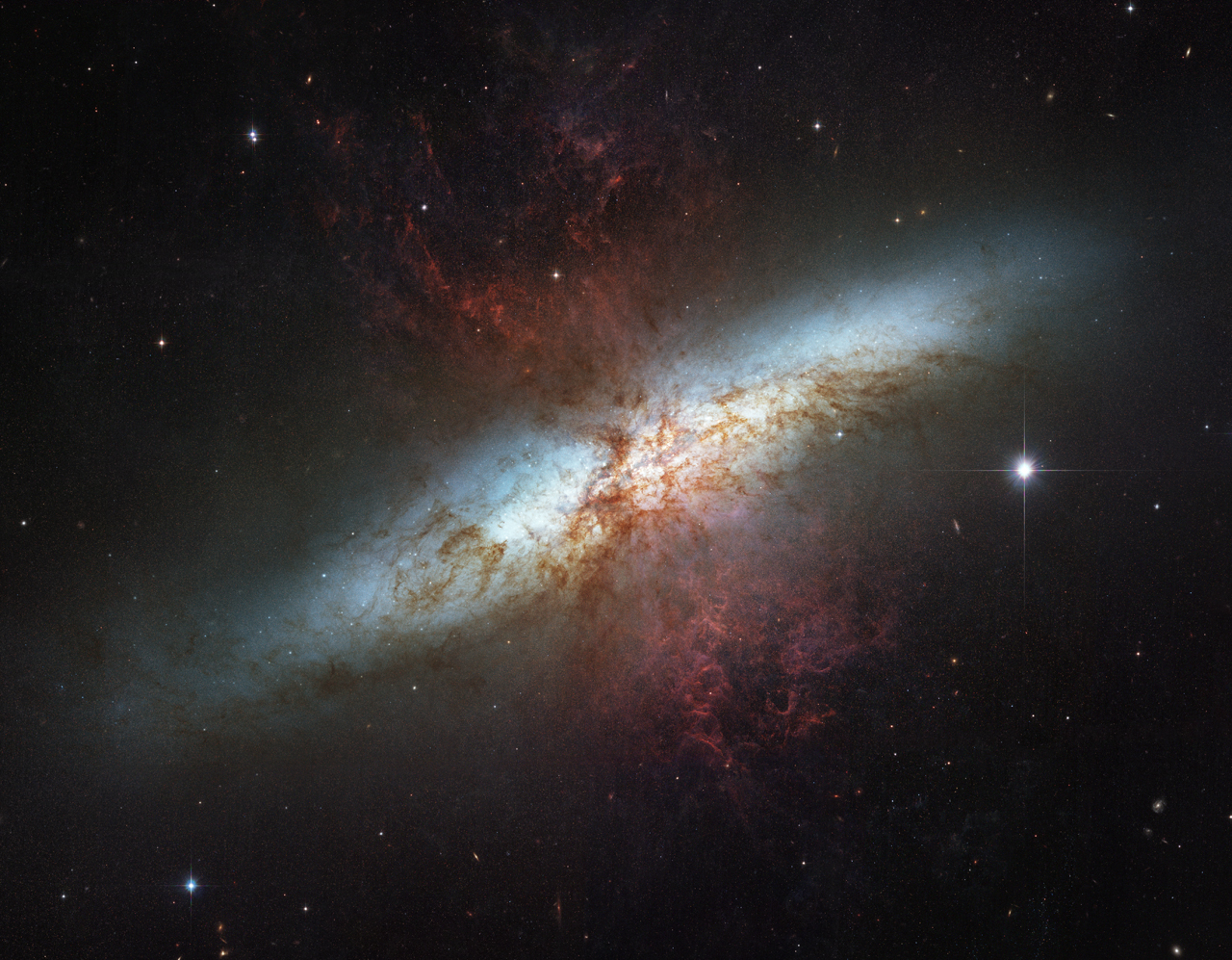
What's lighting up the Cigar Galaxy? M82, as this irregular galaxy is also known, was stirred up by a recent pass near large spiral galaxy M81. This doesn't fully explain the source of the red-glowing outwardly expanding gas, however. Recent evidence indicates that this gas is being driven out by the combined emerging particle winds of many stars, together creating a galactic "superwind." The above photographic mosaic, released yesterday to commemorate the sixteenth anniversary of the Hubble Space Telescope, highlights a specific color of red light strongly emitted by ionized hydrogen gas, showing detailed filaments of this gas. The filaments extend for over 10,000 light years. The 12-million light-year distant Cigar Galaxy is the brightest galaxy in the sky in infrared light, and can be seen in visible light with a small telescope towards the constellation of Ursa Major.
¿Qué ilumina la Galaxia Cigarro? M82, como se conoce también a esta galaxia irregular, fue perturbada por un encuentro reciente cerca de la gran galaxia espiral M81. Sin embargo, esto no explica completamente la fuente del gas que brilla en rojo y se expande hacia el exterior. Las pruebas recientes indican que este gas está siendo expulsado por los vientos de partículas combinados de muchas estrellas, creando conjuntamente un "superviento" galáctico. El mosaico fotográfico anterior, publicado ayer para conmemorar el decimosexto aniversario del Telescopio Espacial Hubble, destaca un color específico de luz roja fuertemente emitida por el gas de hidrógeno ionizado, mostrando filamentos detallados de este gas. Los filamentos se extienden durante más de 10,000 años luz. La Galaxia Cigarro, a una distancia de 12 millones de años luz, es la galaxia más brillante del cielo en luz infrarroja y puede verse en luz visible con un pequeño telescopio hacia la constelación de la Osa Mayor.