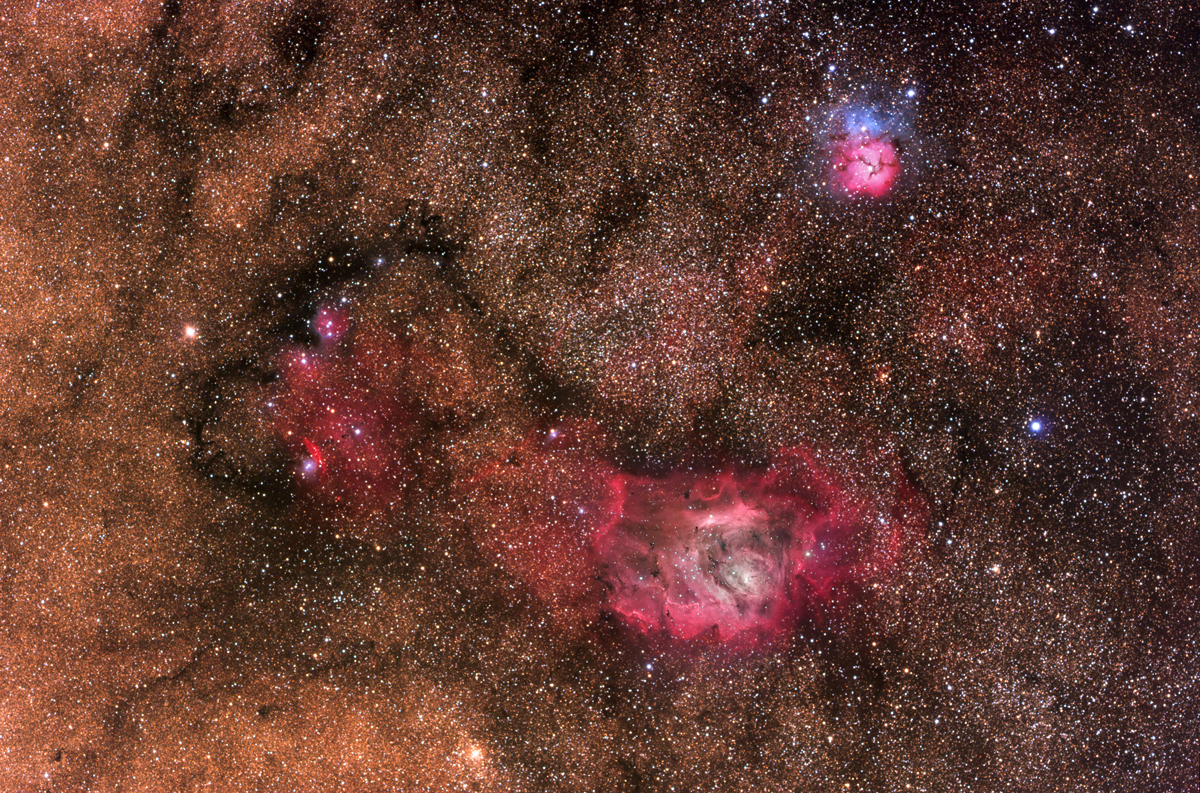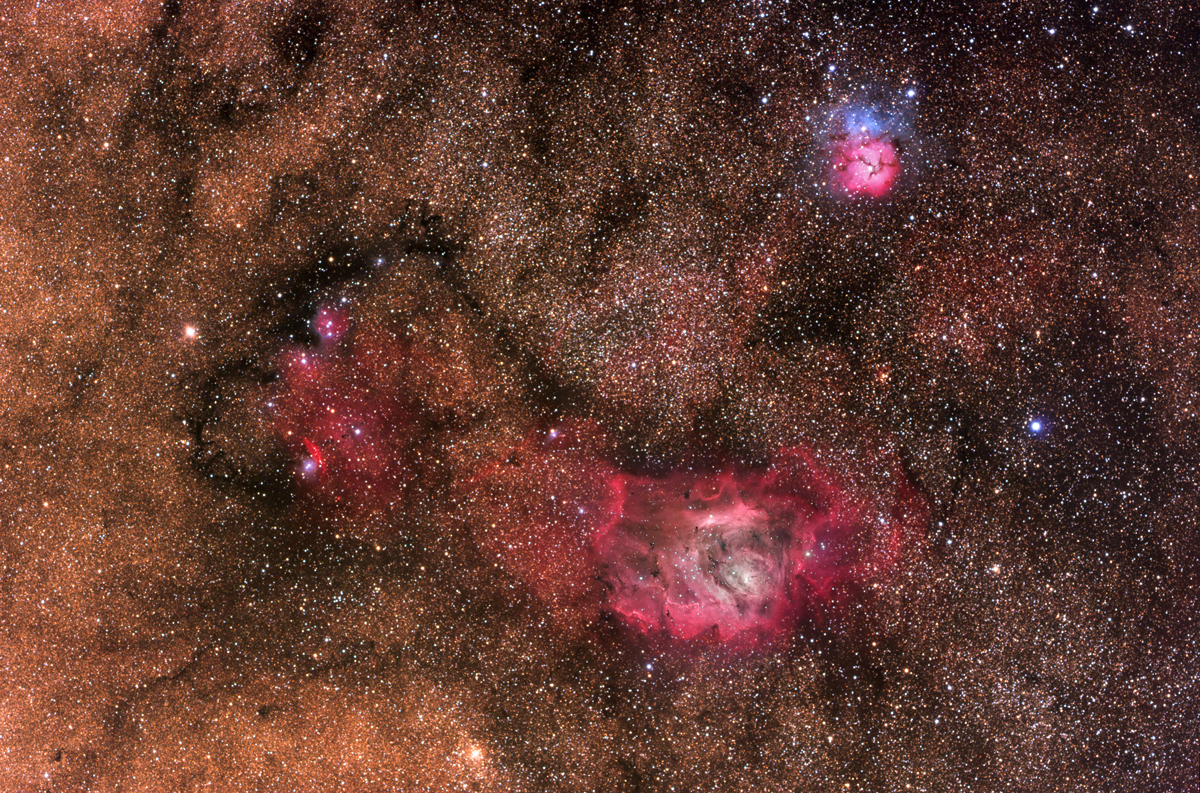
These three bright nebulae are often featured in telescopic tours of the constellation Sagittarius and the crowded starfields of the central Milky Way. In fact, 18th century cosmic tourist Charles Messier cataloged two of them; M8, the nebula below and right of center, and colorful M20 at the upper right. The third, NGC 6559, is left of M8, separated from the the larger nebula by a dark dust lane. All three are stellar nurseries about five thousand light-years or so distant. The expansive M8, over a hundred light-years across, is also known as the Lagoon Nebula while M20's popular moniker is the Trifid. This stunning digital view is actually a collaborative composite recorded by 2 cameras and 2 telescopes about 2 thousand miles apart. The deep, wide image field was captured under dark Arizona skies. Both M8 and M20 were recorded in more detail from an observatory in Pennsylvania. Glowing hydrogen gas creates the dominant red color of the emission nebulae, with contrasting blue hues, most striking in the Trifid, due to dust reflected starlight.
Estas tres nebulosas brillantes se encuentran frecuentemente en los tours telescópicos de la constelación de Sagitario y en los campos estelares abarrotados de la Vía Láctea central. De hecho, el astrónomo del siglo XVIII Charles Messier catalogó dos de ellas: M8, la nebulosa ubicada debajo y a la derecha del centro, y la colorida M20 en la esquina superior derecha. La tercera, NGC 6559, se encuentra a la izquierda de M8, separada de la nebulosa más grande por un carril oscuro de polvo. Las tres son guarderías estelares situadas a aproximadamente cinco mil años luz de distancia. La expansiva M8, que abarca más de cien años luz, también es conocida como la Nebulosa de la Laguna, mientras que el nombre popular de M20 es la Trífida. Esta impresionante vista digital es en realidad un compuesto colaborativo capturado por 2 cámaras y 2 telescopios separados por aproximadamente 2 mil millas. La imagen profunda de amplio campo fue capturada bajo cielos oscuros de Arizona. Tanto M8 como M20 fueron registradas con mayor detalle desde un observatorio en Pensilvania. El gas hidrógeno incandescente crea el color rojo dominante de las nebulosas de emisión, con tonos azules contrastantes, más destacados en la Trífida, debido al polvo que refleja la luz estelar.