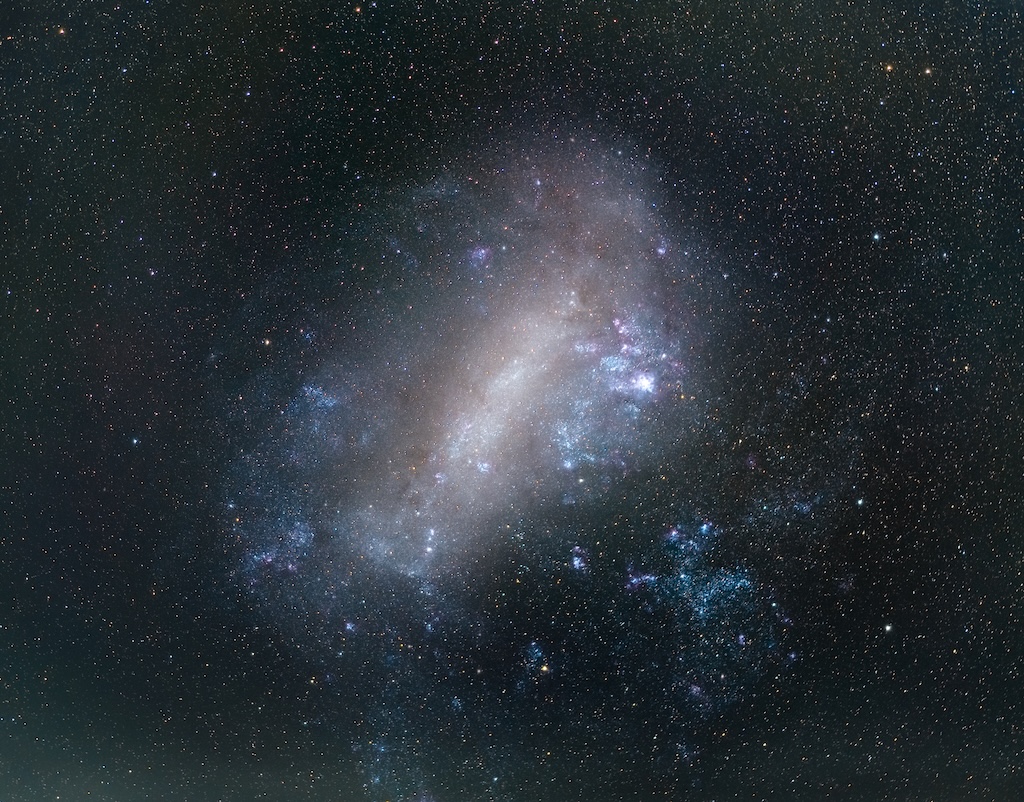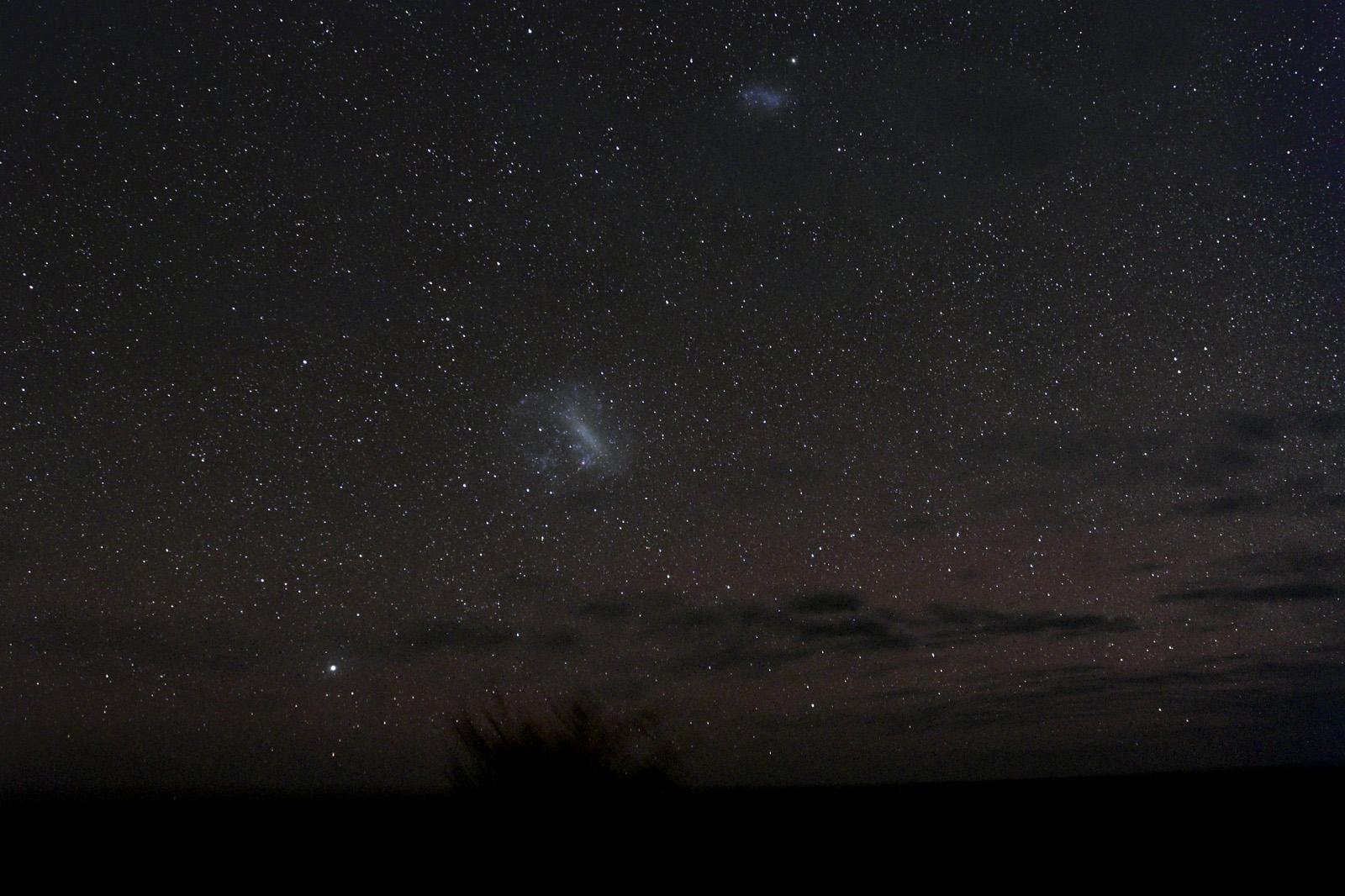
This early morning skyscape recorded near Winton, Queensland, Australia, looks toward the southeast. Low clouds are seen in silhouette against the first hints of sunlight, while two famous cosmic clouds, the Clouds of Magellan, also hover in the brightening sky. The Small Magellanic Cloud (SMC, upper right), and the Large Magellanic Cloud (LMC) are prominent wonders of the southern sky, named for the 16th century Portuguese explorer Ferdinand Magellan. They are small, irregular galaxies in their own right, satellites of our much larger, spiral Milky Way galaxy. The SMC is about 210,000 light-years and the LMC about 180,000 light-years away. At lower left, bright star Canopus (Alpha Carinae), denizen of the Milky Way, is a mere 310 light-years distant.
Este paisaje celeste captado en las primeras horas de la mañana cerca de Winton, Queensland, Australia, se orienta hacia el sudeste. Las nubes bajas se ven en silueta contra los primeros indicios de luz solar, mientras que dos famosas nubes cósmicas, las Nubes de Magallanes, también se ciernen en el cielo que se ilumina. La Pequeña Nube de Magallanes (SMC, esquina superior derecha) y la Gran Nube de Magallanes (LMC) son maravillas prominentes del cielo austral, nombradas en honor del explorador portugués del siglo XVI Fernando de Magallanes. Son galaxias pequeñas e irregulares en sí mismas, satélites de nuestra mucho más grande galaxia espiral Vía Láctea. La SMC se encuentra a unos 210,000 años luz de distancia y la LMC a unos 180,000 años luz. En la esquina inferior izquierda, la brillante estrella Canopo (Alfa Carinae), habitante de la Vía Láctea, está a tan solo 310 años luz de distancia.