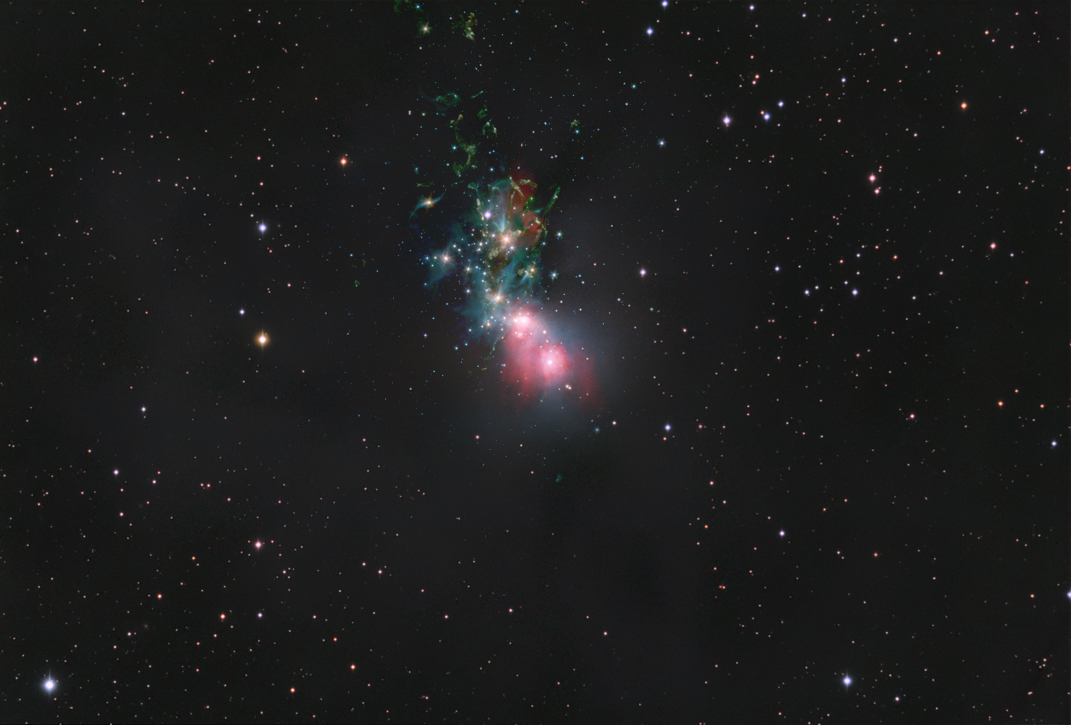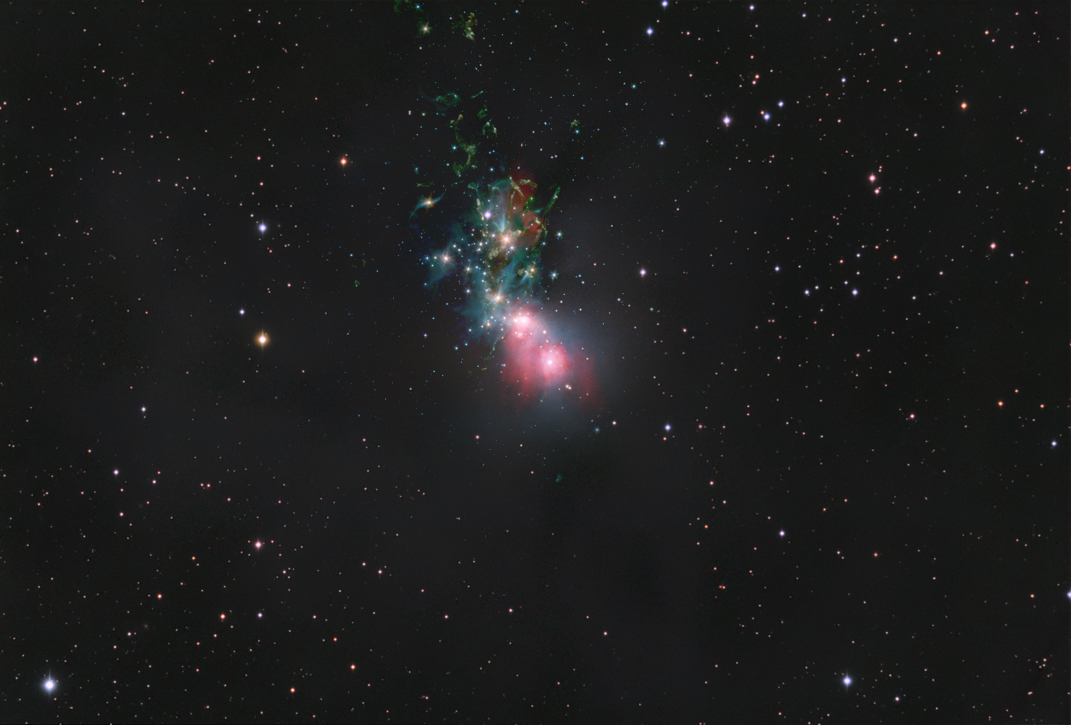
Dusty NGC 1333 is seen in visible light as a reflection nebula, dominated by bluish hues characteristic of starlight reflected by dust. But at longer infrared wavelengths, the interstellar dust itself glows. Moving your cursor over the picture will match up a visible light view with a false-color infrared image of the region from the Spitzer Space Telescope. The penetrating infrared view unmasks youthful stars that are otherwise obscured by the dusty clouds that formed them. Also revealed are greenish streaks and splotches that seem to litter the region. The structures trace the glow of cosmic jets blasting away from emerging young stellar objects and plowing into the cold cloud material. In all, the chaotic environment likely resembles one in which our own Sun formed over 4.5 billion years ago. NGC 1333 is a mere 1,000 light-years distant in the constellation Perseus.
La nebulosa NGC 1333, polvorienta, se ve en luz visible como una nebulosa de reflexión, dominada por tonos azulados característicos de la luz estelar reflejada por el polvo. Pero en longitudes de onda infrarrojas más largas, el polvo interestelar mismo brilla. Mover el cursor sobre la imagen hará coincidir una vista en luz visible con una imagen infrarroja en falso color de la región obtenida por el Telescopio Espacial Spitzer. La penetrante vista infrarroja desvela estrellas jóvenes que de otro modo estarían ocultas por las nubes polvorientas que las formaron. También se revelan rayas y manchas verdosas que parecen cubrir la región. Las estructuras trazan el brillo de chorros cósmicos que salen disparados desde objetos estelares jóvenes emergentes y se estrellan contra el material frío de la nube. En conjunto, el entorno caótico probablemente se asemeje al en el que nuestro propio Sol se formó hace más de 4.5 mil millones de años. La NGC 1333 se encuentra a una distancia de apenas 1.000 años luz en la constelación de Perseo.