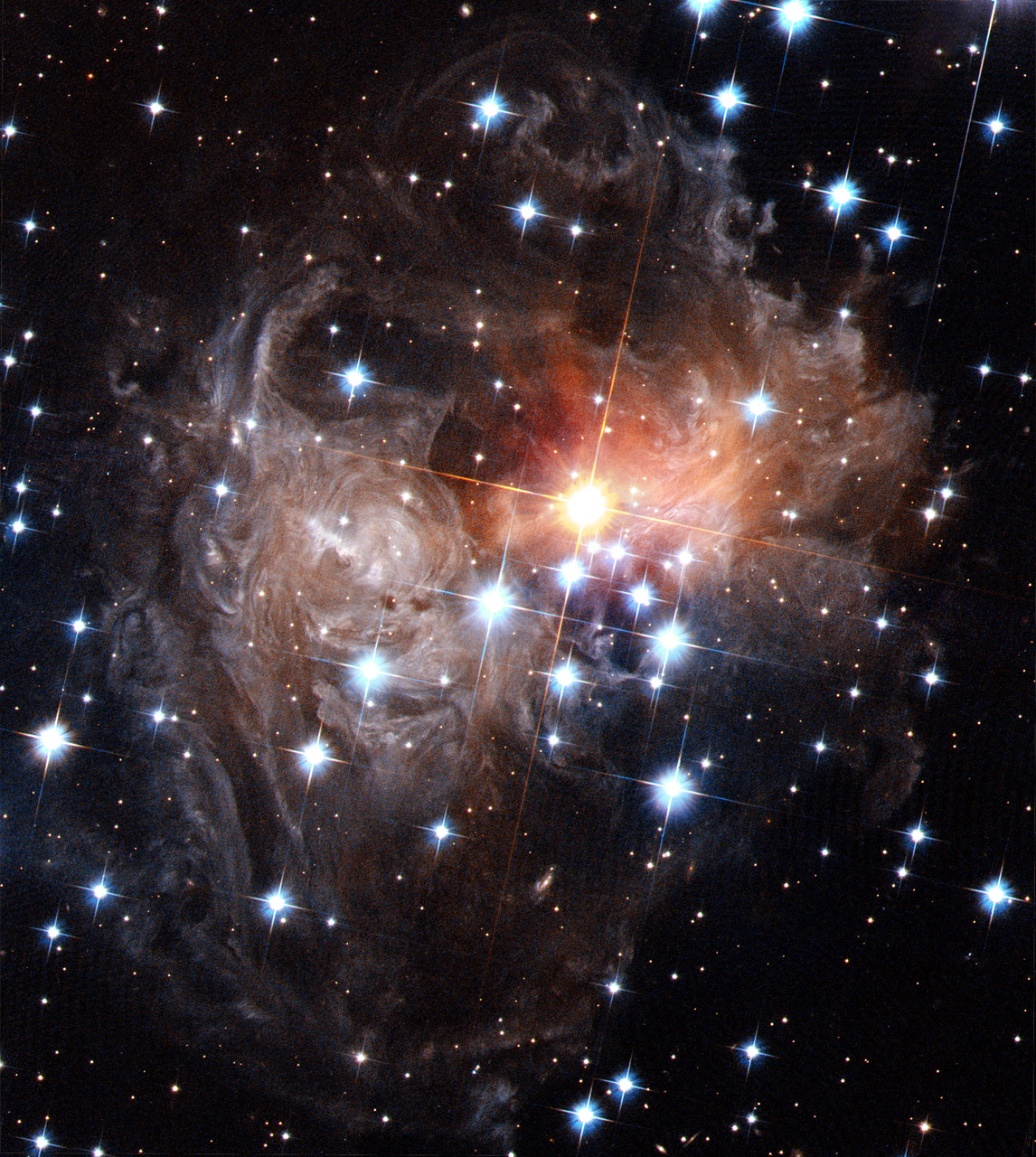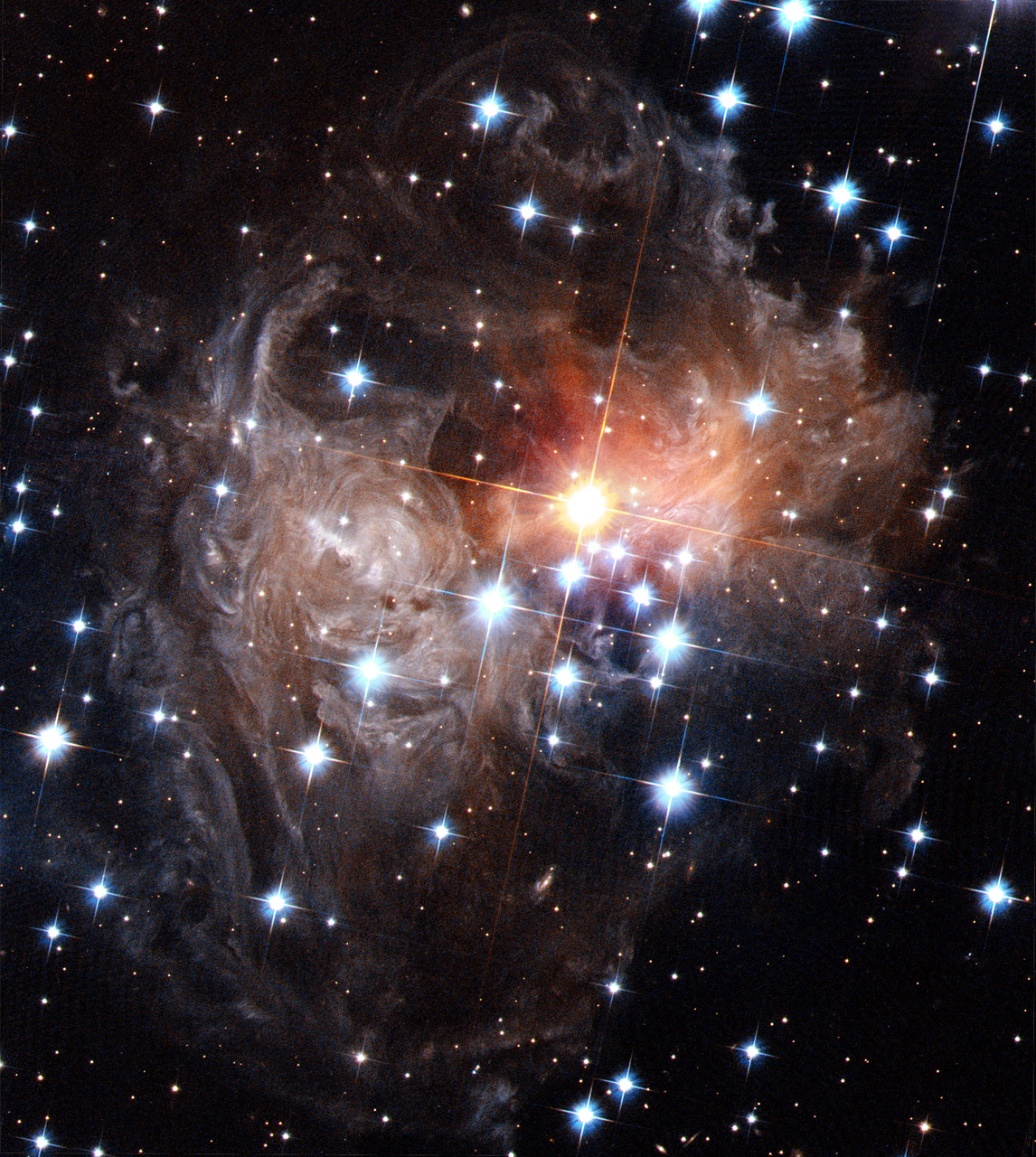
Variable star V838 Monocerotis lies near the edge of our Milky Way Galaxy, about 20,000 light-years from the Sun. Still, ever since a sudden outburst was detected in January 2002, this enigmatic star has taken the center of an astronomical stage. As astronomers watch, light from the outburst echoes across pre-existing dust shells around V838 Mon, progressively illuminating ever more distant regions. This stunning image of swirls of dust surrounding the star was recorded by the Hubble Space Telescope in September of this year. The picture spans about 14 light-years. Astronomers expect the expanding echoes to continue to light up the dusty environs of V838 Mon for at least the rest of the current decade. Researchers have now found that V838 Mon is likely a young binary star, but the cause of its extraordinary outburst remains a mystery.
La estrella variable V838 Monocerotis se encuentra cerca del borde de nuestra galaxia Vía Láctea, a unos 20 000 años luz del Sol. Sin embargo, desde que se detectó una explosión repentina en enero de 2002, esta estrella enigmática ha ocupado el centro del escenario astronómico. Mientras los astrónomos observan, la luz de la explosión se refleja a través de capas preexistentes de polvo alrededor de V838 Mon, iluminando progresivamente regiones cada vez más distantes. Esta asombrosa imagen de espirales de polvo que rodean la estrella fue registrada por el Telescopio Espacial Hubble en septiembre de este año. La imagen abarca aproximadamente 14 años luz. Los astrónomos esperan que los ecos en expansión continúen iluminando el entorno polvoriento de V838 Mon al menos durante el resto de la década actual. Los investigadores han descubierto ahora que V838 Mon probablemente sea una estrella binaria joven, pero la causa de su extraordinaria explosión sigue siendo un misterio.