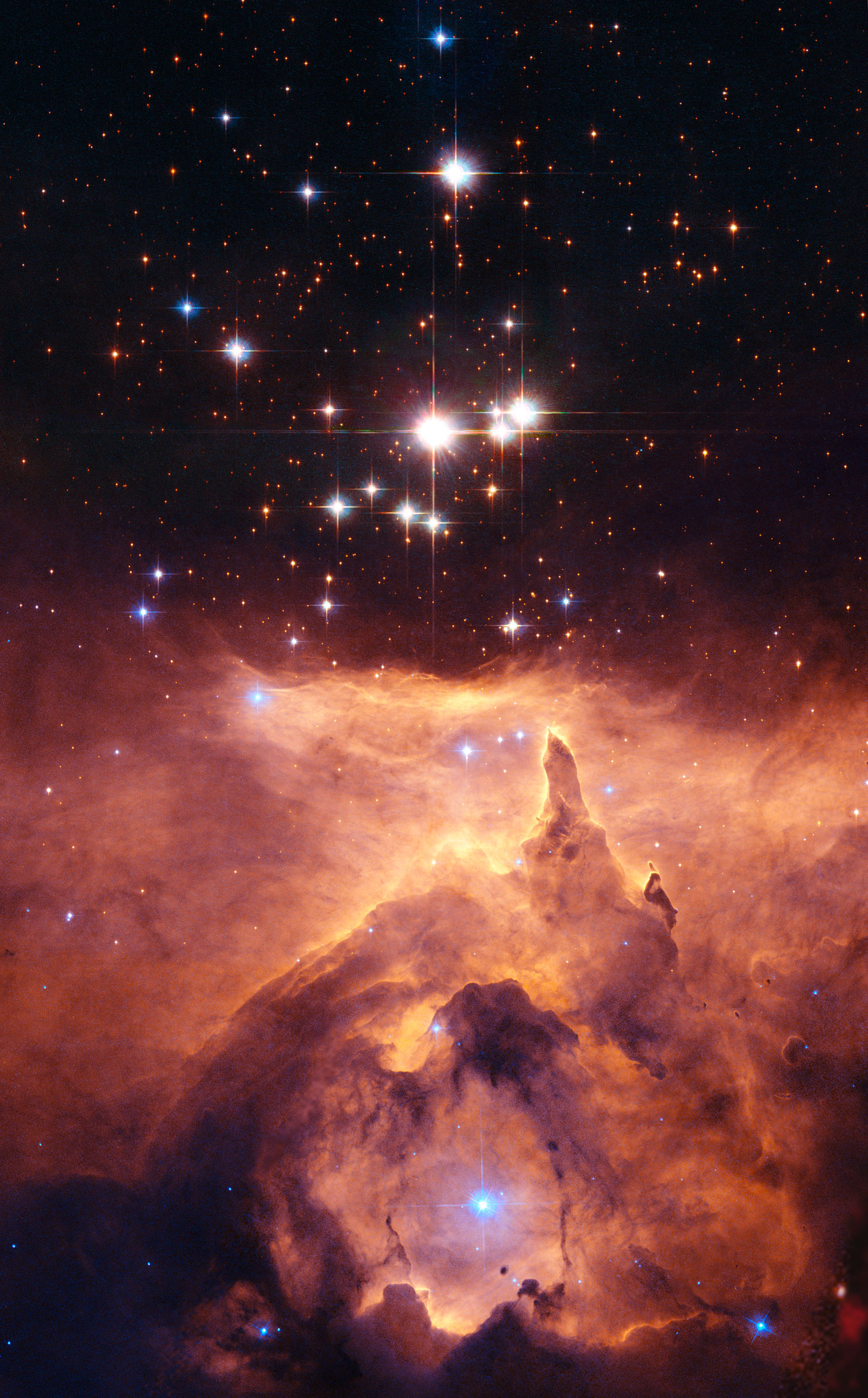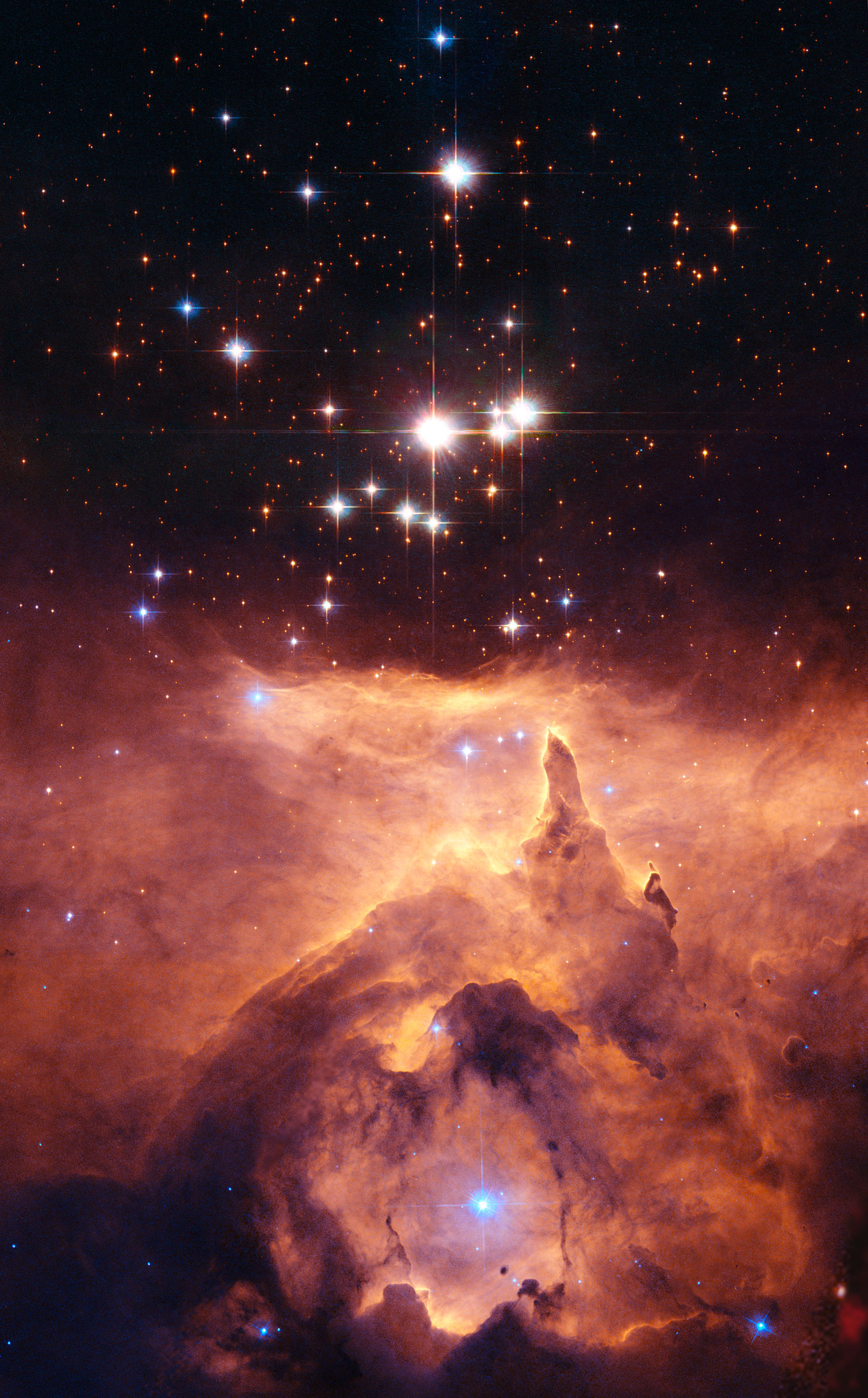
How massive can a normal star be? Estimates made from distance, brightness and standard solar models had given one star in the open cluster Pismis 24 over 200 times the mass of our Sun, making it a record holder. This star is the brightest object located just to the right of the gas front in the above image. Close inspection of images taken recently with the Hubble Space Telescope, however, have shown that Pismis 24-1 derives its brilliant luminosity not from a single star but from three at least. Component stars would still remain near 100 solar masses, making them among the more massive stars currently on record. Toward the image left, stars are still forming in the associated emission nebula NGC 6357, including several that appear to be breaking out and illuminating a spectacular cocoon.
¿Qué tan masiva puede ser una estrella normal? Estimaciones basadas en distancia, brillo y modelos solares estándar habían dado a una estrella en el cúmulo abierto Pismis 24 más de 200 veces la masa de nuestro Sol, convirtiéndola en un récord. Esta estrella es el objeto más brillante ubicado justo a la derecha de la frontera de gas en la imagen de arriba. Sin embargo, una inspección detallada de imágenes tomadas recientemente con el Telescopio Espacial Hubble ha mostrado que Pismis 24-1 obtiene su brillante luminosidad no de una sola estrella, sino de al menos tres. Las estrellas componentes aún tendrían una masa cercana a 100 masas solares, convirtiéndolas en algunas de las estrellas más masivas registradas actualmente. Hacia la izquierda de la imagen, las estrellas aún se están formando en la nebulosa de emisión asociada NGC 6357, incluyendo varias que parecen estar saliendo y iluminando un espectacular capullo.