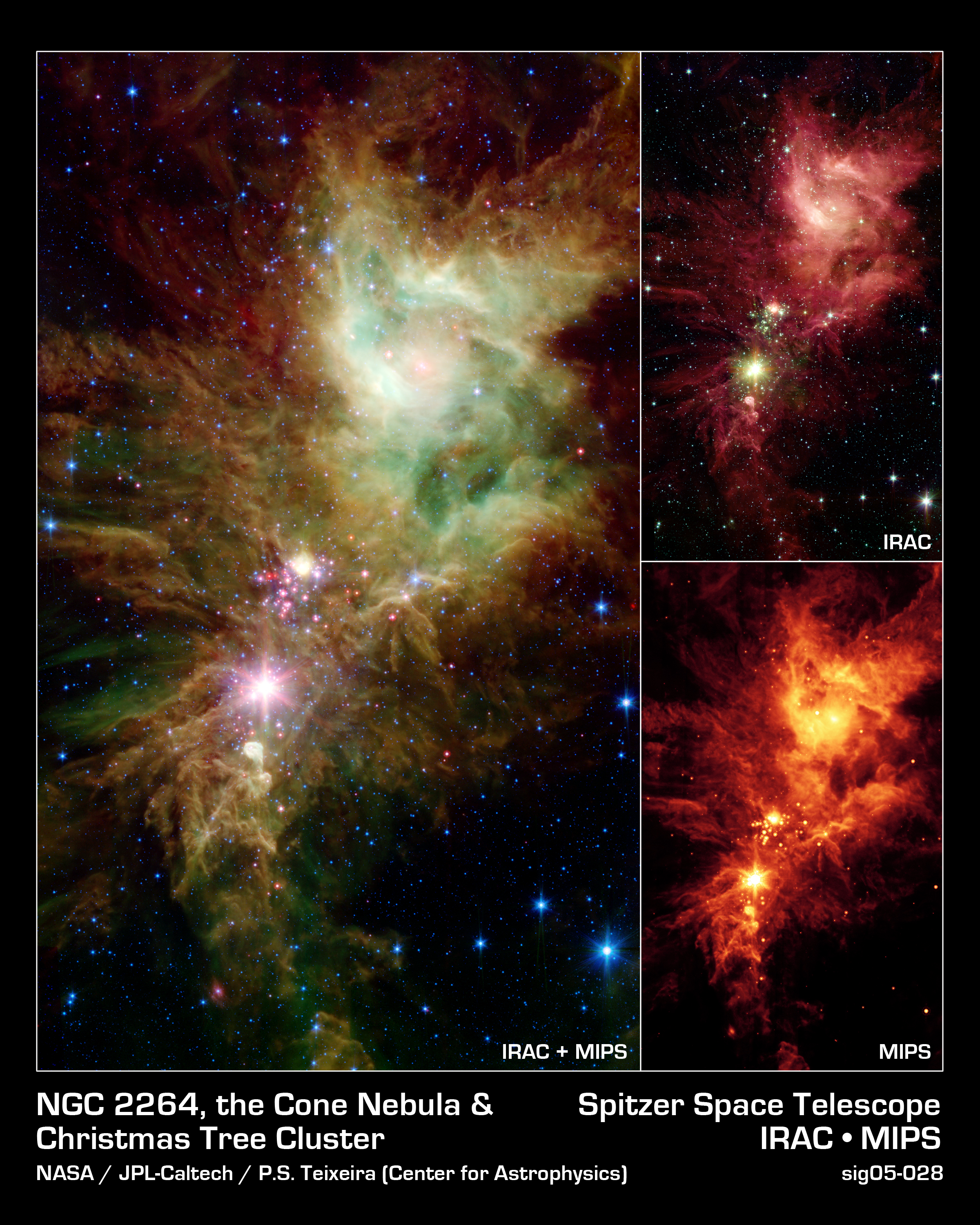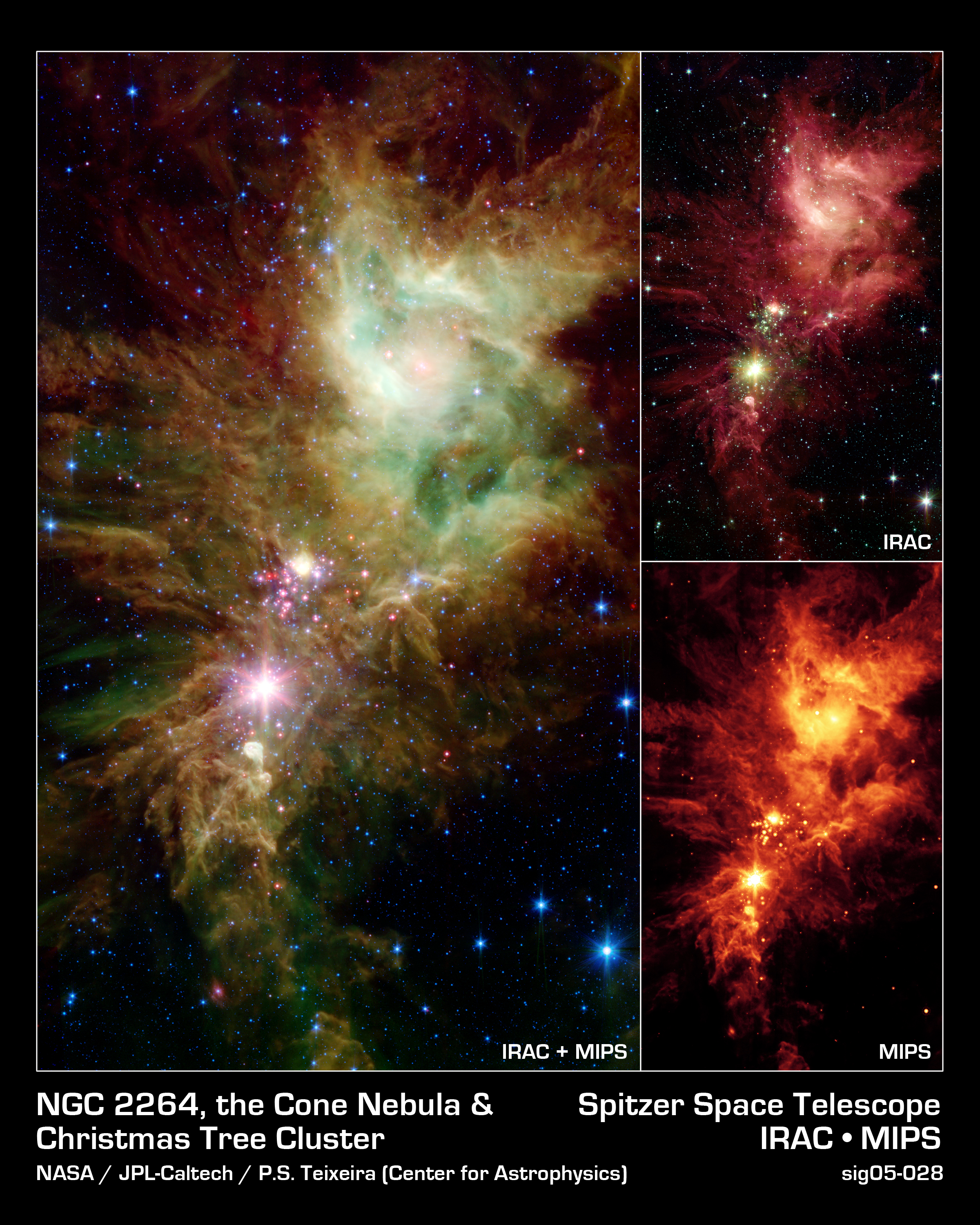
Strange shapes and textures can be found in the neighborhood of the Cone Nebula. These patterns result from the tumultuous unrest that accompanies the formation of the open cluster of stars known as NGC 2264, the Snowflake cluster. To better understand this process, a detailed image of this region was taken in two colors of infrared light by the orbiting Spitzer Space Telescope. Bright stars from the Snowflake cluster dot the field. These stars soon heat up and destroy the gas and dust mountains in which they formed. One such dust mountain is the famous Cone Nebula, visible in the above image on the left, pointing toward a bright star near the center of the field. The entire NGC 2264 region is located about 2,500 light years away toward the constellation of the Unicorn (Monoceros).
Se pueden encontrar formas y texturas extrañas en la vecindad de la Nebulosa del Cono. Estos patrones resultan de la turbulencia tumultuosa que acompaña la formación del cúmulo abierto de estrellas conocido como NGC 2264, el Cúmulo del Copo de Nieve. Para comprender mejor este proceso, el Telescopio Espacial Spitzer en órbita capturó una imagen detallada de esta región en dos colores de luz infrarroja. Estrellas brillantes del Cúmulo del Copo de Nieve salpican el campo. Estas estrellas pronto se calientan y destruyen las montañas de gas y polvo en las que se formaron. Una de tales montañas de polvo es la famosa Nebulosa del Cono, visible en la imagen anterior a la izquierda, apuntando hacia una estrella brillante cerca del centro del campo. Toda la región NGC 2264 se encuentra ubicada aproximadamente a 2.500 años luz de distancia hacia la constelación del Unicornio (Monoceros).