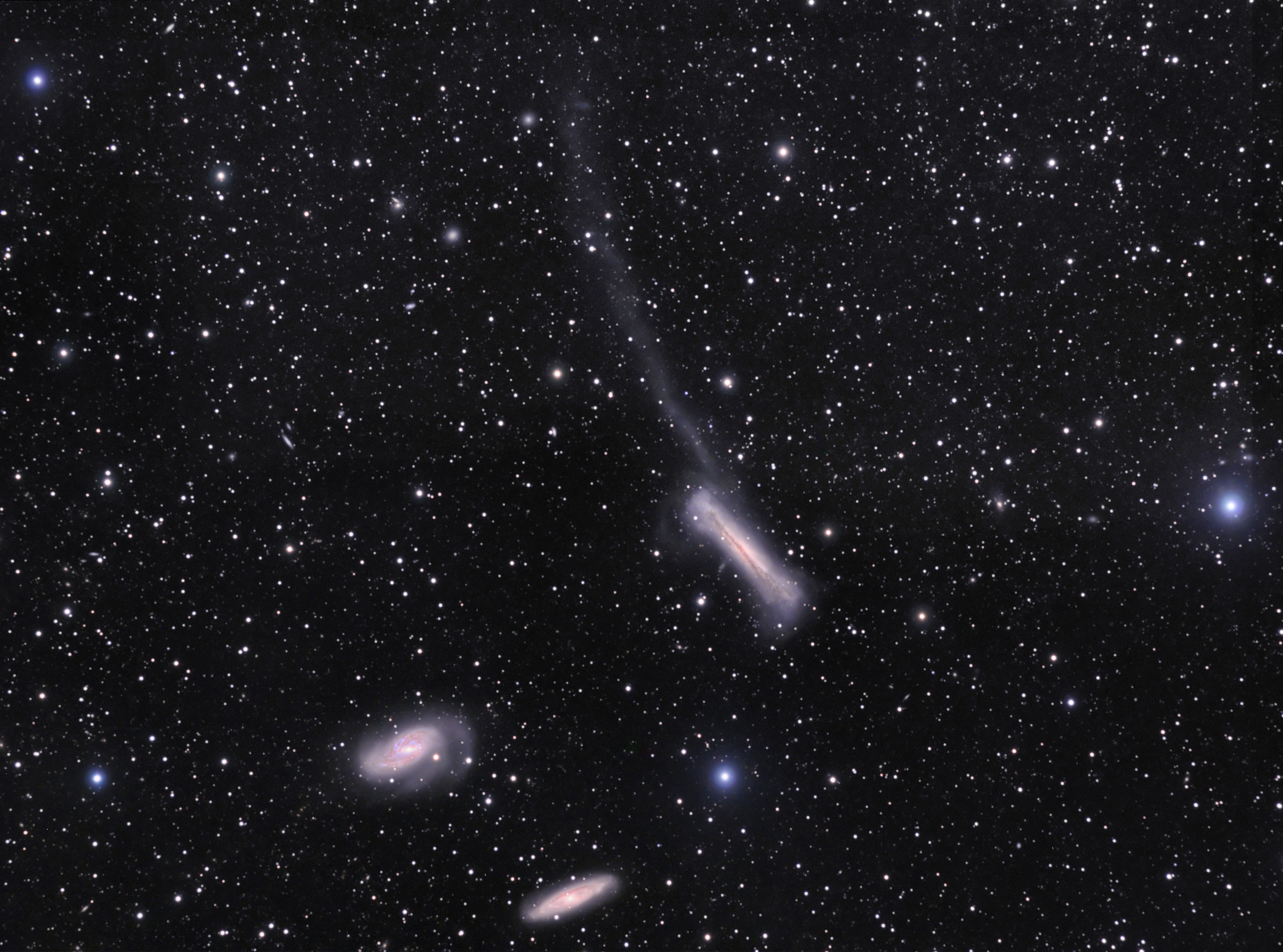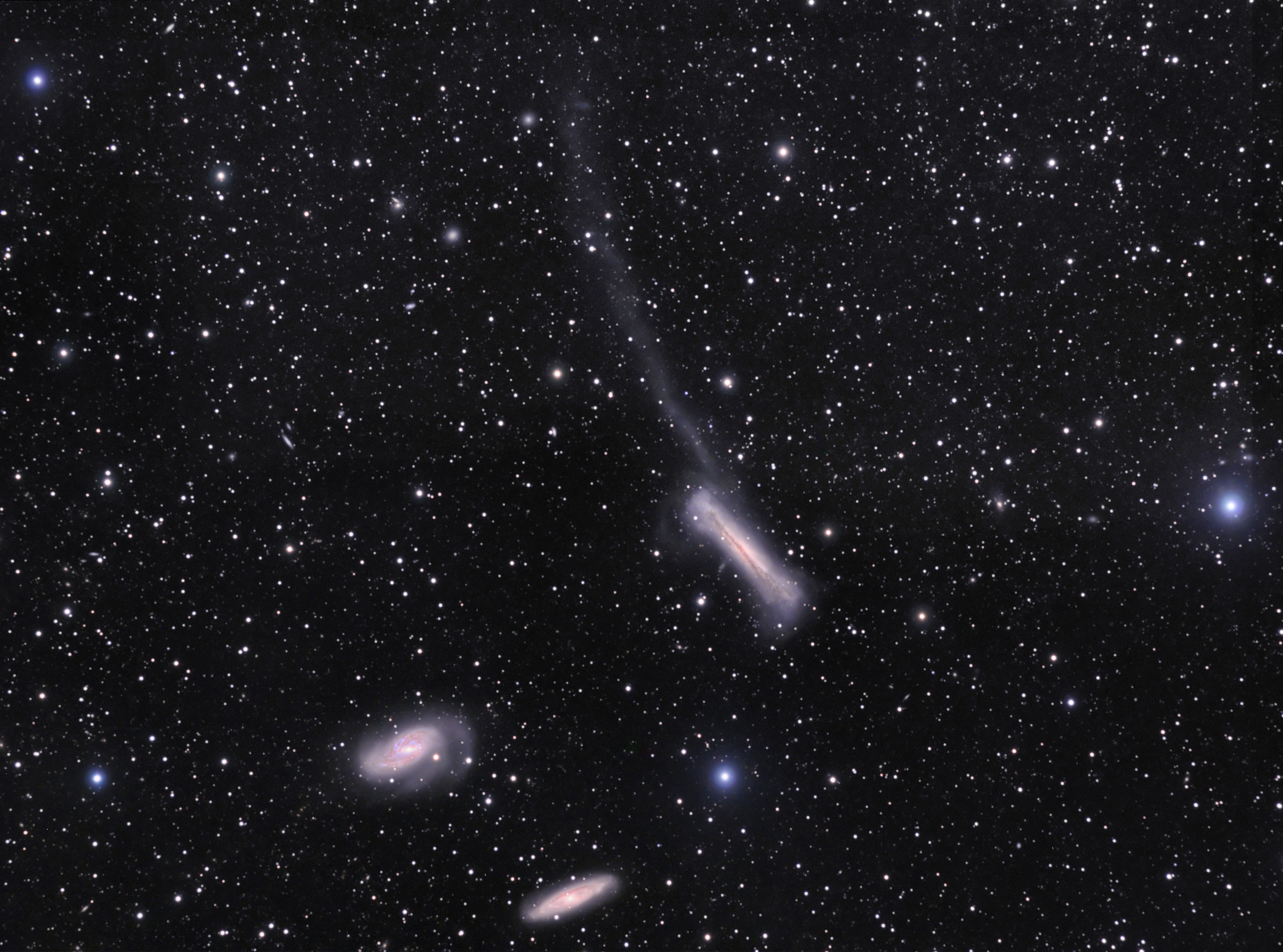
A mere 30 million light-years away, large spiral galaxy NGC 3628 (center) shares its neighborhood in the local Universe with two other large spirals, in a magnificent grouping otherwise known as the Leo Triplett. In fact, fellow trio member M65 is near the bottom edge of this deep cosmic group portrait, with M66, just above it and to the left. But, perhaps most intriguing is the spectacular tail stretching up and to the left for about 300,000 light-years from NGC 3628's warped, edge-on disk. Known as a tidal tail, the structure has been drawn out of the galaxy by gravitational tides during brief but violent past interactions with its large neighbors. Not often imaged so distinctly, the tidal tail is composed of young bluish star clusters and star-forming regions.
A apenas 30 millones de años luz de distancia, la gran galaxia espiral NGC 3628 (centro) comparte su vecindario en el Universo local con otras dos grandes espirales, en un magnífico agrupamiento conocido de otra manera como el Triplete de Leo. De hecho, el miembro del trío M65 está cerca del borde inferior de este profundo retrato cósmico de grupo, con M66, justo arriba y a la izquierda. Sin embargo, quizás lo más intrigante es la cola espectacular que se extiende hacia arriba y hacia la izquierda durante aproximadamente 300,000 años luz desde el disco deformado y de canto de NGC 3628. Conocida como cola de marea, la estructura ha sido extraída de la galaxia por las mareas gravitacionales durante interacciones pasadas breves pero violentas con sus grandes vecinas. No se suele fotografiar con tanta claridad, la cola de marea está compuesta de jóvenes cúmulos estelares azulados y regiones de formación estelar.