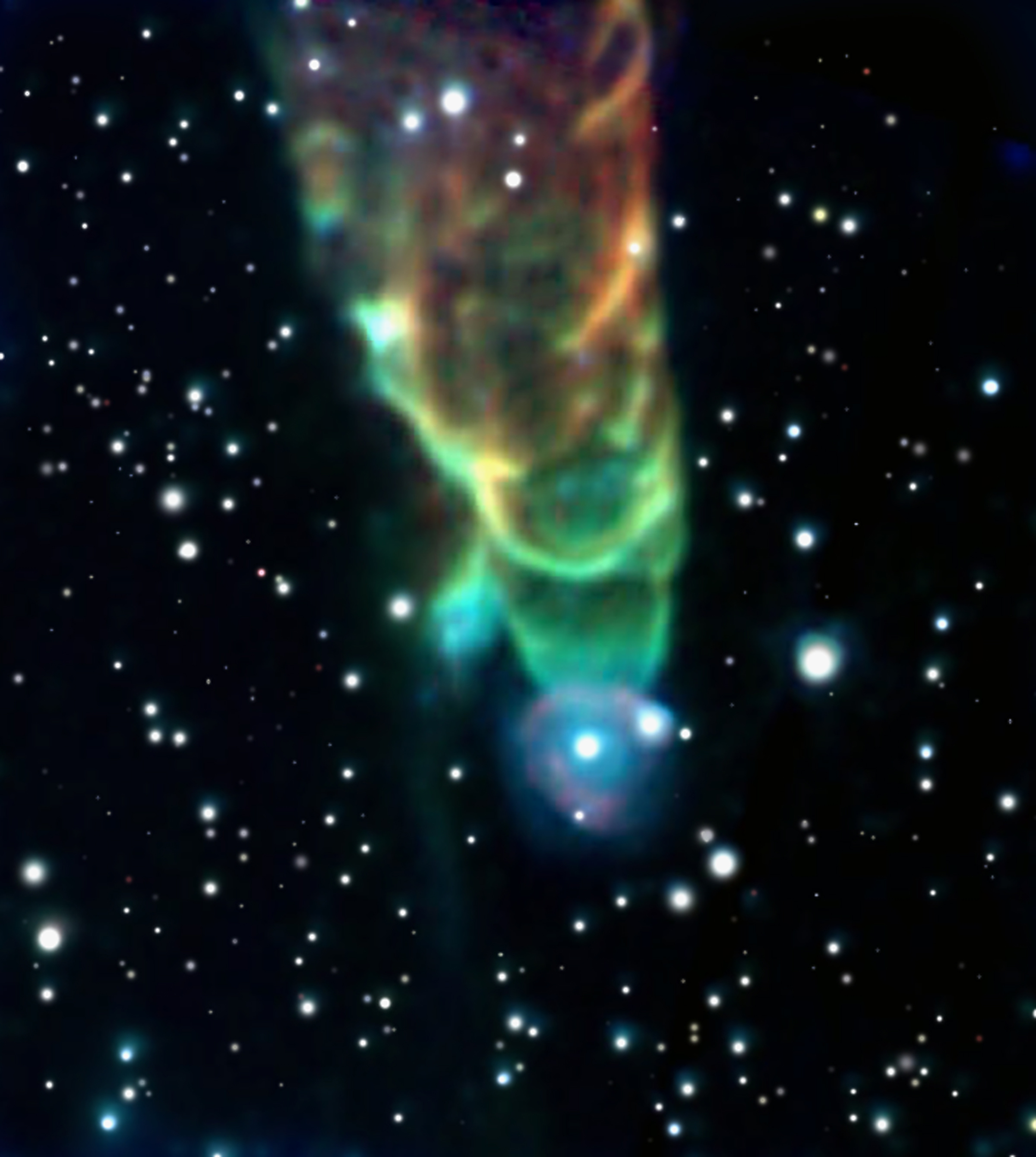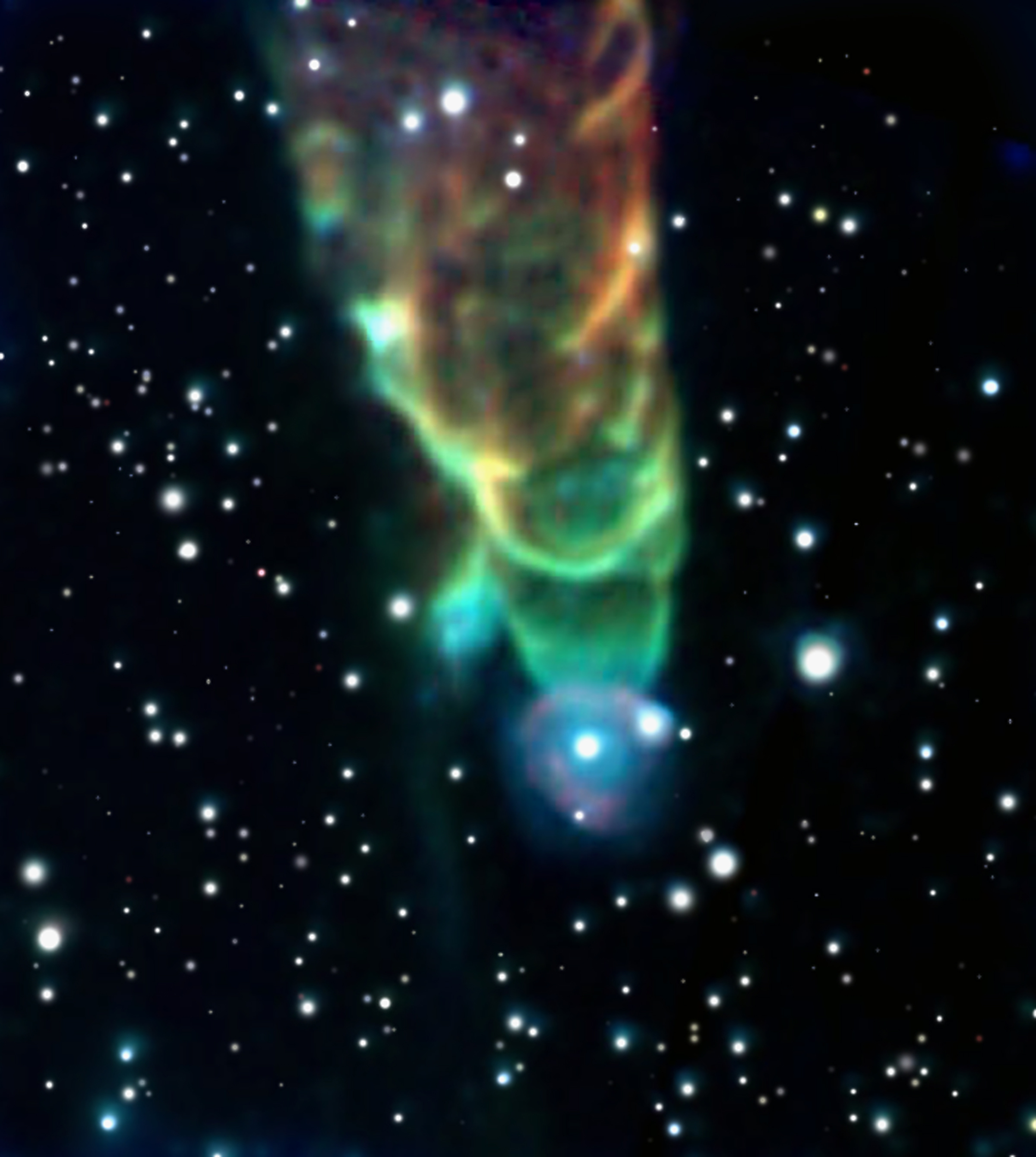
Light-years in length, this cosmic tornado is actually a powerful jet cataloged as HH (Herbig-Haro) 49/50 blasting down from the top of a Spitzer Space Telescope view. Though such energetic outflows are well known to be associated with the formation of young stars, the exact cause of the spiraling structures apparent in this case is still mysterious. The embryonic star responsible for the 100-kilometer per second jet is located just off the top of the picture, while the bright star seen near the tip of the jet may just by chance lie along the line of sight. In the false-color infrared image, the tornado glows with infrared light generated as the outflow heats surrounding dust clouds. The color coding shows a trend from red to blue hues at the tornado's tip indicating a systematic increase in emission at shorter wavelengths. The trend is thought to indicate an increase in molecular excitation closer to where the head of the jet is impacting interstellar gas. HH49/50 is about 450 light-years distant, located in the Chamaeleon I molecular cloud.
Con una extensión de varios años luz, este tornado cósmico es en realidad un poderoso chorro catalogado como HH (Herbig-Haro) 49/50 que se expulsa desde la parte superior de una imagen del Telescopio Espacial Spitzer. Aunque se sabe bien que tales flujos energéticos están asociados con la formación de estrellas jóvenes, la causa exacta de las estructuras en espiral aparentes en este caso sigue siendo misteriosa. La estrella embrionaria responsable del chorro de 100 kilómetros por segundo se ubica justo fuera de la parte superior de la imagen, mientras que la estrella brillante vista cerca de la punta del chorro podría encontrarse por azar en la línea de visión. En la imagen infrarroja en falso color, el tornado brilla con luz infrarroja generada cuando el flujo calienta las nubes de polvo circundantes. La codificación de colores muestra una tendencia de tonos rojos a azules en la punta del tornado, indicando un aumento sistemático en la emisión a longitudes de onda más cortas. Se cree que esta tendencia indica un aumento en la excitación molecular más cerca de donde la cabeza del chorro impacta el gas interestelar. HH49/50 se encuentra a aproximadamente 450 años luz de distancia, ubicado en la nube molecular Chamaeleon I.