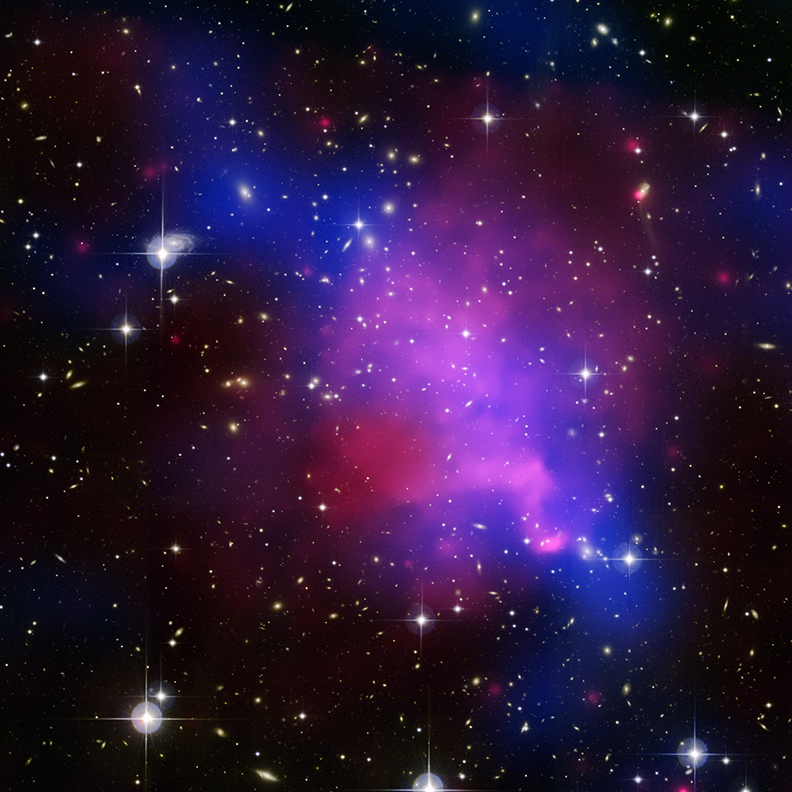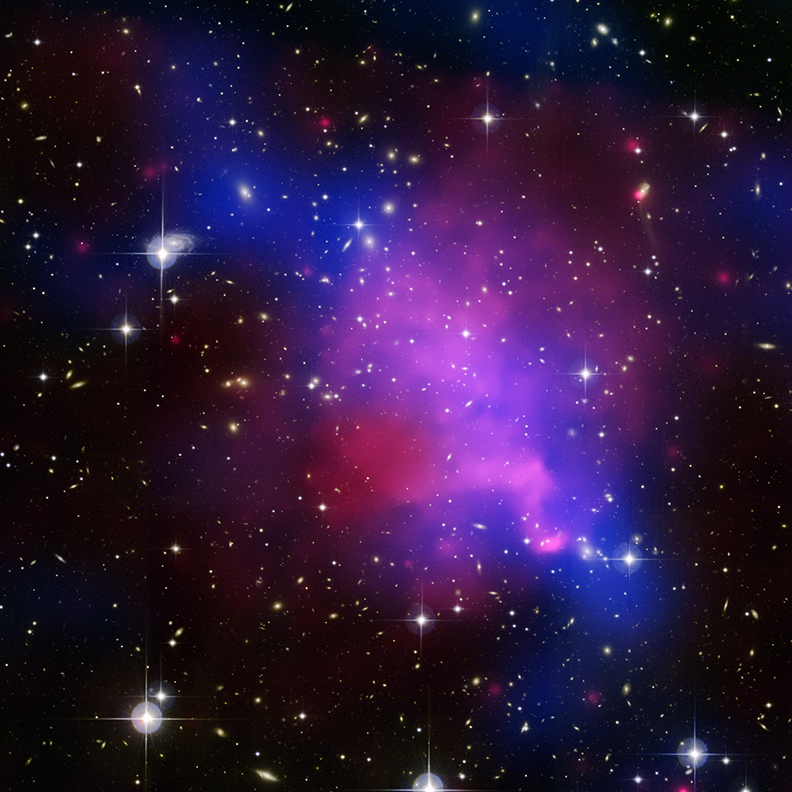
Huge clusters of galaxies are surely colliding in Abell 520 but astrophysicists aren't sure why the dark matter is becoming separated from the normal matter. The dark matter in the above multi-wavelength image is shown in false blue, determined by carefully detailing how the cluster distorts light emitted by more distant galaxies. Very hot gas, a form of normal matter, is shown in false red, determined by the X-rays detected by the Earth-orbiting Chandra X-ray Observatory. Individual galaxies dominated by normal matter appear yellowish or white. Conventional wisdom holds that dark matter and normal matter are attracted the same gravitationally, and so should be distributed the same in Abell 520. Inspection of the above image, however, shows a surprising a lack of a concentration of visible galaxies along the dark matter. One hypothetical answer is that the discrepancy is caused by the large galaxies undergoing some sort of conventional gravitational slingshots. A more controversial hypothesis holds that the dark matter is colliding with itself in some non-gravitational way that has never been seen before. Further simulations and study of this cluster may resolve this scientific conundrum.
Sin duda, enormes cúmulos de galaxias están colisionando en Abell 520, pero los astrofísicos no están seguros de por qué la materia oscura se está separando de la materia normal. La materia oscura en la imagen multiespectral anterior se muestra en falso color azul, determinada por el análisis cuidadoso de cómo el cúmulo distorsiona la luz emitida por galaxias más distantes. El gas muy caliente, una forma de materia normal, se muestra en falso color rojo, determinado por los rayos X detectados por el Observatorio de Rayos X Chandra en órbita terrestre. Las galaxias individuales dominadas por materia normal aparecen amarillentas o blancas. La sabiduría convencional sostiene que la materia oscura y la materia normal son atraídas por la gravedad de la misma manera y, por lo tanto, deberían distribuirse de forma similar en Abell 520. Sin embargo, la inspección de la imagen anterior muestra una sorprendente falta de concentración de galaxias visibles junto con la materia oscura. Una posible respuesta es que la discrepancia es causada por grandes galaxias que experimentan una especie de efectos gravitacionales de honda convencionales. Una hipótesis más controvertida sostiene que la materia oscura está colisionando consigo misma de una manera no gravitacional que nunca ha sido observada. Futuras simulaciones y estudios de este cúmulo podrían resolver este enigma científico.