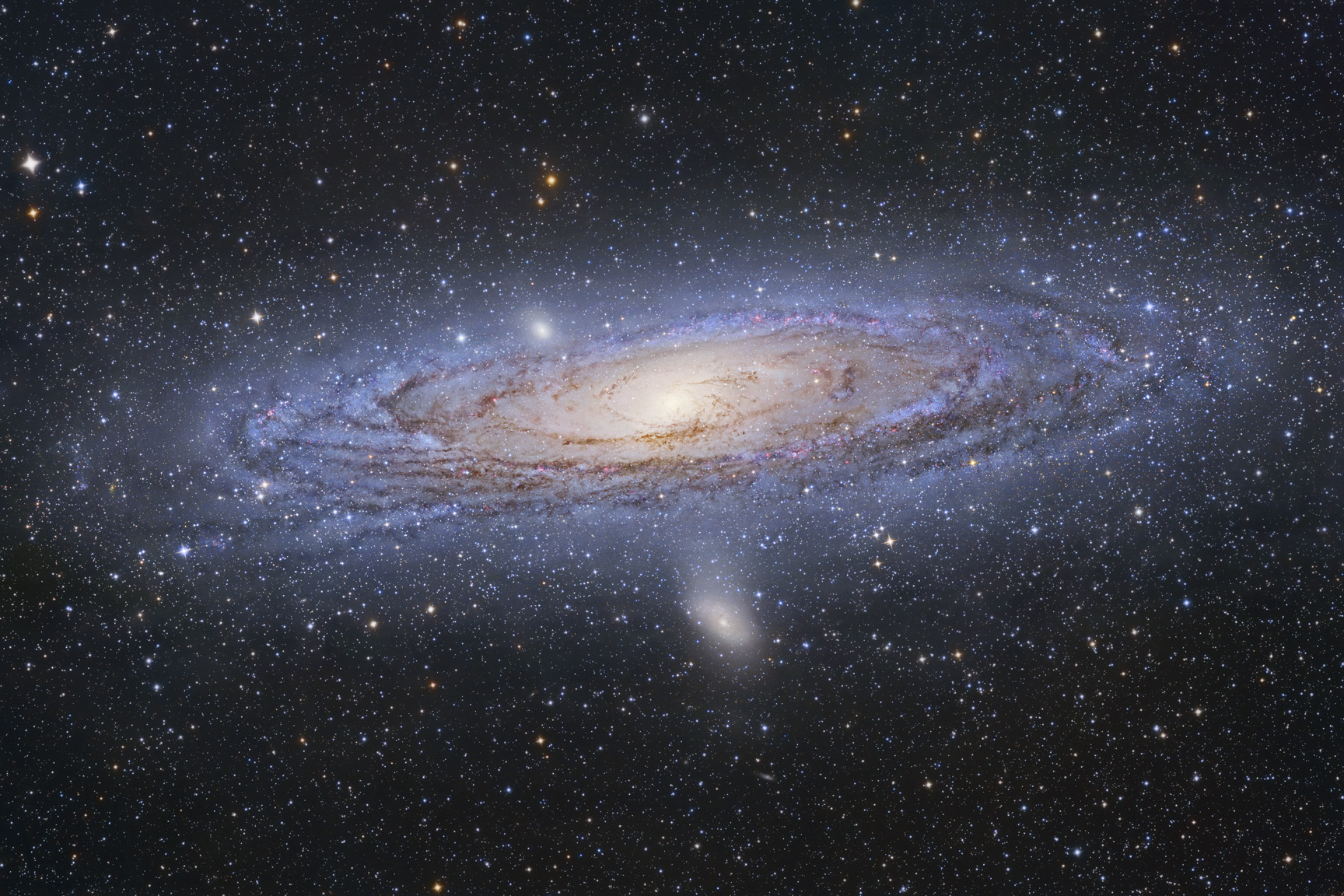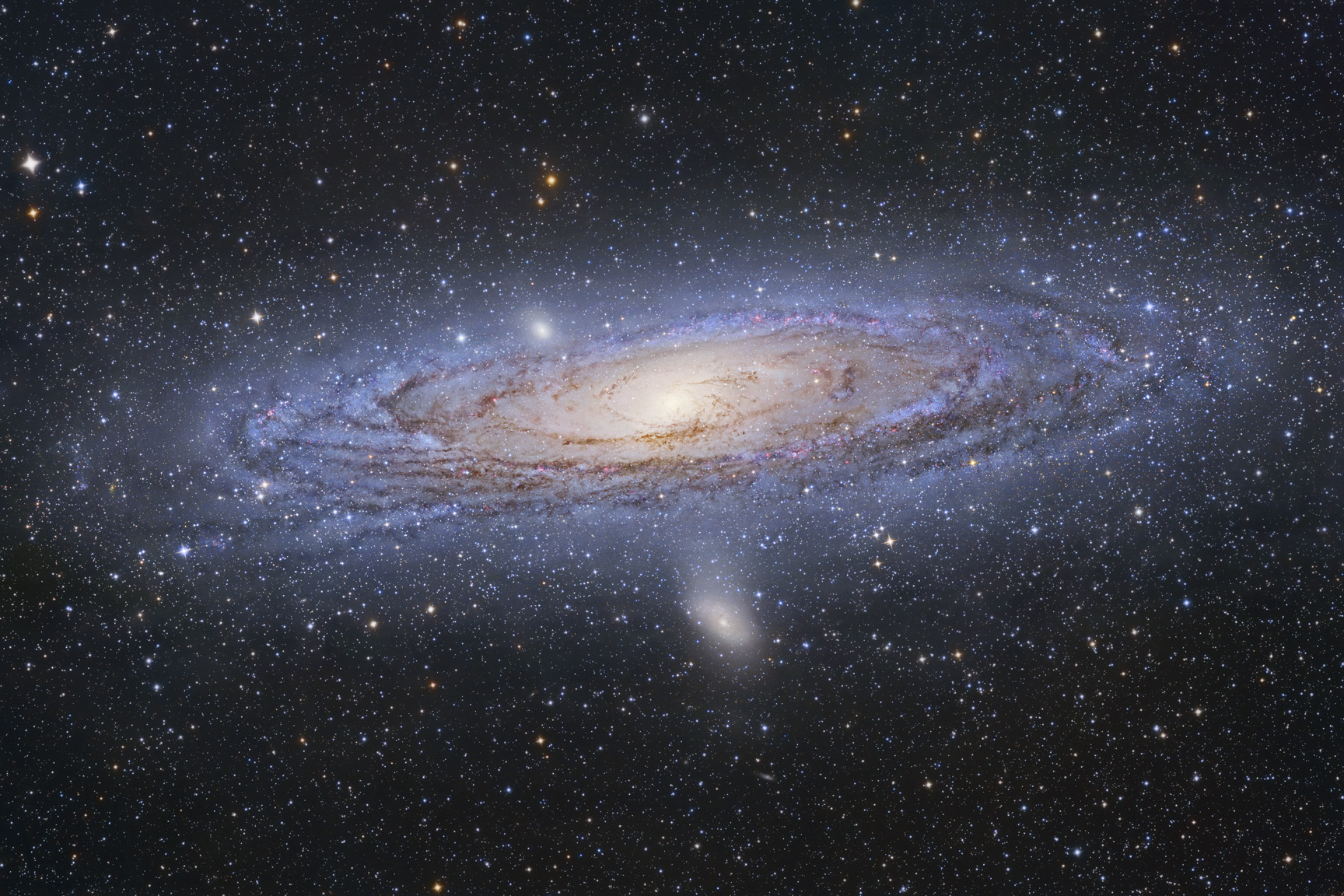
The most distant object easily visible to the unaided eye is M31, the great Andromeda Galaxy some two and a half million light-years away. But without a telescope, even this immense spiral galaxy - spanning over 200,000 light years - appears as a faint, nebulous cloud in the constellation Andromeda. In contrast, a bright yellow nucleus, dark winding dust lanes, gorgeous blue spiral arms and star clusters are recorded in this stunning telescopic digital mosaic. While even casual skygazers are now inspired by the knowledge that there are many distant galaxies like M31, astronomers seriously debated this fundamental concept less than 90 years ago. Were these "spiral nebulae" simply outlying components of our own Milky Way Galaxy or were they instead "island universes" -- distant systems of stars comparable to the Milky Way itself? This question was central to the famous Shapley-Curtis debate of 1920, which was later resolved by observations of M31 in favor of Andromeda, island universe.
El objeto más distante fácilmente visible a simple vista es M31, la gran Galaxia de Andrómeda, a unos dos millones y medio de años luz de distancia. Pero sin un telescopio, incluso esta inmensa galaxia espiral —que abarca más de 200.000 años luz— aparece como una nube nebulosa tenue en la constelación de Andrómeda. En contraste, este impresionante mosaico digital telescópico registra un brillante núcleo amarillento, oscuras bandas de polvo sinuosas, hermosos brazos espirales azules y cúmulos estelares. Aunque ahora incluso los observadores del cielo casual se sienten inspirados por el conocimiento de que existen muchas galaxias distantes como M31, los astrónomos debatieron seriamente este concepto fundamental hace menos de 90 años. ¿Eran estas "nebulosas espirales" simplemente componentes periféricos de nuestra propia Galaxia Vía Láctea, o eran en cambio "universos isla" —sistemas de estrellas distantes comparables a la Vía Láctea? Esta pregunta fue central en el famoso debate Shapley-Curtis de 1920, que posteriormente fue resuelto mediante observaciones de M31 a favor de Andrómeda, universo isla.