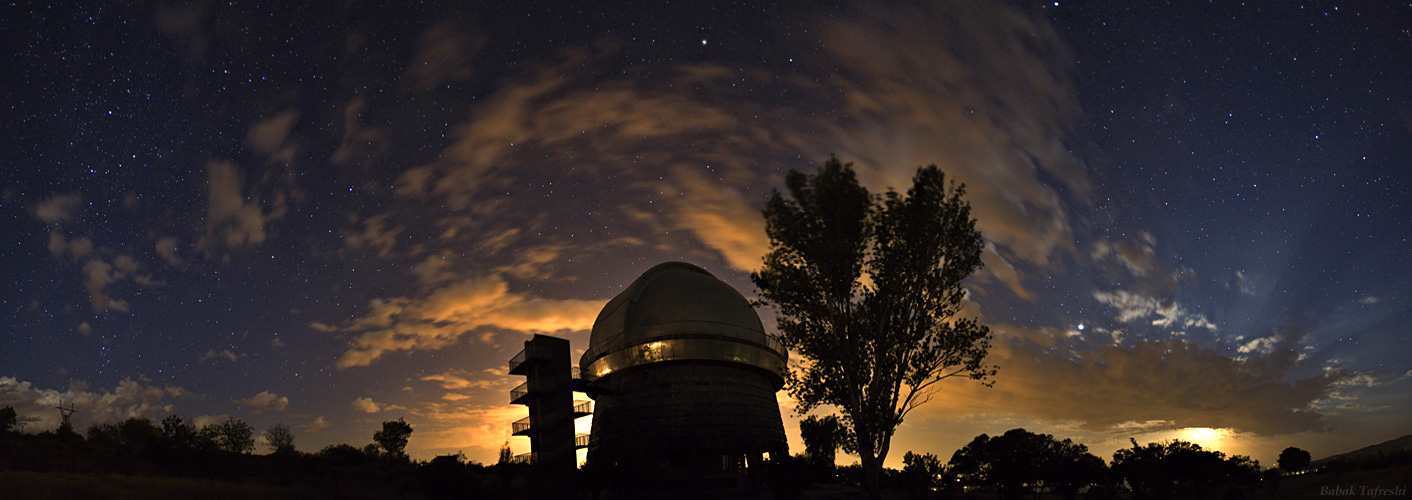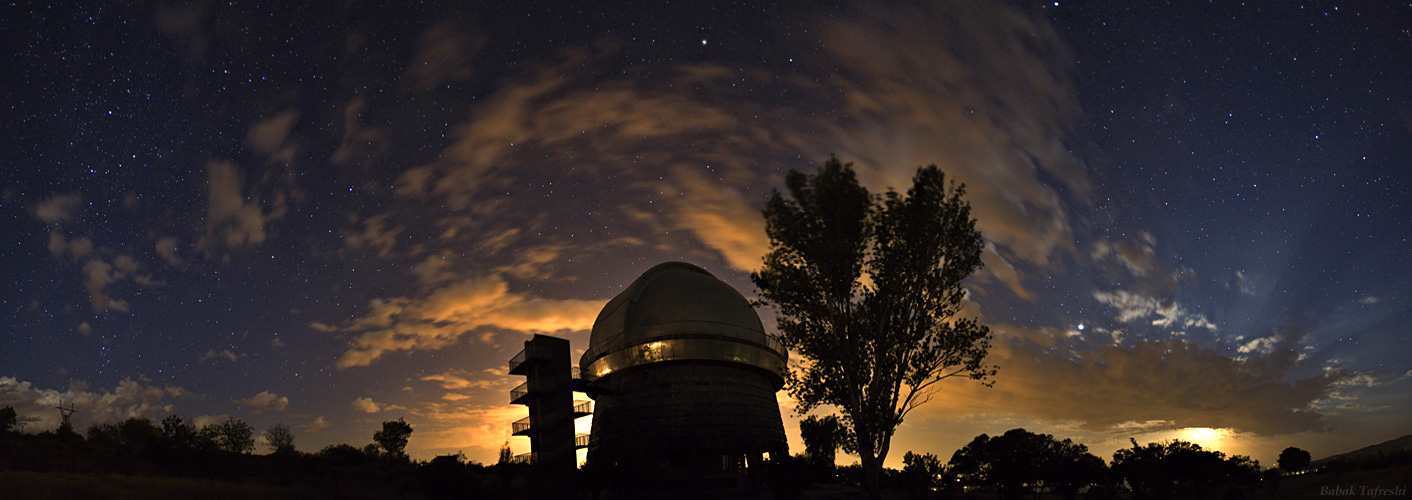
On September 7th, the first quarter Moon and passing clouds contributed to a dramatic night sky over the Byurakan Astrophysical Observatory. This panoramic view begins at the left looking toward the eastern horizon and the rising stars of the constellation Perseus. Sweeping your gaze to the right (south), you'll find the large observatory dome, housing a 2.6 meter diameter telescope, backlit by lights from nearby Yerevan, capital city of Armenia. Fittingly poised above the observatory dome is the bright, giant star Enif in the high-flying constellation Pegasus. Farther to the right, the brightest celestial beacon just above the clouds is our Solar System's ruling gas giant Jupiter. At the far right, the Moon is nearly hidden by an approaching cloudbank, but the clouds themselves actually cast shadows in the bright moonlight, creating the effect of Moon rays across the evening sky.
El 7 de septiembre, la Luna en cuarto creciente y las nubes que pasaban contribuyeron a un espectacular cielo nocturno sobre el Observatorio Astrofísico de Byurakan. Esta vista panorámica comienza a la izquierda mirando hacia el horizonte oriental y las estrellas nacientes de la constelación de Perseo. Desplazando la vista hacia la derecha (sur), encontrará la gran cúpula del observatorio, que alberga un telescopio de 2,6 metros de diámetro, iluminada desde atrás por las luces de la cercana Ereván, capital de Armenia. Estratégicamente posicionada sobre la cúpula del observatorio se encuentra la brillante y gigantesca estrella Enif en la elevada constelación de Pegaso. Más hacia la derecha, el faro celeste más brillante justo sobre las nubes es Júpiter, el gigante de gas que domina nuestro Sistema Solar. En el extremo derecho, la Luna está casi oculta por un banco de nubes que se aproxima, pero las nubes en sí proyectan sombras a la luz lunar brillante, creando el efecto de rayos lunares atravesando el cielo vespertino.