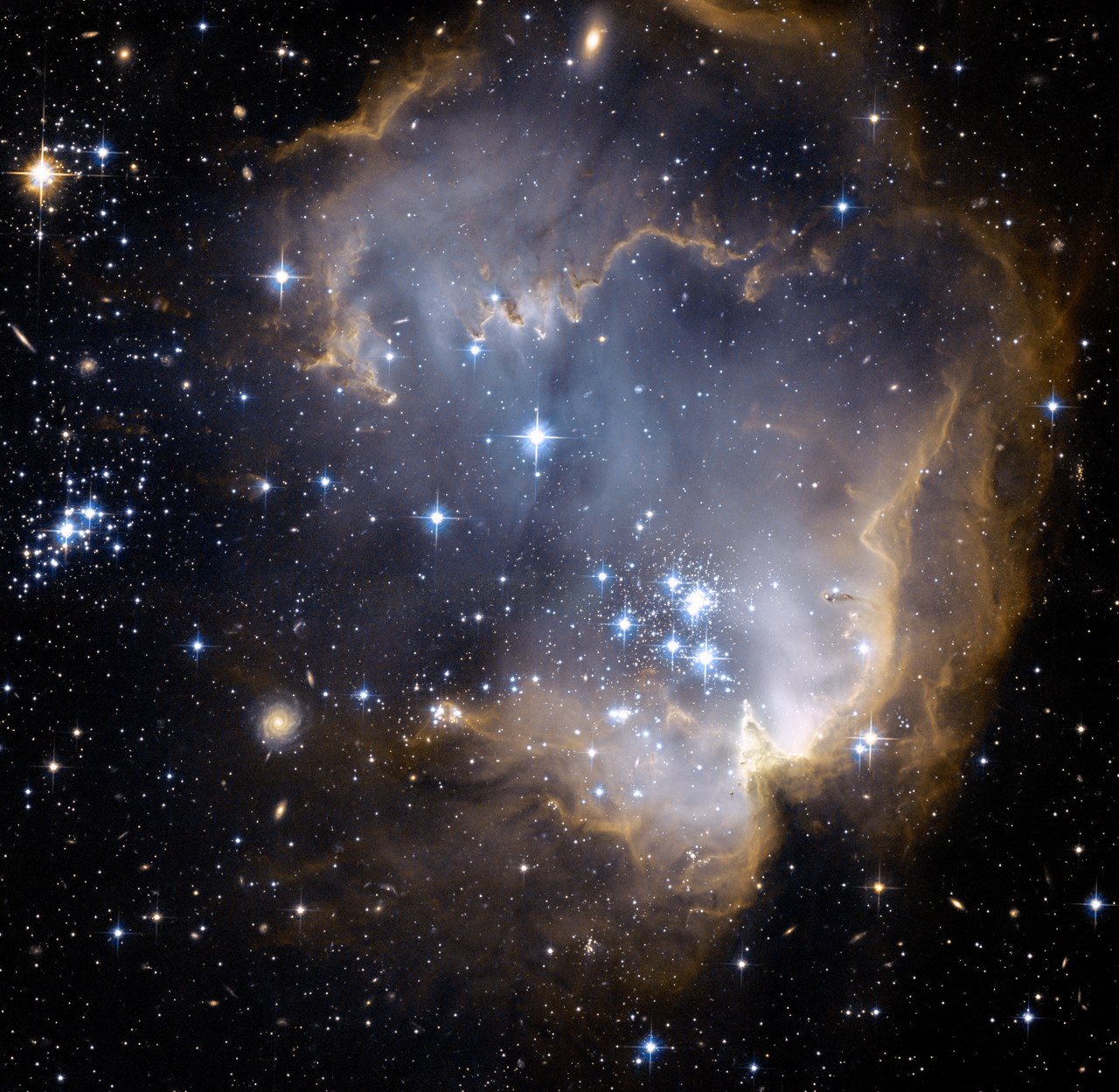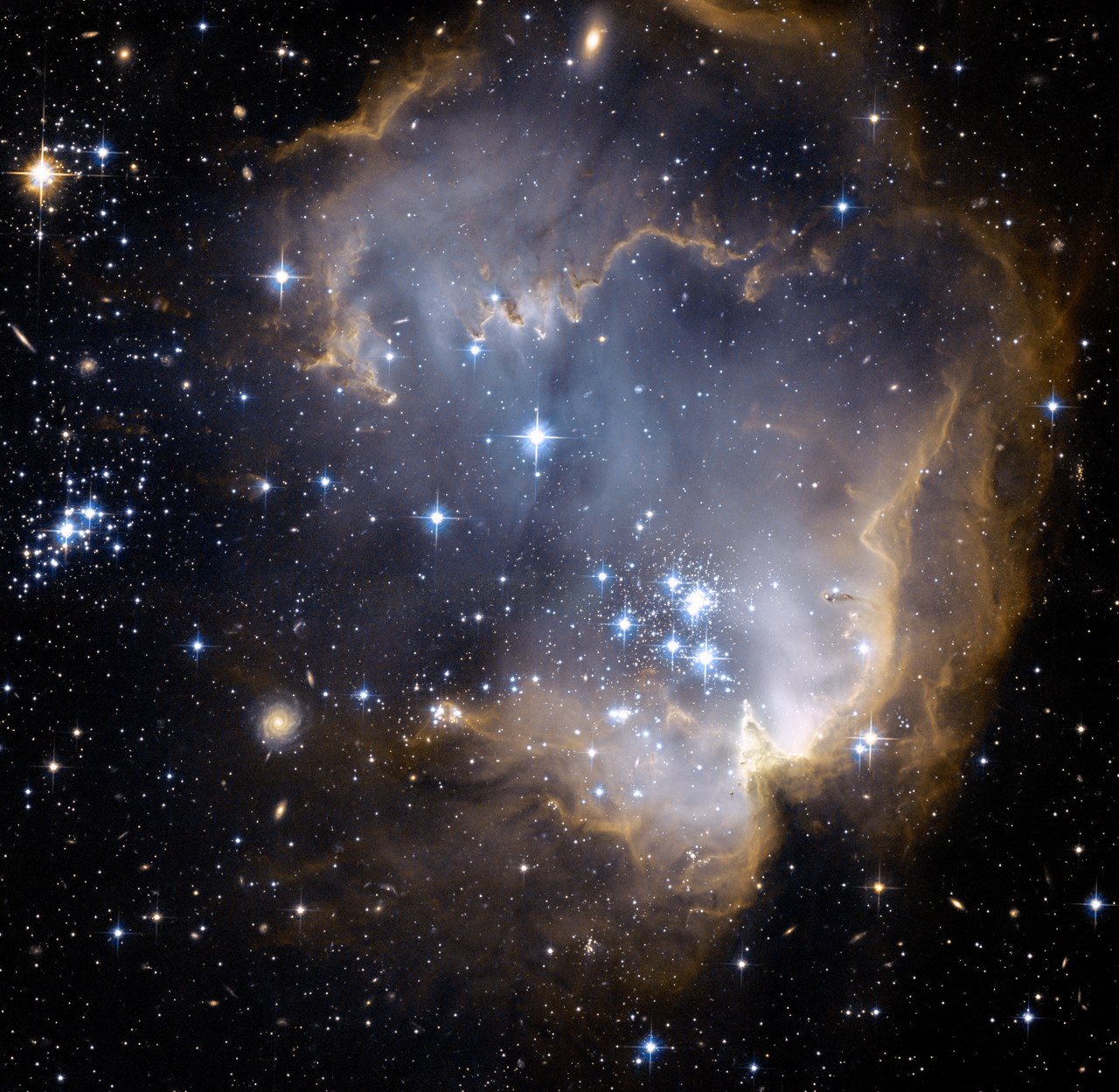
Near the outskirts of the Small Magellanic Cloud, a satellite galaxy some 200 thousand light-years distant, lies 5 million year young star cluster NGC 602. Surrounded by natal gas and dust, NGC 602 is featured in this stunning Hubble image of the region. Fantastic ridges and swept back shapes strongly suggest that energetic radiation and shock waves from NGC 602's massive young stars have eroded the dusty material and triggered a progression of star formation moving away from the cluster's center. At the estimated distance of the Small Magellanic Cloud, the picture spans about 200 light-years, but a tantalizing assortment of background galaxies are also visible in the sharp Hubble view. The background galaxies are hundreds of millions of light-years or more beyond NGC 602.
Cerca de los límites exteriores de la Pequeña Nube de Magallanes, una galaxia satélite ubicada a unos 200 mil años luz de distancia, se encuentra el cúmulo estelar NGC 602, de apenas 5 millones de años de antigüedad. Rodeado de gas y polvo natal, NGC 602 es el protagonista de esta impresionante imagen del Hubble de la región. Las fantásticas crestas y formas barridas hacia atrás sugieren firmemente que la radiación energética y las ondas de choque de las estrellas jóvenes masivas de NGC 602 han erosionado el material polvoriento e impulsado una progresión de formación estelar que se aleja del centro del cúmulo. A la distancia estimada de la Pequeña Nube de Magallanes, la imagen abarca aproximadamente 200 años luz, pero una tentadora variedad de galaxias de fondo también son visibles en la nítida vista del Hubble. Las galaxias de fondo se encuentran a cientos de millones de años luz o más allá de NGC 602.