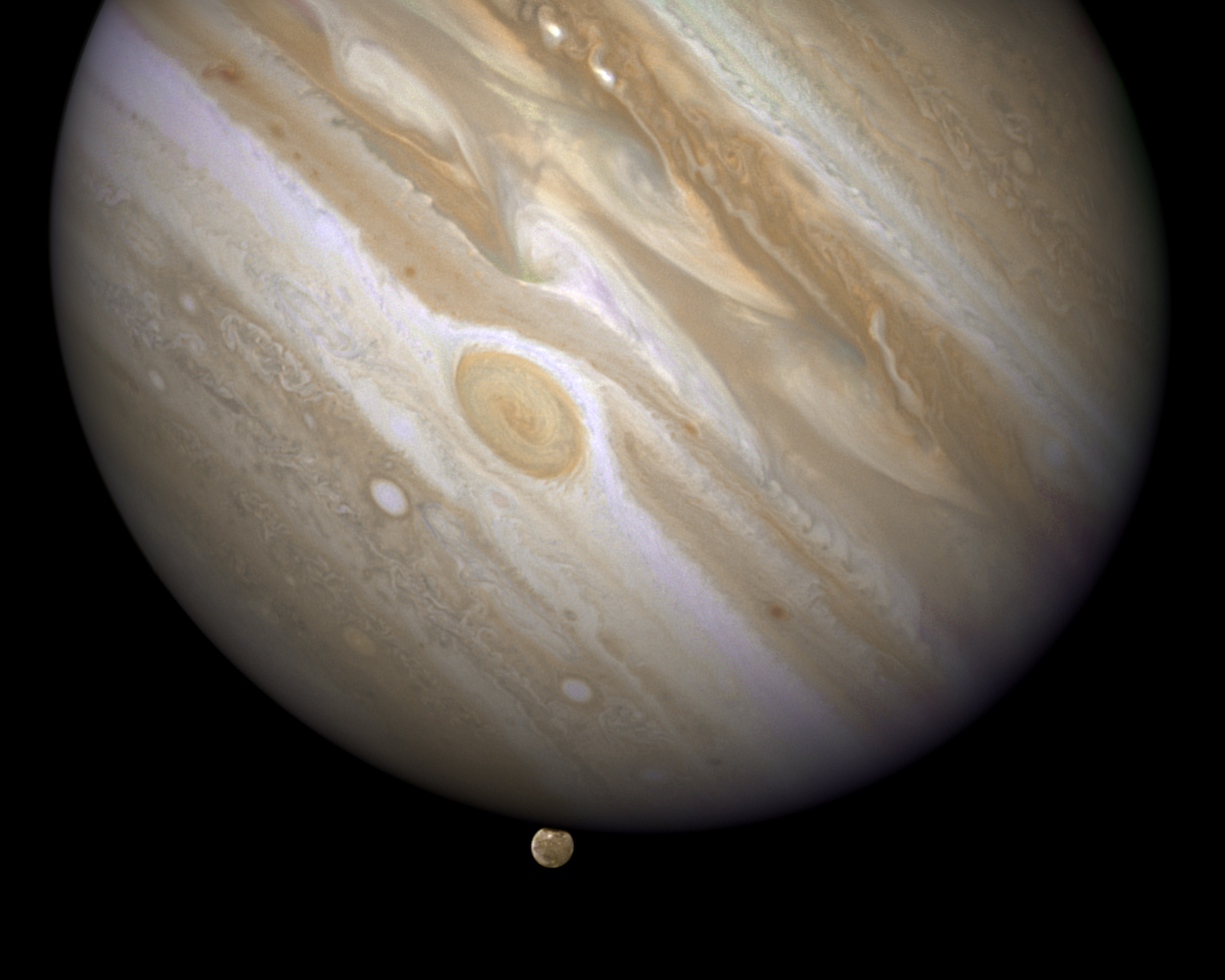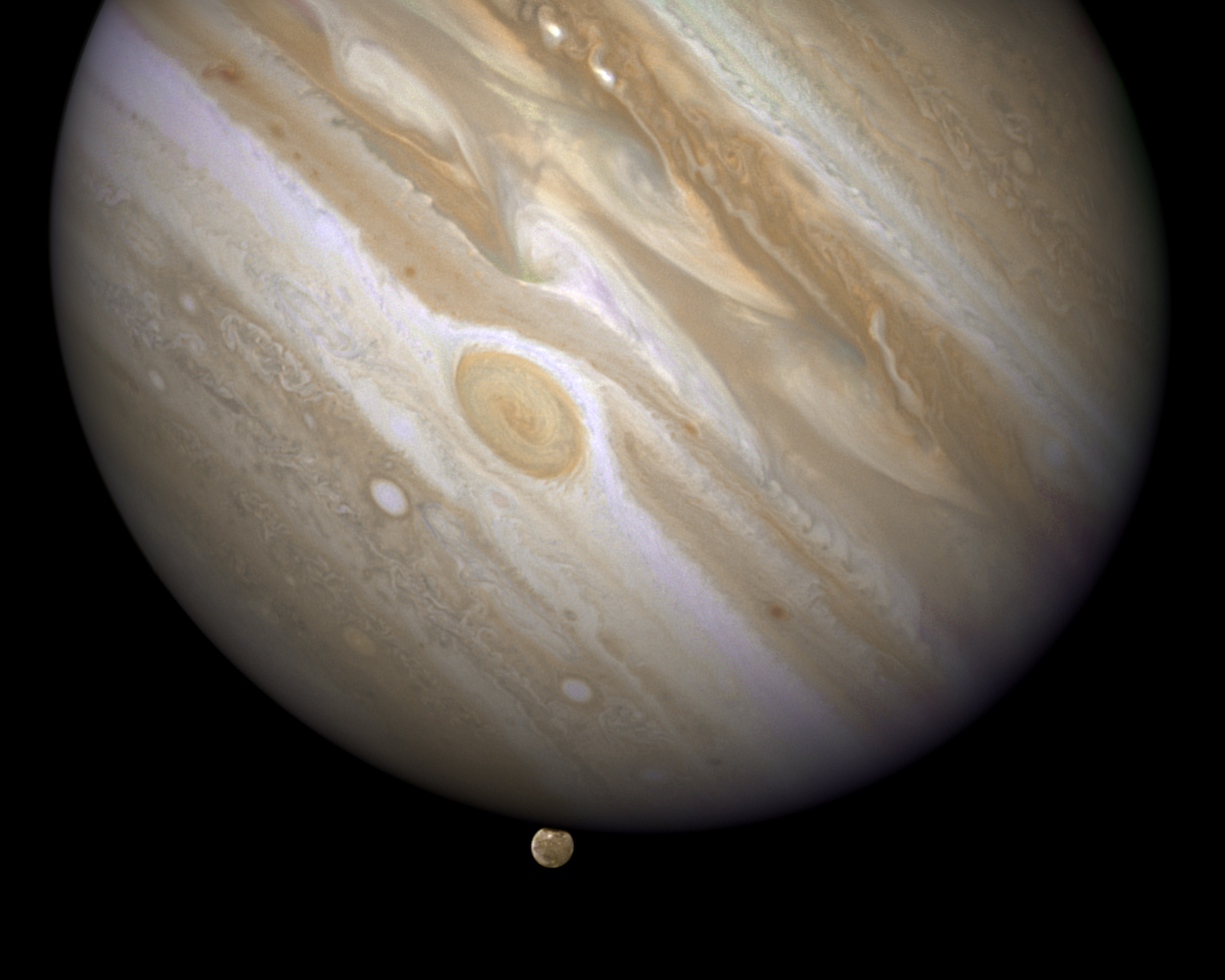
How hazy is Jupiter's upper atmosphere? To help find out, astronomers deployed the Hubble Space Telescope to watch Jupiter eclipse its moon Ganymede. Although Ganymede circles Jupiter once a week, a particularly useful occultation occurs more rarely. Such an occultation was captured in great visual detail in April 2007. When near Jupiter's limb, Ganymede reflects sunlight though Jupiter's upper atmosphere, allowing astronomers to search for haze by noting a slight dimming at different colors. One result of this investigation was the above spectacular image, where bands of clouds that circle Jupiter are clearly visible, as well as magnificent swirling storm systems such as the Great Red Spot. Ganymede, at the image bottom, also shows noticeable detail on its dark icy surface. Since Jupiter and Ganymede are so bright, many eclipses can be seen right here on Earth with a small telescope.
¿Cuán brumosa es la atmósfera superior de Júpiter? Para ayudar a determinarlo, los astrónomos desplegaron el Telescopio Espacial Hubble para observar a Júpiter eclipsando a su luna Ganimedes. Aunque Ganimedes orbita a Júpiter una vez por semana, una ocultación particularmente útil ocurre más raramente. Tal ocultación fue capturada con gran detalle visual en abril de 2007. Cuando está cerca del limbo de Júpiter, Ganimedes refleja la luz solar a través de la atmósfera superior de Júpiter, lo que permite a los astrónomos buscar bruma observando un ligero oscurecimiento en diferentes colores. Uno de los resultados de esta investigación fue la imagen espectacular anterior, donde las bandas de nubes que rodean a Júpiter son claramente visibles, así como magníficos sistemas de tormentas arremolinadas como la Gran Mancha Roja. Ganimedes, en la parte inferior de la imagen, también muestra detalles notables en su superficie helada y oscura. Dado que Júpiter y Ganimedes son tan brillantes, muchos eclipses pueden verse directamente desde la Tierra con un pequeño telescopio.