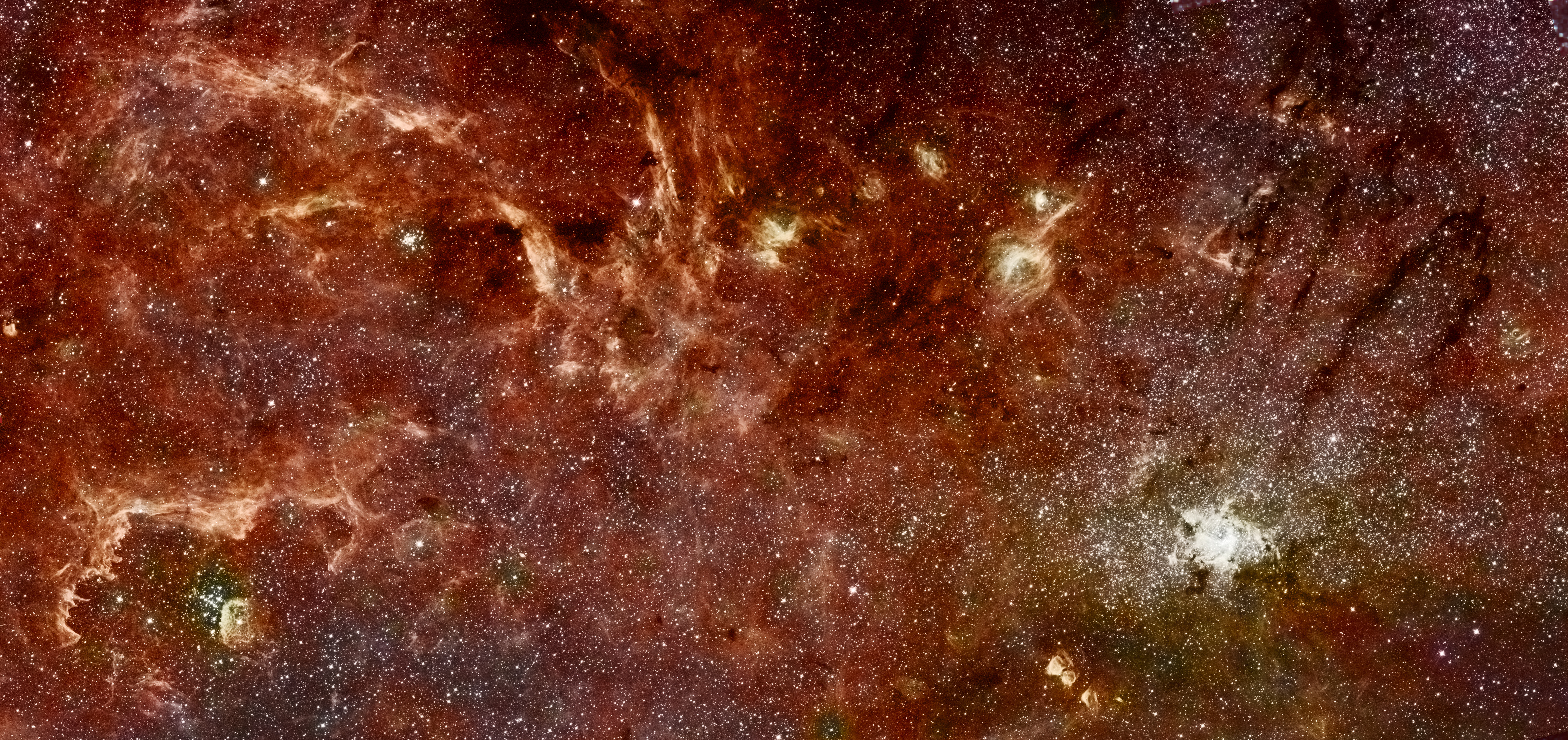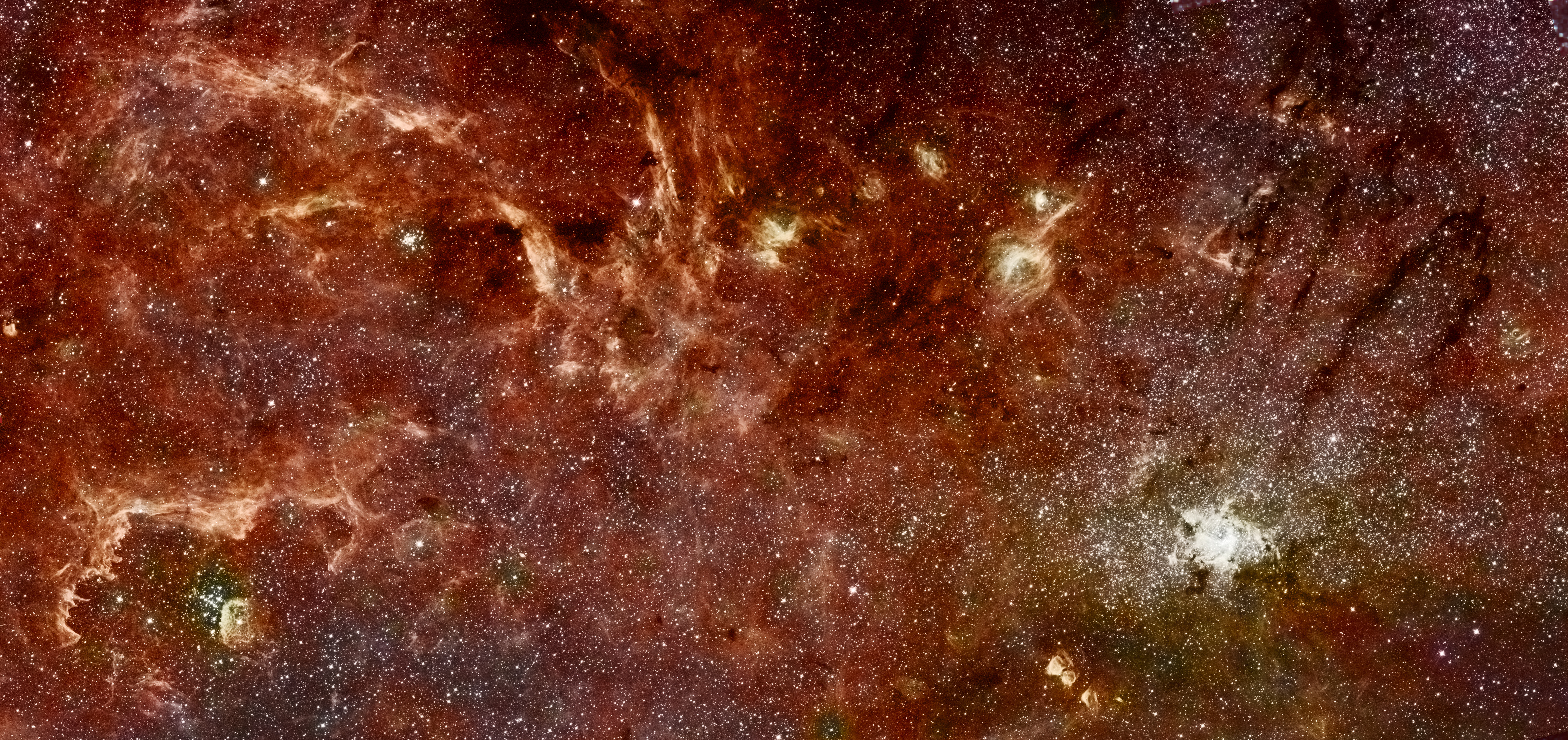
What's happening at the center of our Milky Way Galaxy? To help find out, the orbiting Hubble and Spitzer space telescopes have combined their efforts to survey the region in unprecedented detail in infrared light. Infrared light is particularly useful for probing the Milky Way's center because visible light is more greatly obscured by dust. The above image encompasses over 2,000 images from the Hubble Space Telescope's NICMOS taken last year. The image spans 300 by 115 light years with such high resolution that structures only 20 times the size of our own Solar System are discernable. Clouds of glowing gas and dark dust as well as three large star clusters are visible. Magnetic fields may be channeling plasma along the upper left near the Arches Cluster, while energetic stellar winds are carving pillars near the Quintuplet Cluster on the lower left. The massive Central Cluster of stars surrounding Sagittarius A* is visible on the lower right. Why several central, bright, massive stars appear to be unassociated with these star clusters is not yet understood.
¿Qué está sucediendo en el centro de nuestra galaxia Vía Láctea? Para ayudar a descubrirlo, los telescopios espaciales Hubble y Spitzer en órbita han combinado sus esfuerzos para inspeccionar la región con un detalle sin precedentes en luz infrarroja. La luz infrarroja es particularmente útil para investigar el centro de la Vía Láctea porque la luz visible está más obstaculizada por el polvo. La imagen anterior abarca más de 2000 imágenes tomadas el año pasado por el instrumento NICMOS del Telescopio Espacial Hubble. La imagen se extiende por 300 por 115 años luz con una resolución tan alta que son discernibles estructuras únicamente 20 veces el tamaño de nuestro propio Sistema Solar. Son visibles nubes de gas incandescente y polvo oscuro, así como tres cúmulos estelares grandes. Los campos magnéticos pueden estar canalizando plasma cerca del Cúmulo de Arquímedes en la parte superior izquierda, mientras que los vientos estelares energéticos están tallando pilares cerca del Cúmulo Quintuplete en la parte inferior izquierda. El masivo Cúmulo Central de estrellas que rodea a Sagitario A* es visible en la parte inferior derecha. Aún no se comprende por qué varias estrellas masivas centrales y brillantes parecen no estar asociadas con estos cúmulos estelares.