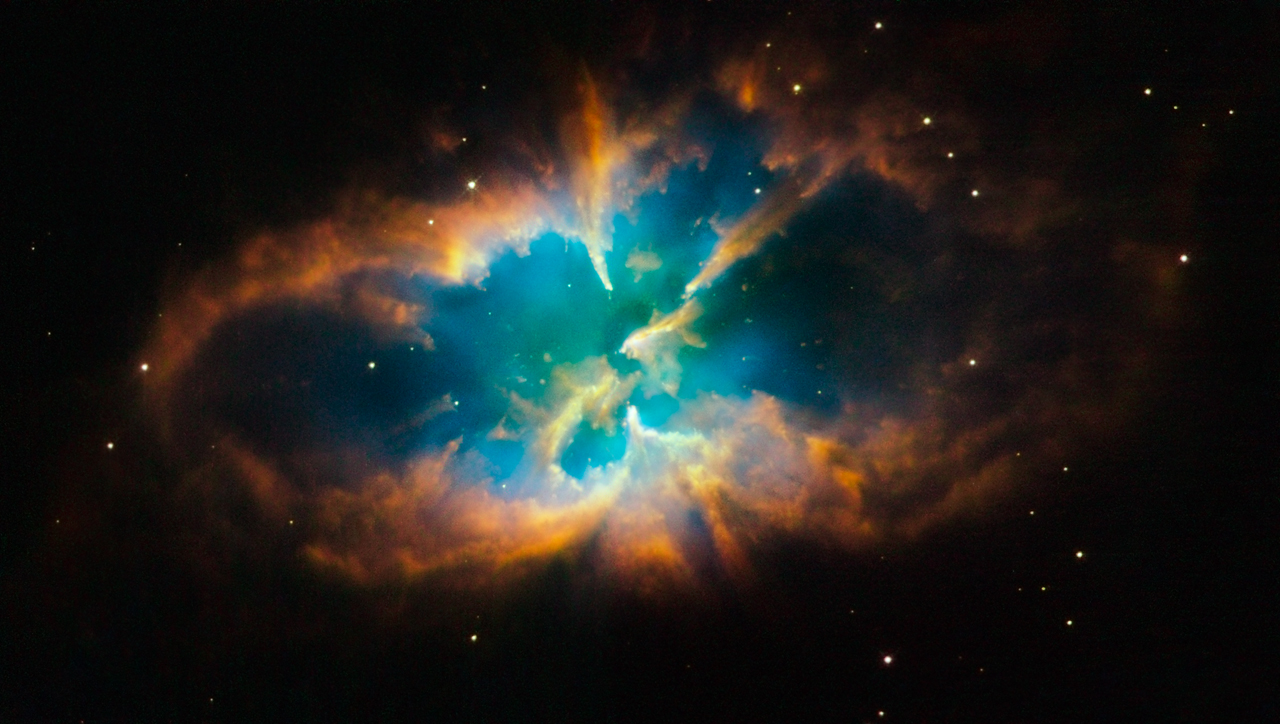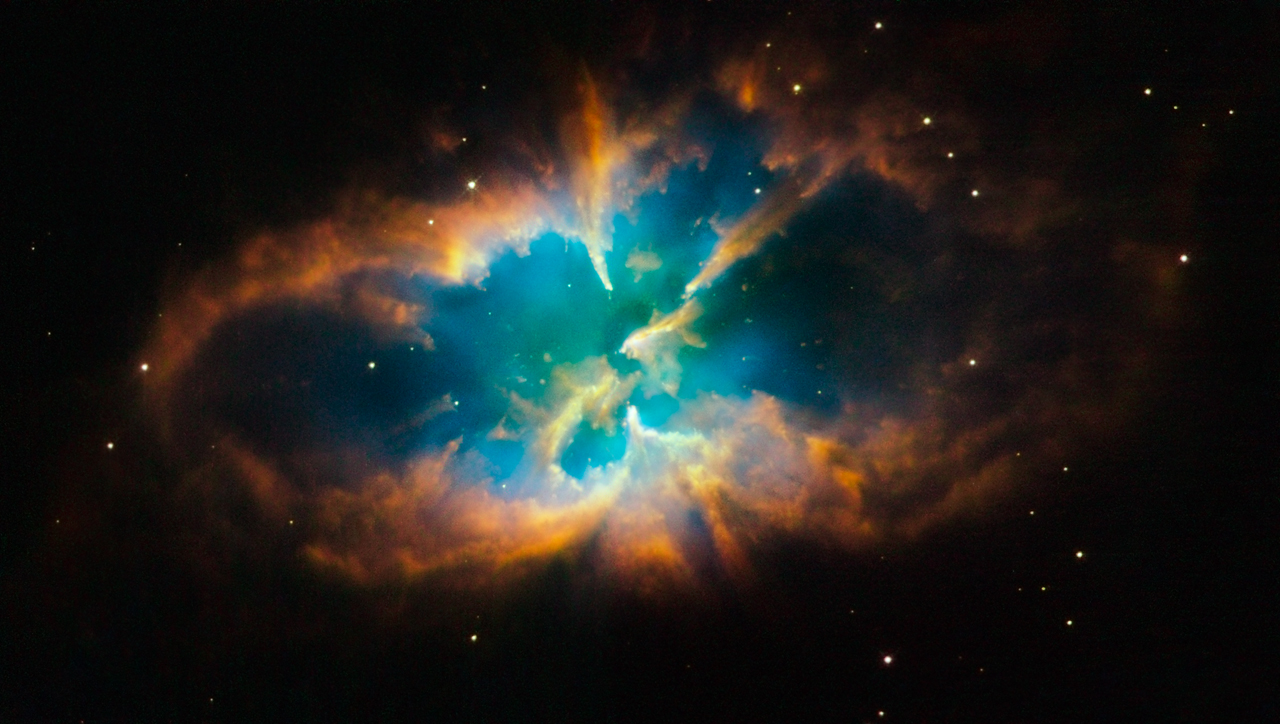
NGC 2818 is a beautiful planetary nebula, the gaseous shroud of a dying sun-like star. It could well offer a glimpse of the future that awaits our own Sun after spending another 5 billion years or so steadily using up hydrogen at its core, and then finally helium, as fuel for nuclear fusion. Curiously, NGC 2818 seems to lie within an open star cluster, NGC 2818A, that is some 10,000 light-years distant toward the southern constellation Pyxis (the Compass). At the distance of the star cluster, the nebula would be about 4 light-years across. But accurate velocity measurements show that the nebula's own velocity is very different from the cluster's member stars. The result is strong evidence that NGC 2818 is only by chance found along the line of sight to the star cluster and so may not share the cluster's distance or age. The Hubble image is a composite of exposures through narrow-band filters, presenting emission from nitrogen, hydrogen, and oxygen atoms in the nebula as red, green, and blue hues. Editor's Note (Jan. 26, 2009): Thanks to Daniel Majaess (St. Mary's Univ., Halifax) for corrections.
NGC 2818 es una hermosa nebulosa planetaria, la envoltura gaseosa de una estrella similar al Sol en su etapa final. Bien podría ofrecer un atisbo del futuro que aguarda a nuestro propio Sol después de pasar aproximadamente otros 5 mil millones de años consumiendo constantemente hidrógeno en su núcleo y, finalmente, helio, como combustible para la fusión nuclear. Curiosamente, NGC 2818 parece hallarse dentro de un cúmulo estelar abierto, NGC 2818A, que se encuentra a unos 10.000 años luz de distancia hacia la constelación austral Pyxis (la Brújula). A la distancia del cúmulo estelar, la nebulosa tendría aproximadamente 4 años luz de diámetro. Sin embargo, mediciones precisas de velocidad muestran que la velocidad propia de la nebulosa es muy diferente de la de las estrellas miembros del cúmulo. El resultado es evidencia sólida de que NGC 2818 se encuentra solo por casualidad en la línea de visión hacia el cúmulo estelar y, por lo tanto, puede no compartir la distancia ni la edad del cúmulo. La imagen del Telescopio Espacial Hubble es una composición de exposiciones a través de filtros de banda estrecha, presentando la emisión de átomos de nitrógeno, hidrógeno y oxígeno de la nebulosa en tonos rojo, verde y azul.