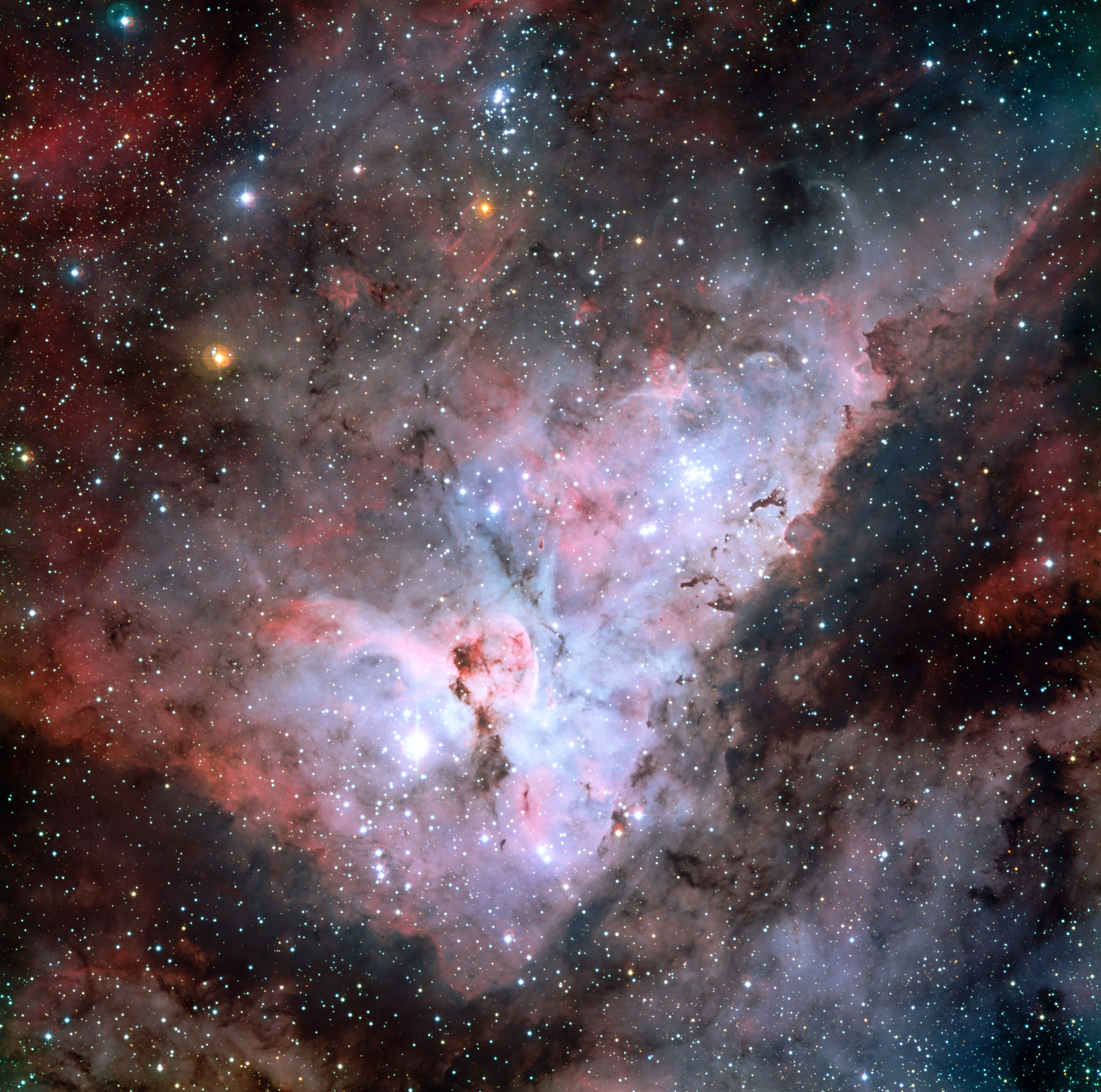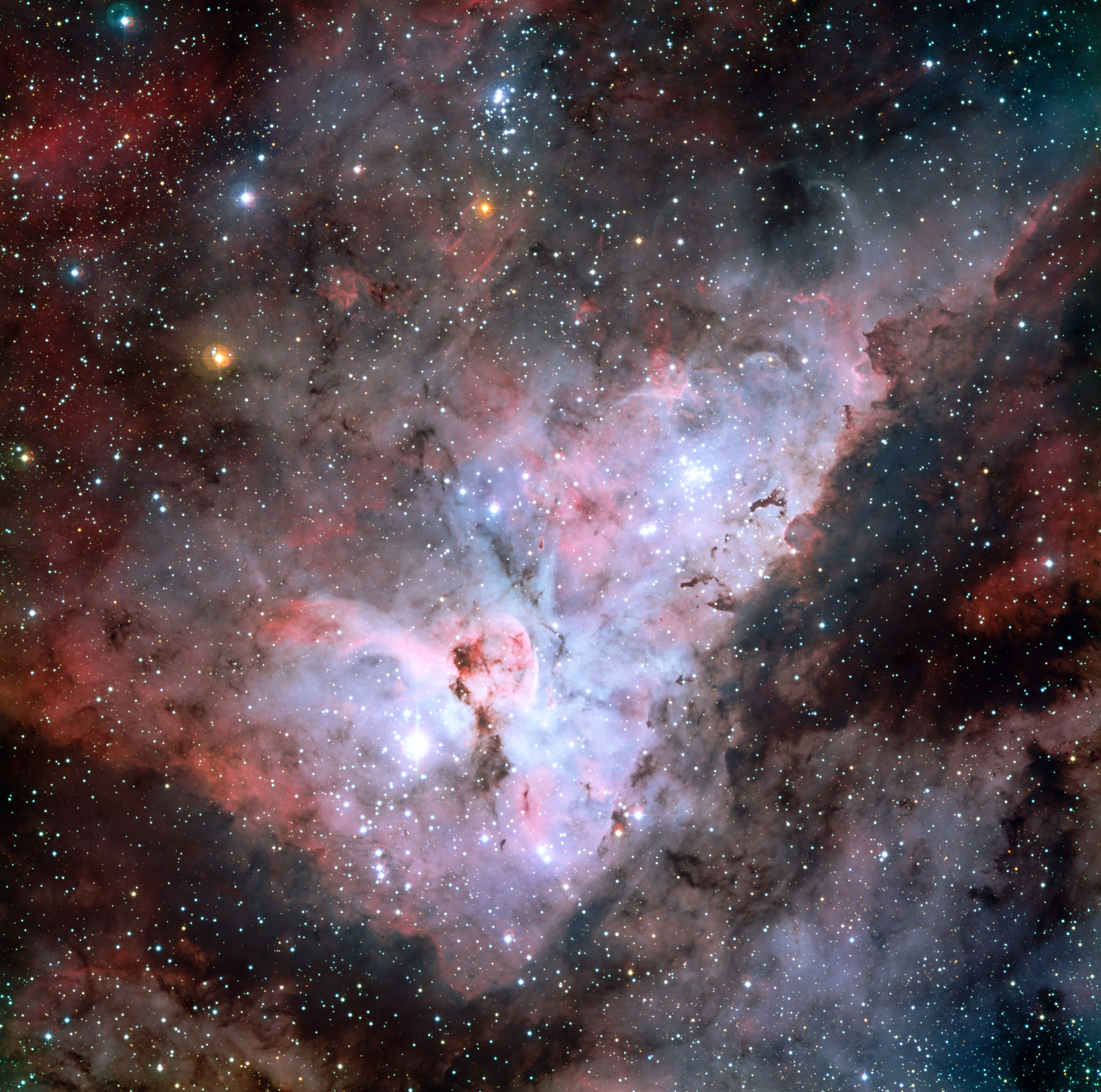
A jewel of the southern sky, the Great Carina Nebula, aka NGC 3372, spans over 300 light-years, one of our Galaxy's largest star forming regions. Like the smaller, more northerly Great Orion Nebula, the Carina Nebula is easily visible to the unaided eye, though at a distance of 7,500 light-years it is some 5 times farther away. This stunning telescopic view from the 2.2-meter ESO/MPG telescope La Silla Observatory in Chile reveals remarkable details of the region's glowing filaments of interstellar gas and dark cosmic dust clouds. The Carina Nebula is home to young, extremely massive stars, including the still enigmatic variable Eta Carinae, a star with well over 100 times the mass of the Sun. Eta Carinae is the bright star left of the central dark notch in this field and near the dusty Keyhole Nebula (NGC 3324).
Joya del cielo austral, la Gran Nebulosa de Carina, también conocida como NGC 3372, se extiende por más de 300 años luz, siendo una de las regiones de formación estelar más grandes de nuestra Galaxia. Al igual que la más pequeña Gran Nebulosa de Orión, ubicada más al norte, la Nebulosa de Carina es fácilmente visible a simple vista, aunque a una distancia de 7.500 años luz se encuentra aproximadamente 5 veces más lejos. Esta impresionante vista telescópica obtenida con el telescopio de 2,2 metros ESO/MPG de la Observatorio La Silla en Chile revela detalles notables de los filamentos luminosos de gas interestelar y las nubes de polvo cósmico oscuro de la región. La Nebulosa de Carina alberga estrellas jóvenes extremadamente masivas, incluyendo la aún enigmática variable Eta Carinae, una estrella con una masa superior a 100 veces la del Sol. Eta Carinae es la estrella brillante ubicada a la izquierda de la muesca central oscura en este campo, cerca de la polvorosa Nebulosa de la Cerradura (NGC 3324).