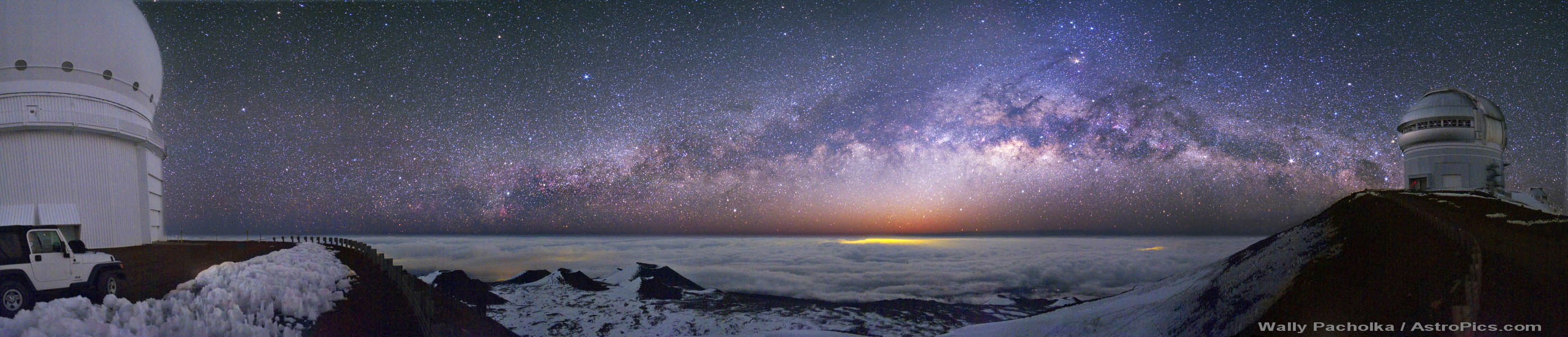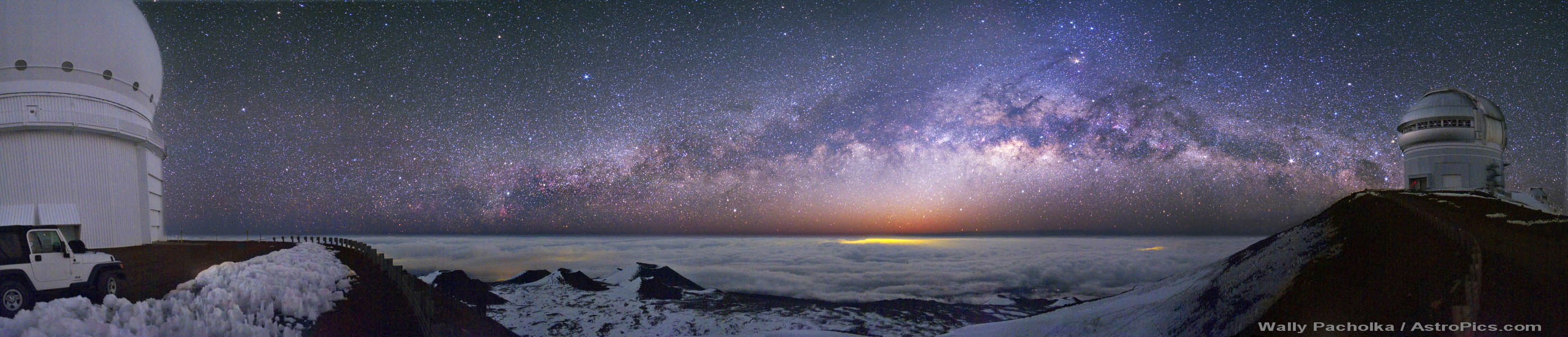
Aloha and welcome to a breathtaking skyscape. The dreamlike panoramic view looks out from the 4,200 meter volcanic summit of Mauna Kea, Hawai'i, across a layer of clouds toward a starry night sky and the rising Milky Way. Anchoring the scene on the far left is the dome of the Canada-France-Hawaii Telescope (CFHT), with north star Polaris shining beyond the dome to the right. Farther right, headed by bright star Deneb, the Northern Cross asterism is embedded along the plane of the Milky Way as it peeks above the horizon. Both Northern Cross and brilliant white Vega hang over a foreground grouping of cinder cones. Near the center are the reddish nebulae, stars and dust clouds of the central Milky Way. Below, illumination from the city lights of Hilo creates an eerie, greenish glow in the clouds. Red supergiant star Antares shines above the Milky Way's central bulge while bright Alpha Centauri lies still farther right, along the dusty galactic plane. Finally, at the far right is the large Gemini North Observatory. The compact group of stars known as the Southern Cross is just left of the telescope dome. Need some help identifying the stars? Just slide your cursor over the picture, or download this smaller, labeled panorama.
Aloha y bienvenido a un paisaje celestial cautivador. Esta vista panorámica de ensueño se extiende desde la cumbre volcánica de 4.200 metros de Mauna Kea, Hawái, atravesando una capa de nubes hacia un cielo nocturno estrellado y la Vía Láctea naciente. Anclando la escena en el extremo izquierdo se encuentra la cúpula del Telescopio Canadiense-Francés-Hawaiano (CFHT), con la estrella polar Polaris brillando más allá de la cúpula hacia la derecha. Más a la derecha, encabezado por la brillante estrella Deneb, el asterismo de la Cruz del Norte está incrustado a lo largo del plano de la Vía Láctea mientras se asoma sobre el horizonte. Tanto la Cruz del Norte como la brillante y blanca Vega se ciernen sobre un grupo de conos de ceniza en primer plano. Cerca del centro se encuentran las nebulosas rojizas, estrellas y nubes de polvo de la Vía Láctea central. Debajo, la iluminación de las luces de la ciudad de Hilo crea un brillo verdoso y espectral en las nubes. La estrella supergigante roja Antares brilla sobre el bulbo central de la Vía Láctea, mientras que la brillante Alfa Centauri se encuentra aún más a la derecha, a lo largo del plano galáctico polvoriento. Finalmente, en el extremo derecho se encuentra el gran Observatorio Géminis Norte. El compacto grupo de estrellas conocido como la Cruz del Sur se encuentra justo a la izquierda de la cúpula del telescopio.