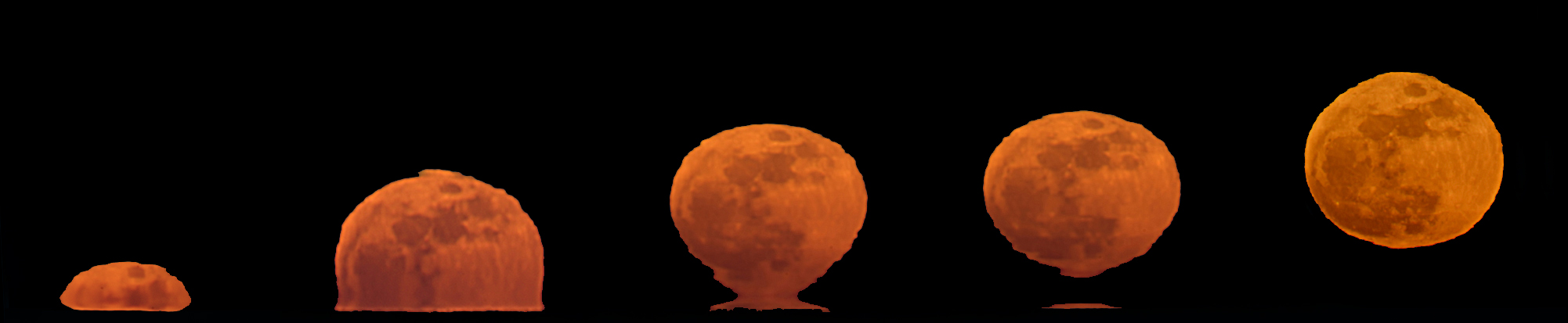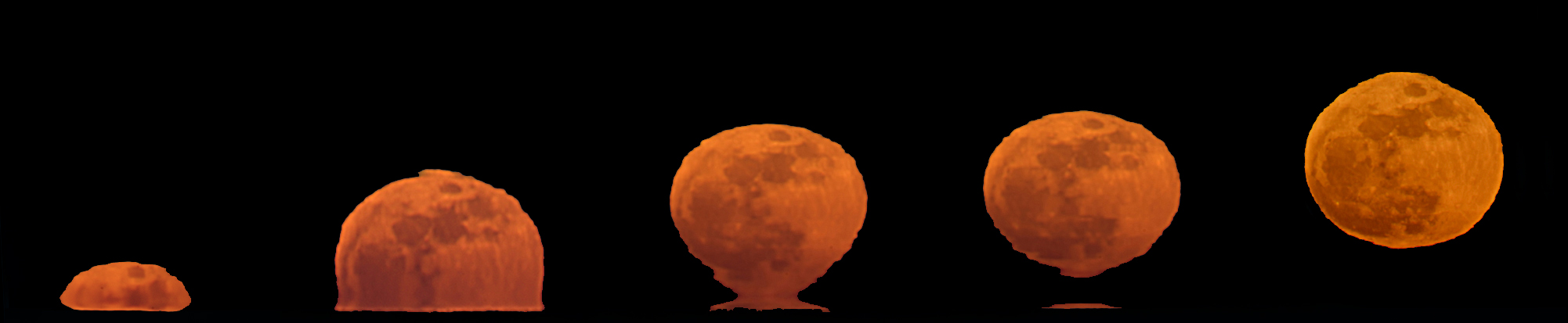
What's happened to the Moon? Nothing, although from some locations, February's full moon, which occurred about two weeks ago, appeared strangely distorted as it rose. Visible in particular was a curiously inverted image section pinched off near the horizon, an effect dubbed the Etruscan vase by the pioneering science fiction writer Jules Verne for its familiar shape. This odd moon image piece was created by moonlight refracting through an atmospheric inversion layer on Earth where cold air was trapped near the surface. The photographer also reported that, as the moon rose, a red rim was faintly visible on the lower part of the moon, while a green rim appeared on the top. Similar to the Sun's famous green flash, these effects arise when the Earth's atmosphere acts like a prism, sending different colors of light on slightly different paths. The above image mosaic has been horizontally compressed by computer to fit a standard screen.
¿Qué le ha sucedido a la Luna? Nada, aunque desde algunas ubicaciones, la luna llena de febrero, que ocurrió hace aproximadamente dos semanas, pareció extrañamente distorsionada al elevarse. Lo más visible fue una imagen invertida curiosamente separada cerca del horizonte, un efecto denominado jarrón etrusco por el escritor de ciencia ficción Jules Verne por su forma característica. Esta imagen lunar peculiar fue creada por la refracción de la luz lunar a través de una capa de inversión atmosférica en la Tierra donde aire frío quedó atrapado cerca de la superficie. El fotógrafo también informó que, conforme la luna se elevaba, un borde rojo fue débilmente visible en la parte inferior de la luna, mientras que un borde verde apareció en la parte superior. Similar al famoso destello verde del Sol, estos efectos surgen cuando la atmósfera de la Tierra actúa como un prisma, enviando diferentes colores de luz por trayectorias ligeramente diferentes. El mosaico de imagen anterior ha sido comprimido horizontalmente por computadora para ajustarse a una pantalla estándar.