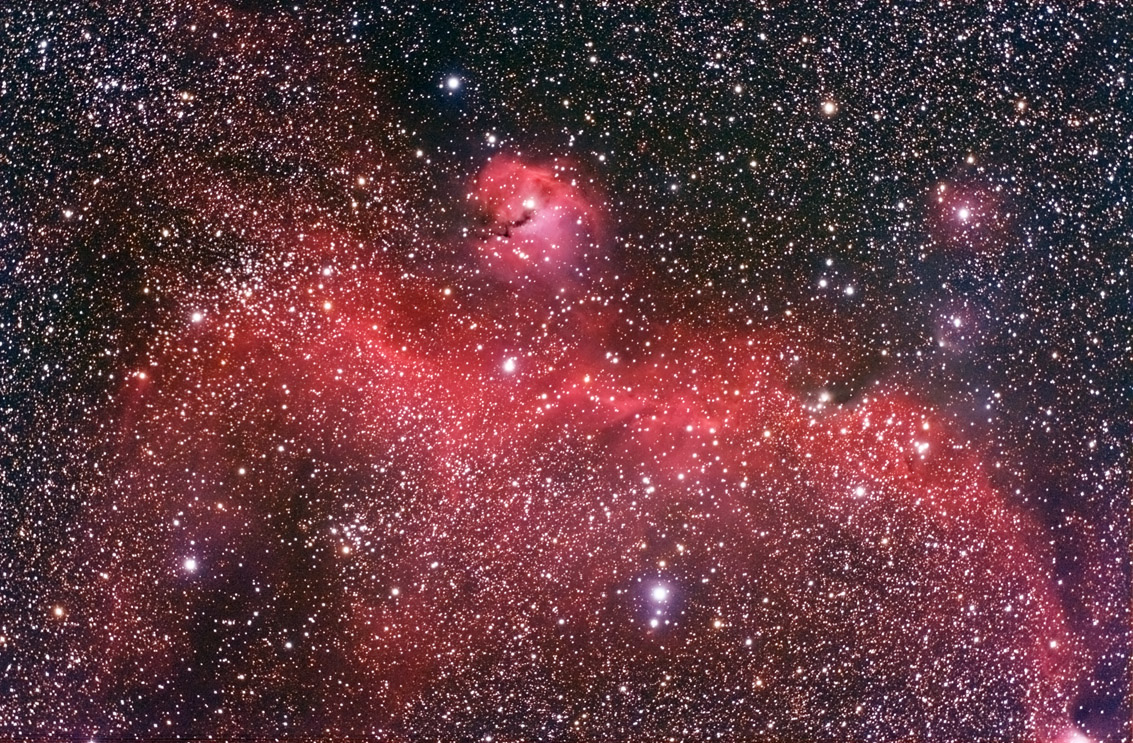
Images from two different cameras, a digital SLR and an astronomical CCD camera, are combined in this color starscape. Both cameras made use of the same telescope at the oceanside Winter Star Party in the Florida Keys, appropriately creating this portrait of the Seagull Nebula. The wide view covers a 4x3 degree swath across the plane of the Milky Way, near the direction of Sirius, alpha star of the constellation Canis Major. Of course, the broad region includes objects with other catalog designations: notably NGC 2327 - a compact, dusty emission region with an embedded massive star that forms the bird's head (above center), and IC 2177 - forming the sweeping arc of the seagull's wings. Dominated by the reddish glow of atomic hydrogen, the complex of cosmic gas and dust clouds with bright young stars spans over 250 light-years at an estimated 3,800 light-year distance.
Imágenes obtenidas con dos cámaras diferentes, una cámara digital SLR y una cámara CCD astronómica, se combinan en esta escena estelar en color. Ambas cámaras utilizaron el mismo telescopio durante la Winter Star Party en la costa del océano en los Florida Keys, creando adecuadamente este retrato de la Nebulosa Cisne. La vista amplia abarca un área de 4x3 grados a lo largo del plano de la Vía Láctea, cerca de la dirección de Sirio, la estrella alfa de la constelación de Canis Major. Por supuesto, la amplia región incluye objetos con otras designaciones de catálogo: notablemente NGC 2327, una región compacta y polvorienta de emisión con una estrella masiva incrustada que forma la cabeza del pájaro (arriba del centro), y IC 2177, que forma el arco amplio de las alas del cisne. Dominada por el resplandor rojizo del hidrógeno atómico, la compleja nube de gas y polvo cósmico con estrellas jóvenes brillantes abarca más de 250 años luz a una distancia estimada de 3.800 años luz.