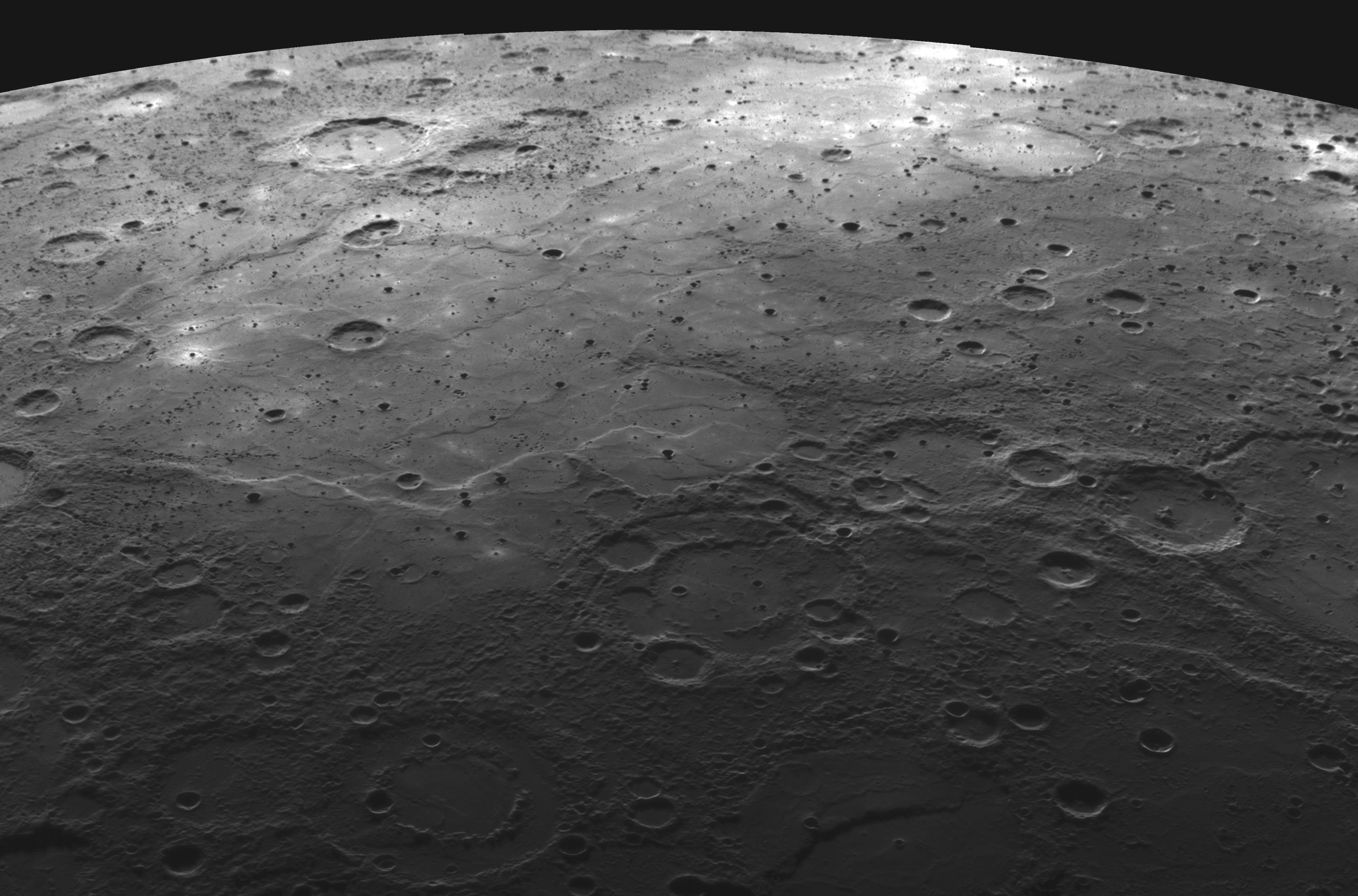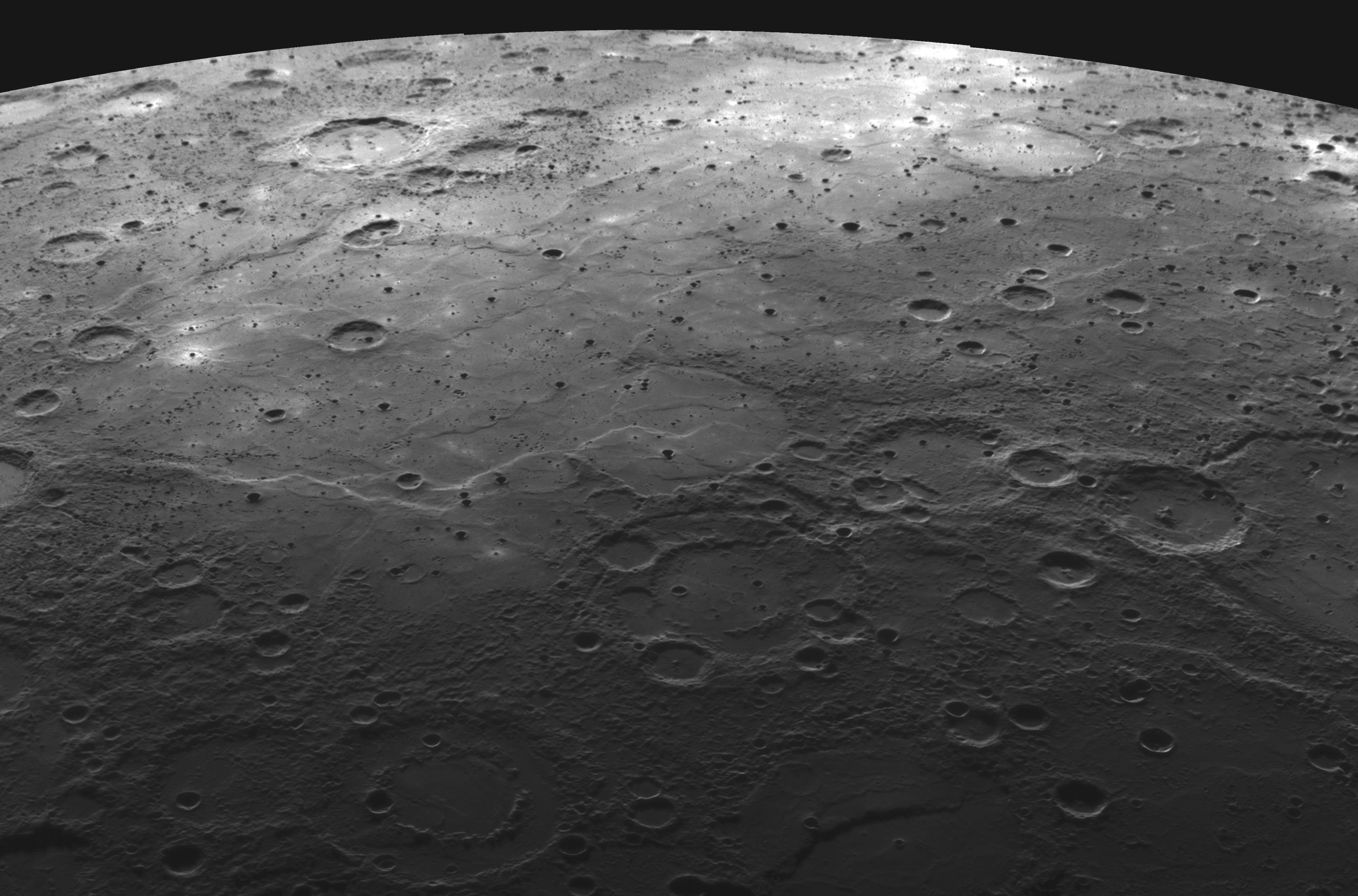
Why are many large craters on Mercury relatively smooth inside? Recent images from the robotic MESSENGER spacecraft that flew by Mercury last October show previously uncharted regions of Mercury that have large craters with an internal smoothness similar to the maria on Earth's own Moon. Therefore, like our Moon's maria, these craters on Mercury are thought to have been flooded by lava floes that are old but not as old as the surrounding more highly cratered surface. The above image mosaic of the western limb of Mercury was created by MESSENGER as it approached the Solar System's innermost planet last October. Old and heavily textured terrain runs across much of the image bottom, while across the middle left lies comparatively smooth impact basins where small craters may appear similar at first to protruding hills. MESSENGER will buzz past Mercury again later this year before entering orbit in 2011.
¿Por qué son muchos de los grandes cráteres de Mercurio relativamente suaves por dentro? Imágenes recientes obtenidas por la nave espacial robótica MESSENGER, que realizó un sobrevuelo de Mercurio en octubre pasado, muestran regiones previamente no mapeadas del planeta que presentan grandes cráteres con una suavidad interna similar a las maria de la Luna de la Tierra. Por lo tanto, al igual que las maria de nuestra Luna, se cree que estos cráteres en Mercurio fueron inundados por corrientes de lava antiguas, pero no tan antiguas como la superficie circundante, que está más impactada y con mayor densidad de cráteres. El mosaico de la imagen de la porción occidental del limbo de Mercurio fue creado por MESSENGER mientras se acercaba al planeta más interior del Sistema Solar en octubre pasado. El terreno antiguo y muy texturado se extiende por gran parte de la parte inferior de la imagen, mientras que en la parte izquierda central se encuentran cuencas de impacto relativamente suaves, donde pequeños cráteres pueden parecer inicialmente similares a colinas salientes. MESSENGER realizará otro sobrevuelo de Mercurio a finales de este año antes de entrar en órbita en 2011.