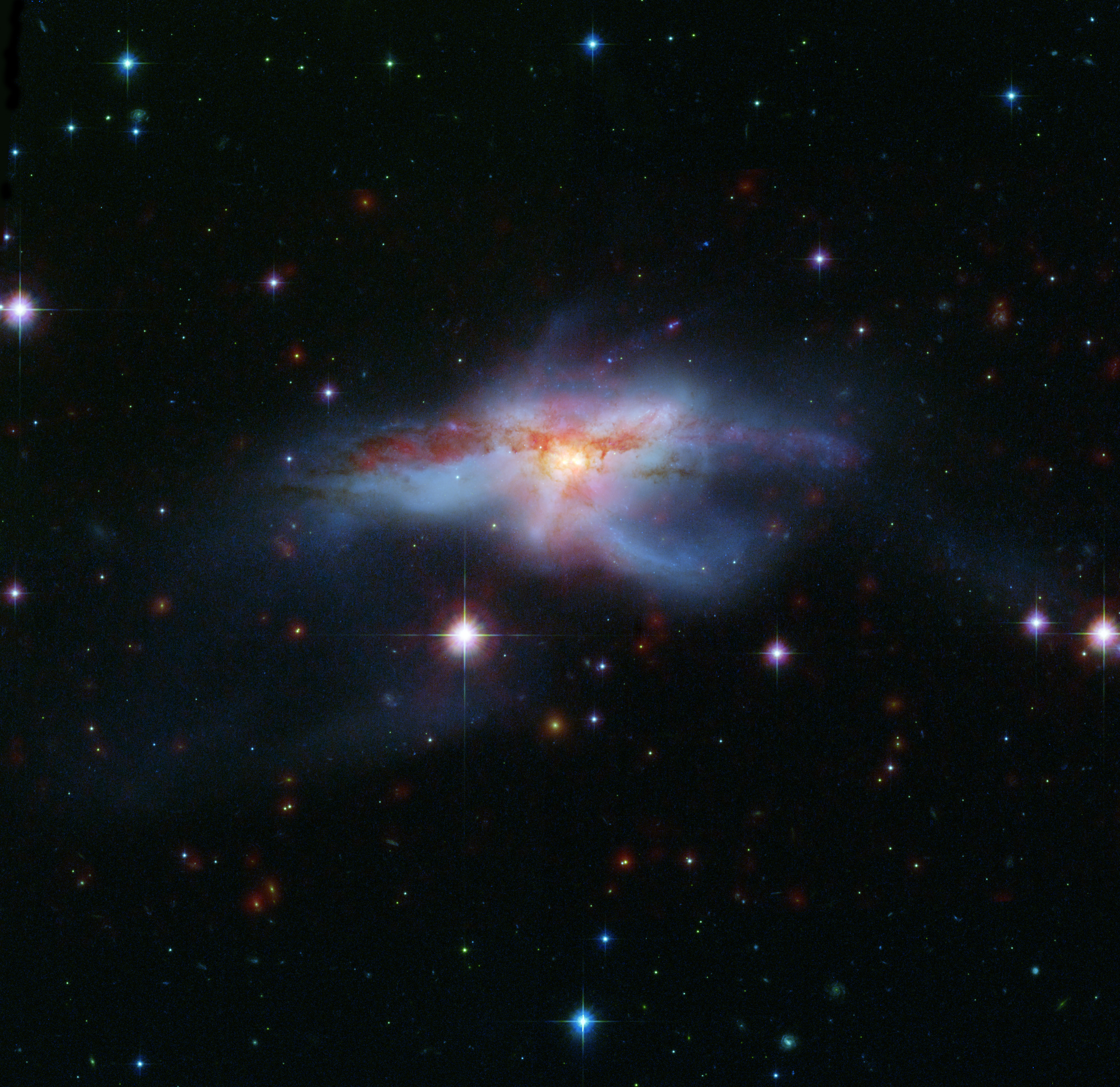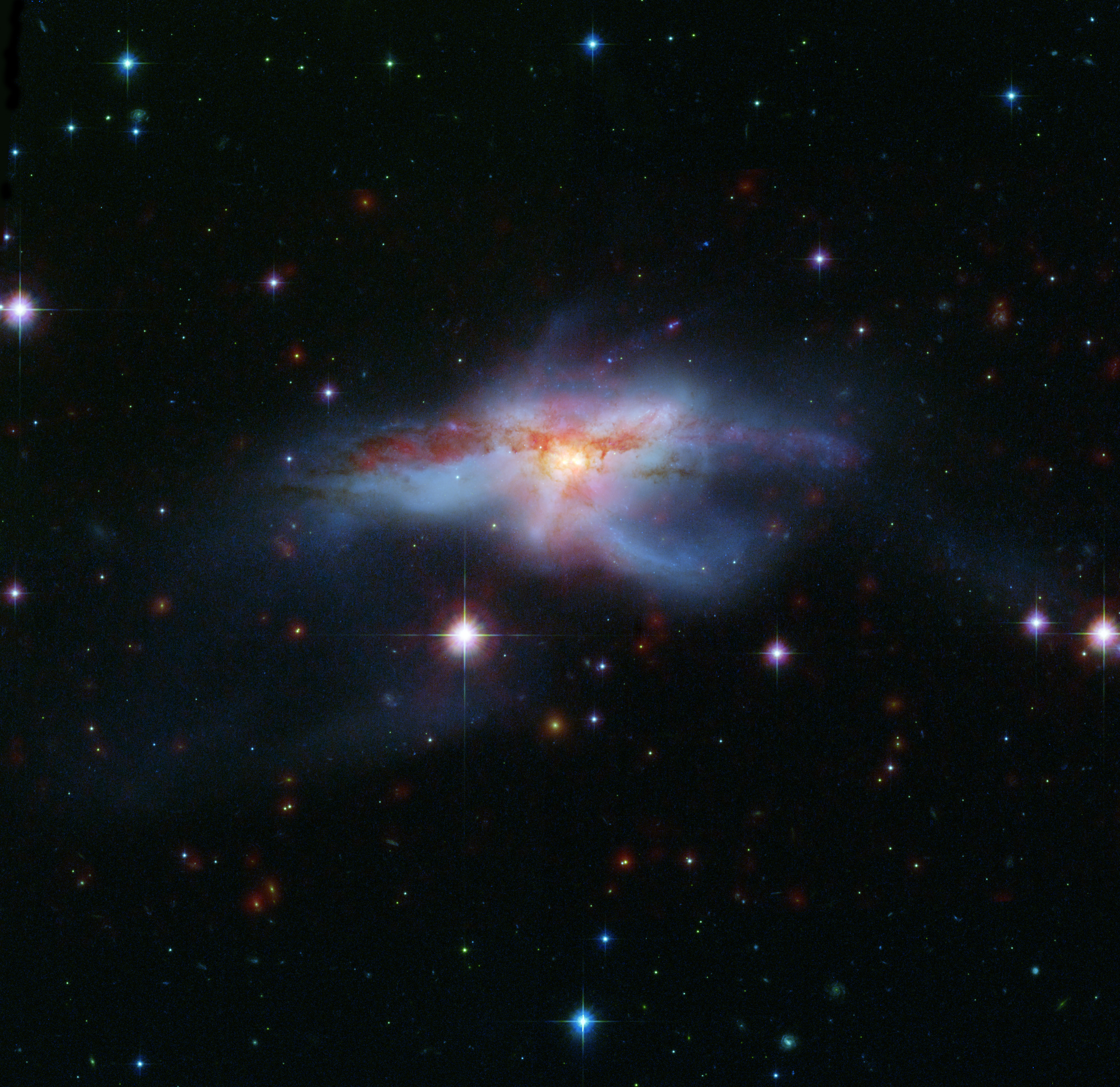
NGC 6240 offers a rare glimpse of a cosmic catastrophe in its final throes. The titanic galaxy-galaxy collision is located a mere 400 million light-years away in the constellation Ophiuchus. One of the brightest sources in the infrared sky, the merging galaxies spew distorted tidal tails of stars, gas, and dust and undergo frantic bursts of star formation. The two supermassive black holes in the original galactic cores will also coalesce into a single, even more massive black hole. Soon, only one large galaxy will remain. This dramatic image of the scene is a multiwavelength composite; red colors trace infrared emission from dust recorded by the Spitzer Space Telescope, with Hubble visible light images of stars and gas in green and blue hues. The view spans over 300,000 light-years at the estimated distance of NGC 6240.
NGC 6240 ofrece una visión inusual de una catástrofe cósmica en sus últimas etapas. Esta colisión galáctica de dimensiones titánicas tiene lugar a solo 400 millones de años luz de distancia, en la constelación de Ofiuco. Una de las fuentes más brillantes del cielo en el rango infrarrojo, las galaxias en proceso de fusión expulsan colas distorsionadas de estrellas, gas y polvo, y experimentan violentos brotes de formación estelar. Los dos agujeros negros supermasivos que se encontraban en los núcleos originales de las galaxias también se fusionarán en un solo agujero negro aún más masivo. Pronto, solo quedará una gran galaxia. Esta imagen dramática del escenario es una composición de múltiples longitudes de onda; los tonos rojos representan emisiones infrarrojas del polvo registradas por el Telescopio Espacial Spitzer, mientras que las imágenes ópticas del Telescopio Espacial Hubble de estrellas y gas aparecen en tonos verdes y azules. La imagen abarca más de 300 000 años luz a la distancia estimada de NGC 6240.