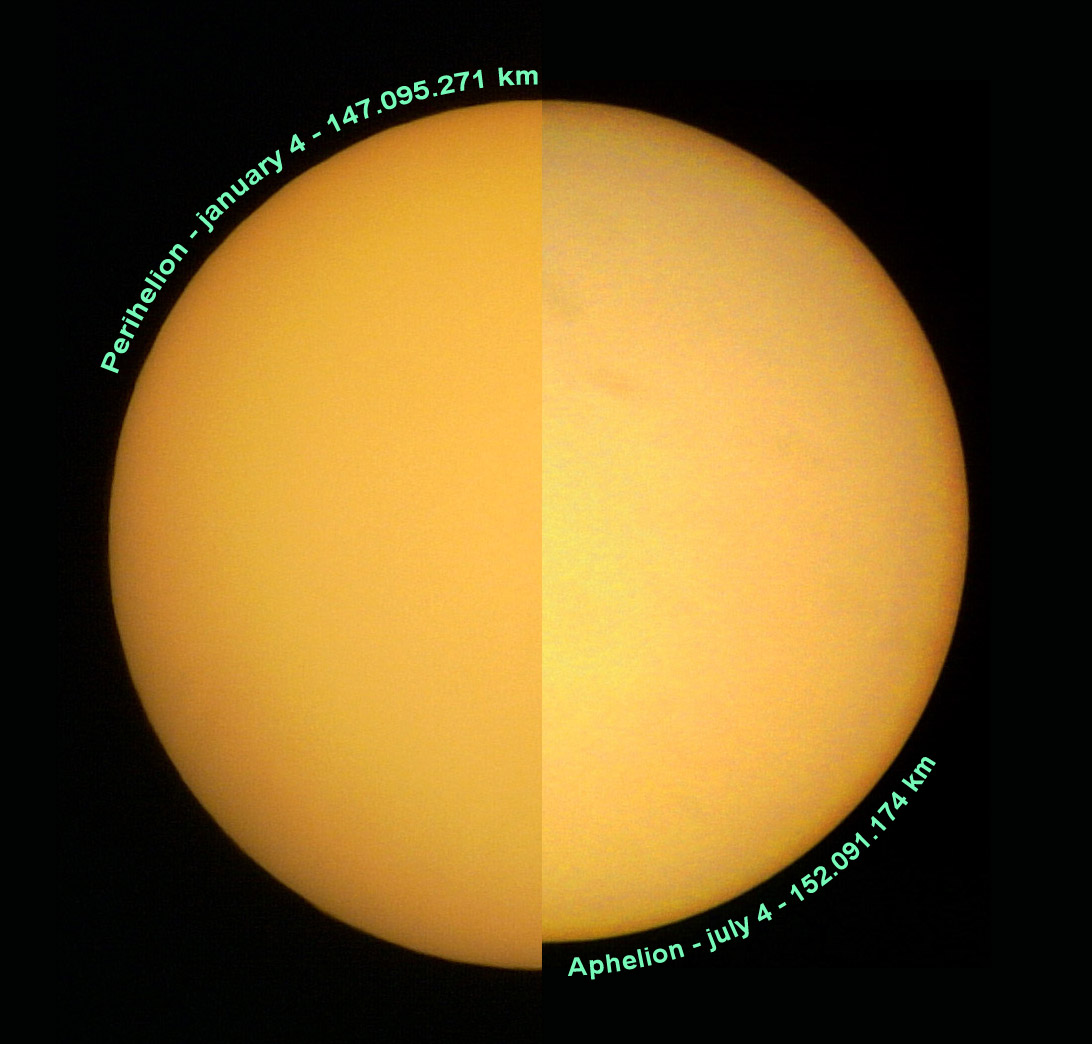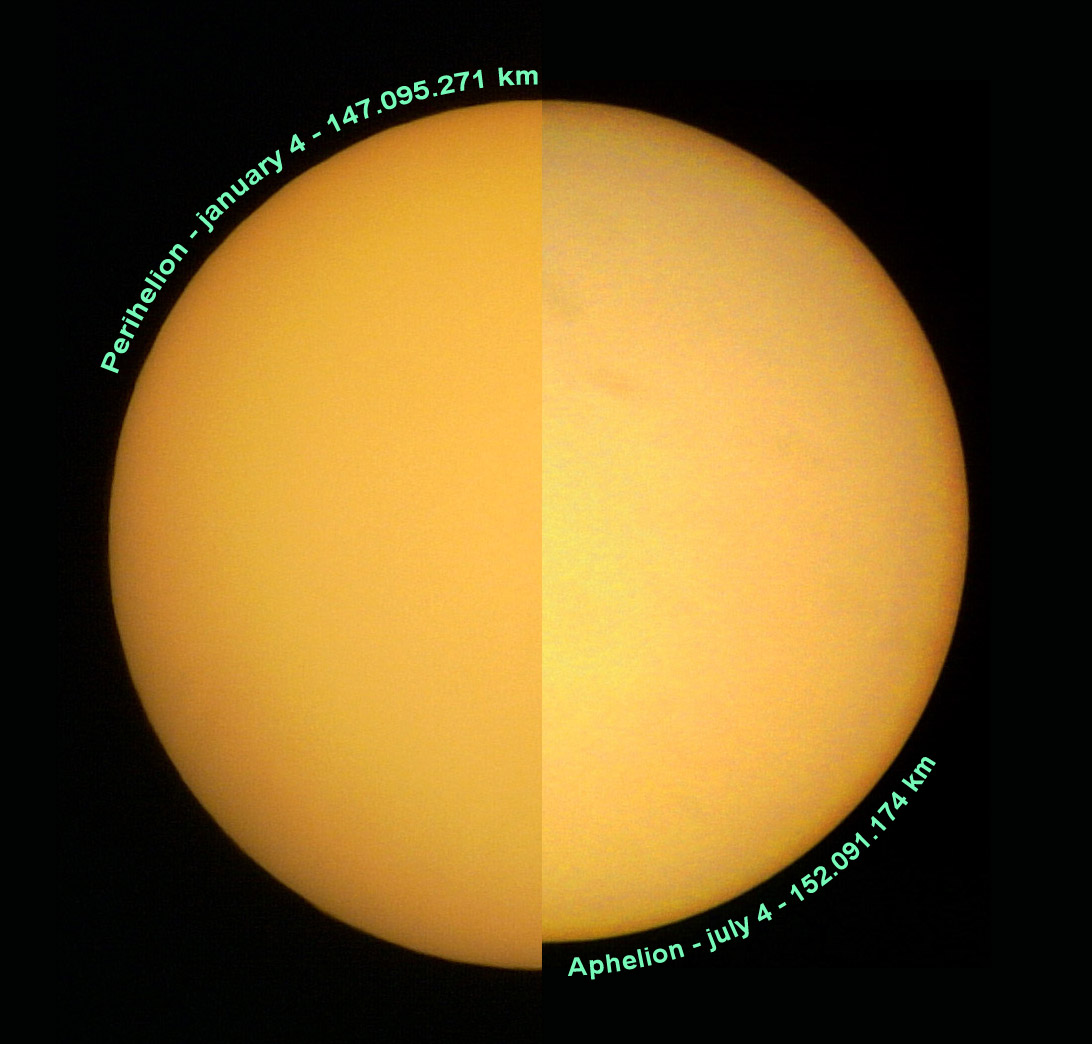
This year Aphelion, the point in Earth's elliptical orbit when it is farthest from the Sun, occurs tomorrow, July 4th. Of course, that doesn't affect the seasons on our fair planet. Those are determined by the tilt of Earth's axis of rotation and not Earth's distance from the Sun, so July is still winter in the south and summer in northern hemisphere. But it does mean that on July 4th the Sun will be at its smallest apparent size. This composite neatly compares two pictures of the Sun taken with the same telescope and camera on the dates of Perihelion (closest approach) and Aphelion in 2008. The image labels include Earth's distance in kilometers from the Sun on the two dates. Otherwise difficult to notice, the change in the Sun's apparent diameter between Perihelion and Aphelion is clear. The difference amounts to a little over 3 percent.
Este año, el Afelio, el punto en la órbita elíptica de la Tierra cuando está más alejada del Sol, ocurrirá mañana, el 4 de julio. Por supuesto, eso no afecta las estaciones en nuestro planeta. Estas están determinadas por la inclinación del eje de rotación de la Tierra y no por la distancia de la Tierra al Sol, por lo que julio sigue siendo invierno en el hemisferio sur y verano en el hemisferio norte. Pero eso sí significa que el 4 de julio el Sol tendrá su tamaño aparente más pequeño. Esta imagen compuesta compara claramente dos fotografías del Sol tomadas con el mismo telescopio y cámara en las fechas del Perihelio (acercamiento más cercano) y del Afelio en 2008. Las etiquetas de las imágenes incluyen la distancia de la Tierra al Sol en kilómetros en esas dos fechas. De lo contrario difícil de notar, el cambio en el diámetro aparente del Sol entre el Perihelio y el Afelio es claramente visible. La diferencia asciende a un poco más del 3 por ciento.