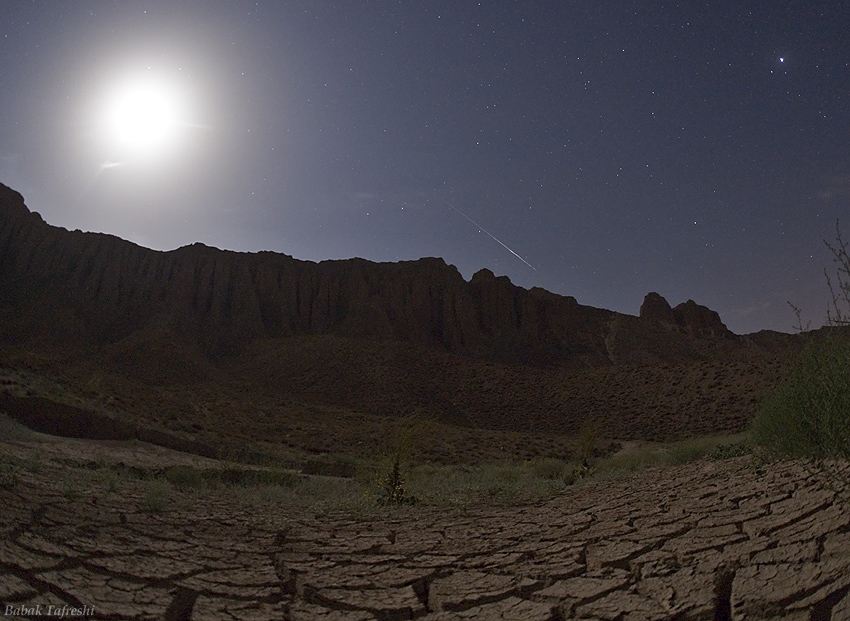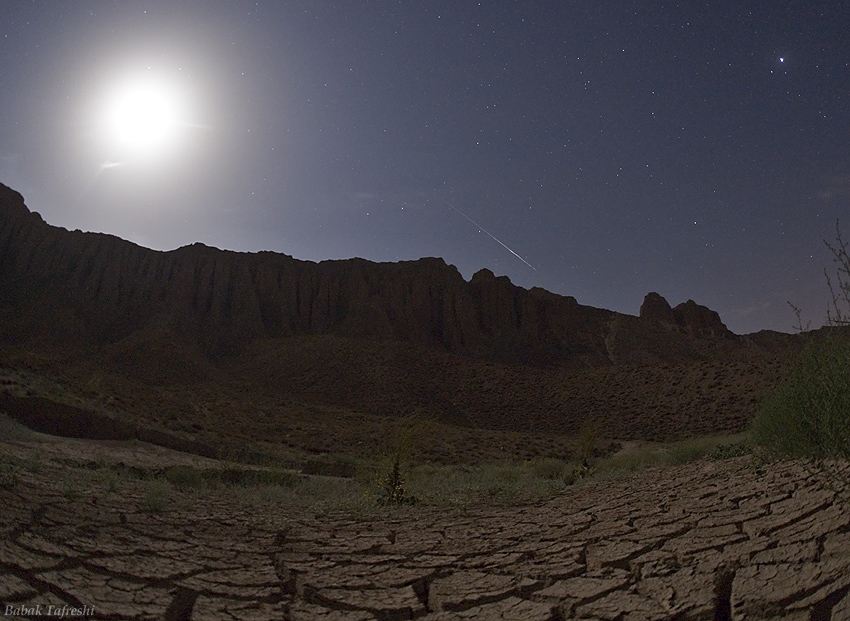
Dark skies are favored for viewing meteor showers. But the annual Perseid Meteor Shower still entertained skygazers around the world this week even though the Moon brightened the night. At its last quarter phase and rising around midnight on August 13, after the shower's anticipated peak, the Moon is seen here above rock formations in the Alborz Mountains near Firouzkooh, Iran. With a dramatic desert landscape in the foreground, a Perseid meteor is streaking through the moonlit sky between the overexposed Moon and bright planet Jupiter at the upper right. A regular celestial event in the northern hemisphere, the Perseid Meteor Shower is caused by planet Earth's yearly passage through the dust stream cast off by comet Swift-Tuttle.
Los cielos oscuros son preferidos para observar las lluvias de meteoritos. Pero la Lluvia de Meteoritos de las Perseidas aún entretuvo a los observadores del cielo en todo el mundo esta semana, a pesar de que la Luna aclaró la noche. En su fase de cuarto menguante y apareciendo alrededor de la medianoche del 13 de agosto, después del pico esperado de la lluvia, la Luna se ve aquí sobre formaciones rocosas en los Montes Alborz cerca de Firouzkooh, Irán. Con un paisaje desértico dramático en primer plano, un meteorito de las Perseidas atraviesa el cielo iluminado por la luna entre la Luna sobreexposta y el brillante planeta Júpiter en la parte superior derecha. Un evento celestial regular en el hemisferio norte, la Lluvia de Meteoritos de las Perseidas es causada por el paso anual de la Tierra a través del flujo de polvo expulsado por el cometa Swift-Tuttle.