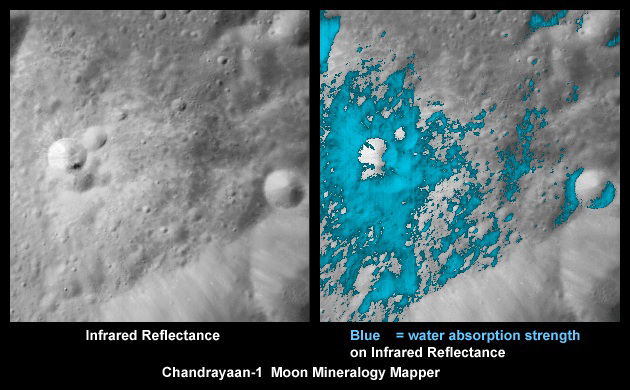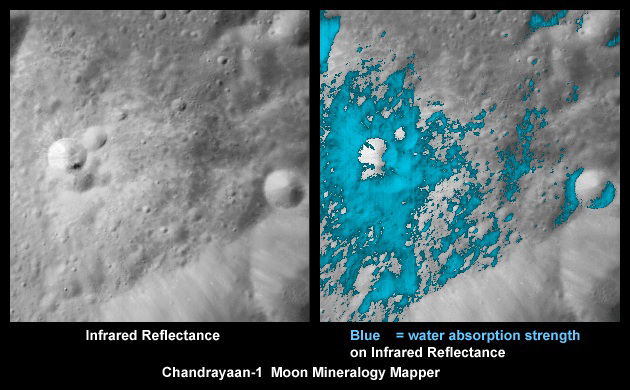
Water has been discovered on the surface of the Moon. No lakes have been found, but rather NASA's Moon Mineralogy Mapper aboard India's new Chandrayaan-1 lunar orbiter radios back that parts of the Moon's surface absorb a very specific color of light identified previously only with water. Currently, scientists are trying to fit this with other facts about the Moon to figure out how much water is there, and even what form this water takes. Unfortunately, even the dampest scenarios leave our moon dryer than the driest of Earth's deserts. A fascinating clue being debated is whether the water signal rises and falls during a single lunar day. If true, the signal might be explainable by hydrogen flowing out from the Sun and interacting with oxygen in the lunar soil. This could leave an extremely thin monolayer of water, perhaps only a few molecules thick. Some of the resulting water might subsequently evaporate away in bright sunlight. Pictured above, the area near a crater on the far side of the Moon shows a relatively high abundance of water-carrying minerals in false-color blue. Next week, the new LCROSS satellite will release an impactor that will strike a permanently shadowed crater near the lunar south pole to see if any hidden water or ice sprays free there.
Se ha descubierto agua en la superficie de la Luna. No se han encontrado lagos, sino que el Observador Mineralógico de la Luna de la NASA a bordo del nuevo satélite lunar indio Chandrayaan-1 transmite que partes de la superficie lunar absorben un color muy específico de luz que previamente solo se había identificado con el agua. Actualmente, los científicos intentan encajar este hallazgo con otros hechos sobre la Luna para determinar cuánta agua hay allí, e incluso en qué forma se encuentra este agua. Desafortunadamente, incluso los escenarios más húmedos dejan nuestra luna más seca que los desiertos más áridos de la Tierra. Una pista fascinante que se debate es si la señal de agua sube y baja durante un solo día lunar. Si es cierto, la señal podría explicarse por hidrógeno que fluye desde el Sol e interactúa con oxígeno en el suelo lunar. Esto podría dejar una capa extremadamente fina de agua, quizás solo unos pocos moléculas de espesor. Alguno del agua resultante podría evaporarse posteriormente bajo la luz solar intensa. En la imagen de arriba, el área cerca de un cráter en el lado lejano de la Luna muestra una relativamente alta abundancia de minerales que contienen agua en color azul falso. La semana que viene, el nuevo satélite LCROSS liberará un impactador que golpeará un cráter permanentemente en sombra cerca del polo sur lunar para ver si sale agua o hielo oculto allí.