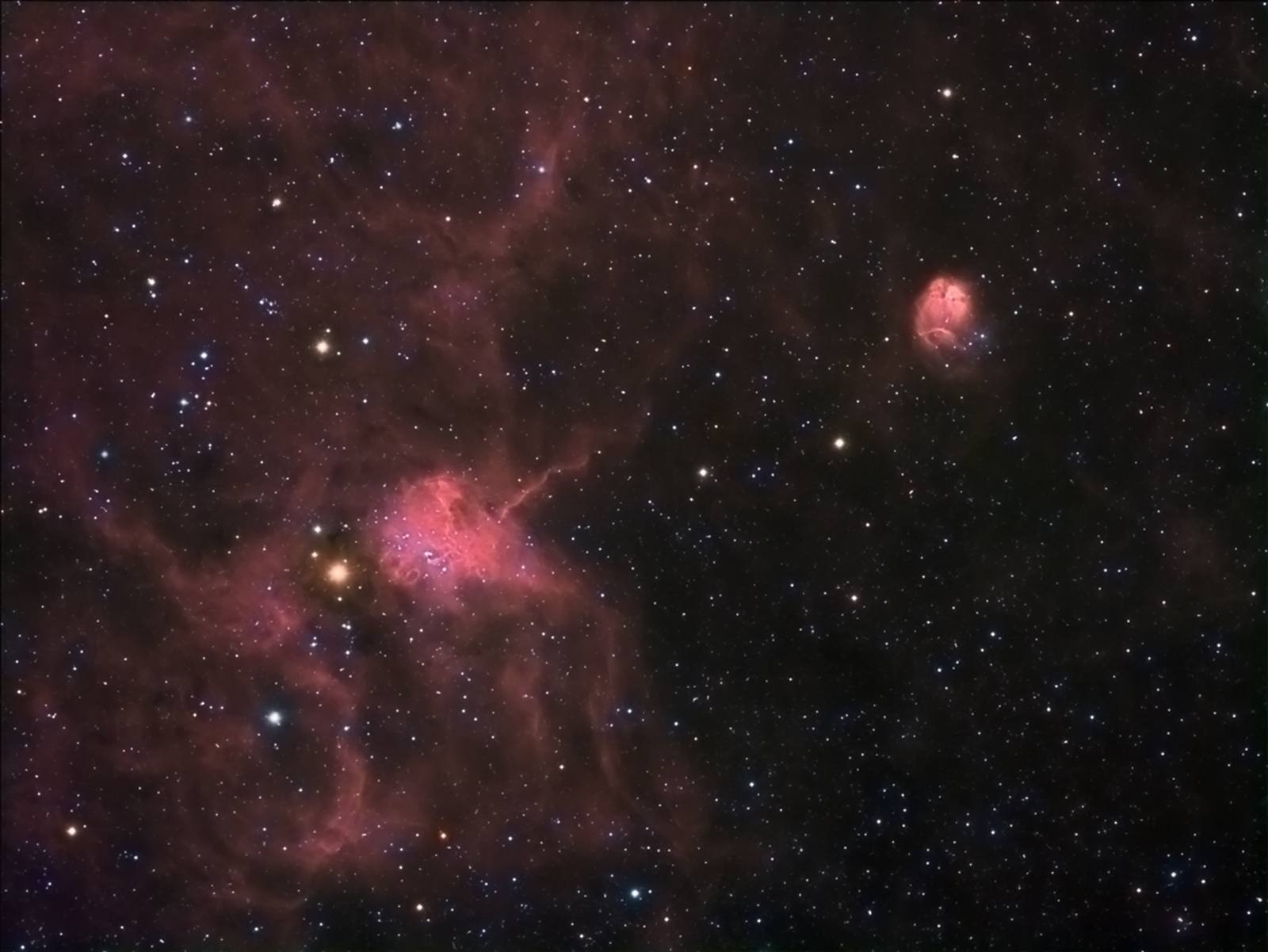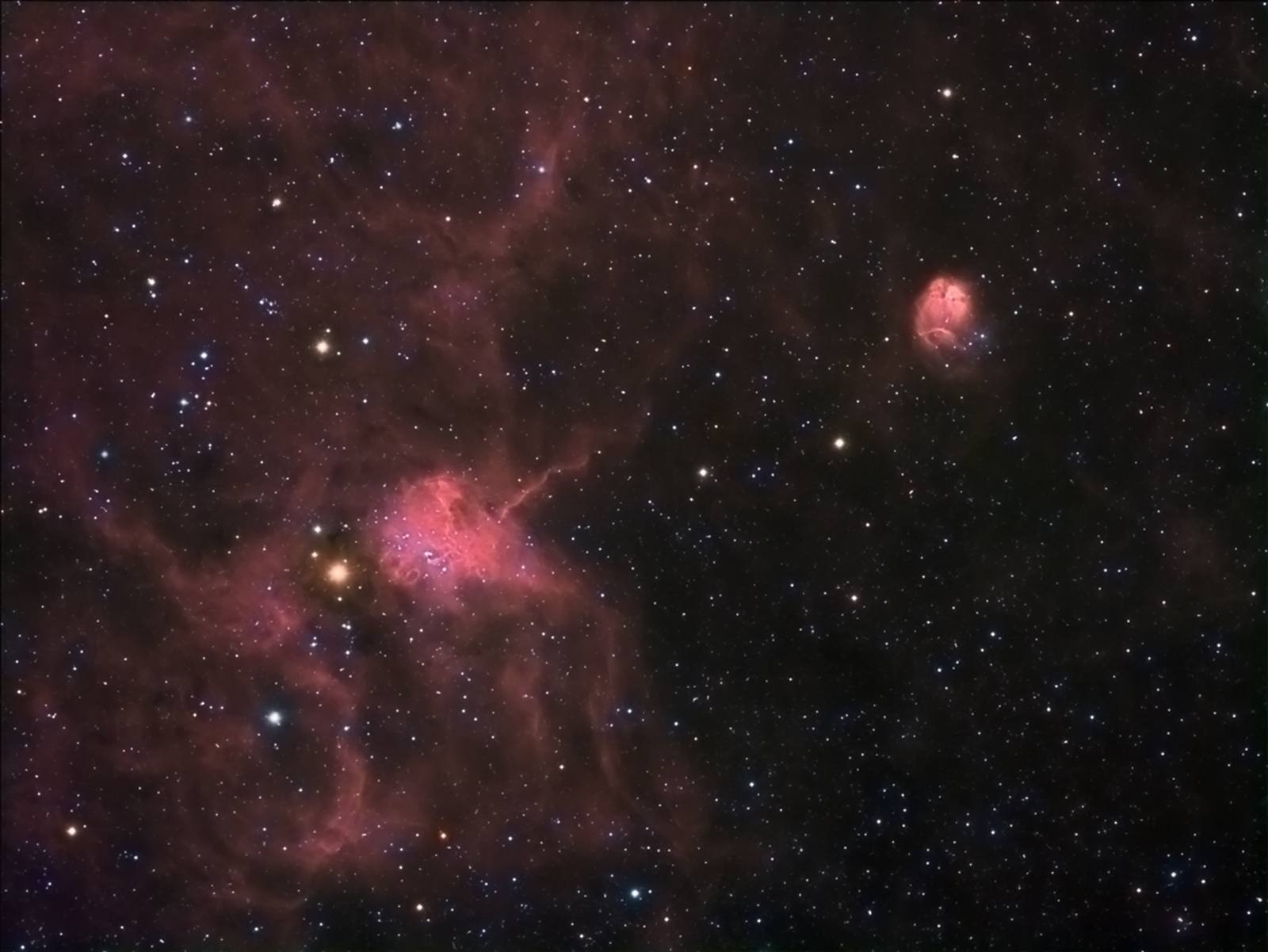
Bright clusters and nebulae abound in the ancient northern constellation of Auriga. The region includes the open star cluster M38, emission nebula IC 410 with Tadpoles, Auriga's own Flaming Star Nebula IC 405, and this interesting pair IC 417 (lower left) and NGC 1931. An imaginative eye toward the expansive IC 417 and diminutive NGC 1931 suggests a cosmic spider and fly. About 10,000 light-years distant, both represent young, open star clusters formed in interstellar clouds and still embedded in glowing hydrogen gas. For scale, the more compact NGC 1931 is about 10 light-years across. Note: An APOD editor will review great space images on Thursday, January 14, in Houghton, Michigan.
En la antigua constelación del Auriga del hemisferio norte abundan los brillantes cúmulos estelares y nebulosas. La región incluye el cúmulo estelar abierto M38, la nebulosa emisora IC 410 con sus Tadpoles, la propia nebulosa estelar incandescente IC 405 del Auriga, y este interesante par de objetos: IC 417 (inferior izquierda) y NGC 1931. Una mirada imaginativa hacia el extenso IC 417 y el diminuto NGC 1931 sugiere una araña y una mosca cósmicas. A unos 10 000 años luz de distancia, ambos representan jóvenes cúmulos estelares abiertos formados en nubes interestelares y aún incrustados en gas hidrógeno brillante. Para escala, el más compacto NGC 1931 tiene aproximadamente 10 años luz de diámetro.