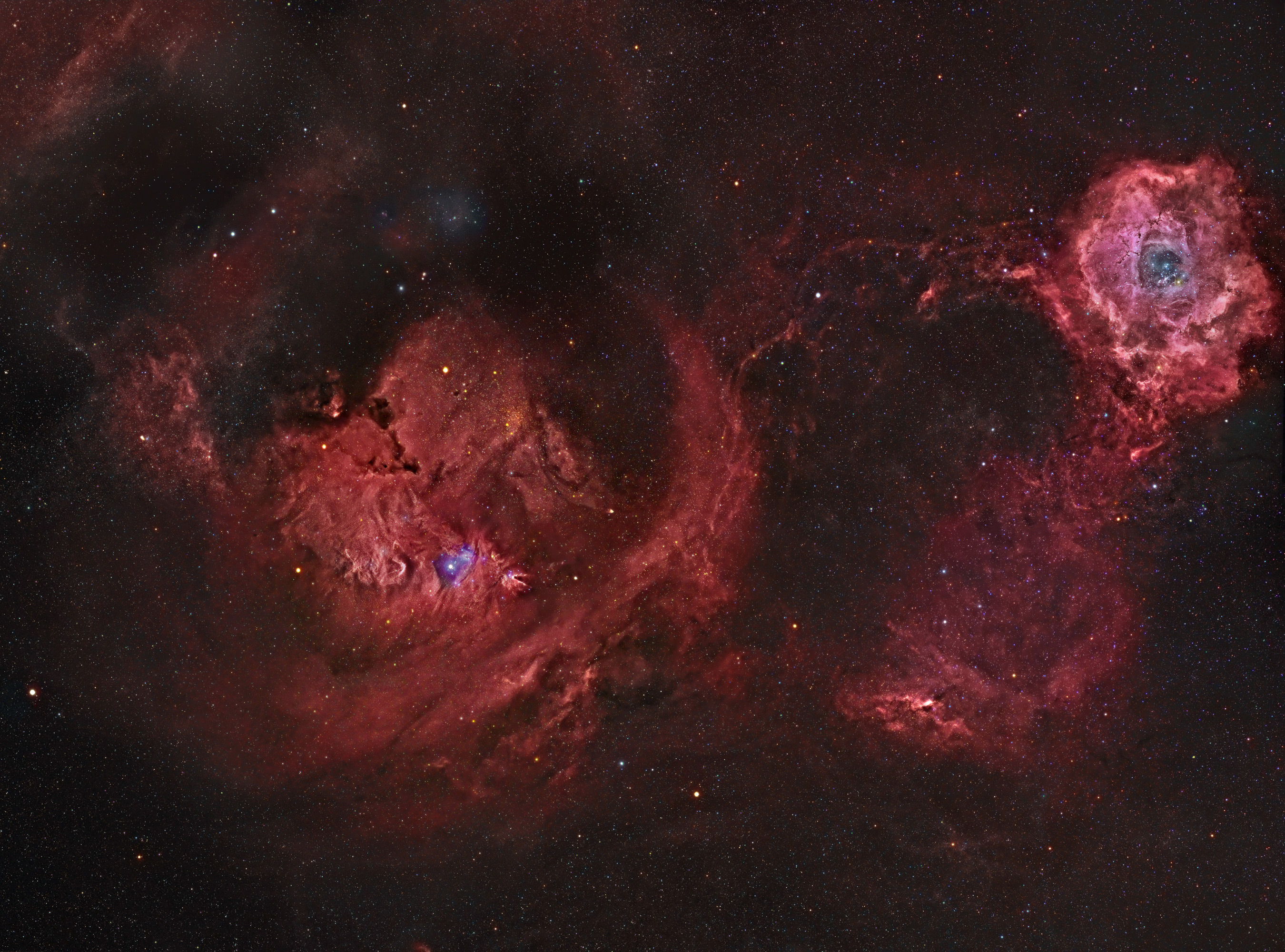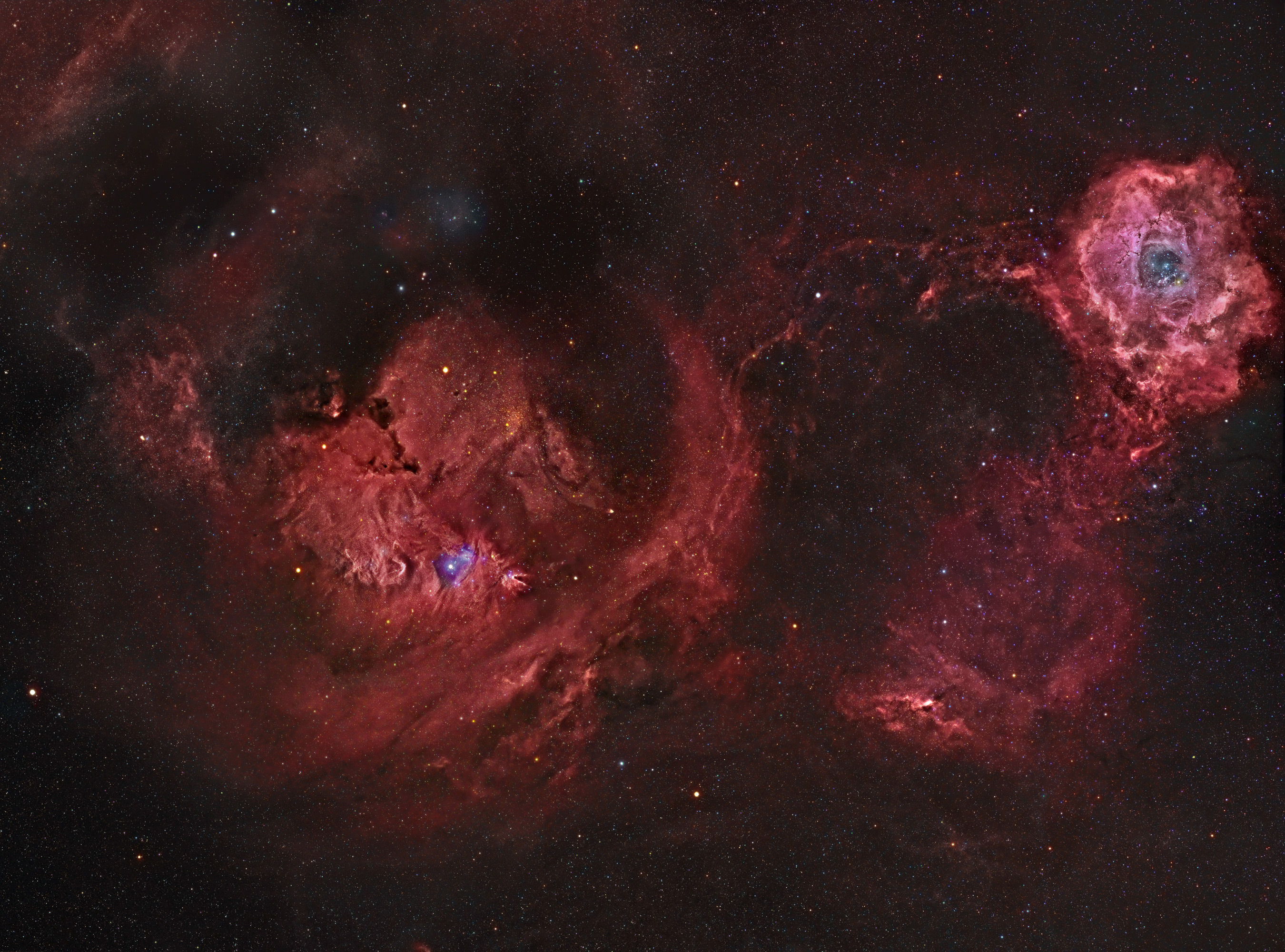
What surrounds the florid Rosette nebula? To better picture this area of the sky, the famous flowery emission nebula on the far right has been captured recently in a deep and dramatic wide field image that features several other sky highlights. Designated NGC 2237, the center of the Rosette nebula is populated by the bright blue stars of open cluster NGC 2244, whose winds and energetic light are evacuating the nebula's center. Below the famous flower, a symbol of Valentine's Day, is a column of dust and gas that appears like a rose's stem but extends hundreds of light years. Across the above image, the bright blue star just left and below the center is called S Monocerotis. The star is part of the open cluster of stars labelled NGC 2264 and known as the Snowflake cluster. To the right of S Mon is a dark pointy featured called the Cone nebula, a nebula likely shaped by winds flowing out a massive star obscured by dust. To the left of S Mon is the Fox Fur nebula, a tumultuous region created by the rapidly evolving Snowflake cluster. The Rosette region, at about 5,000 light years distant, is about twice as far away as the region surrounding S Mon. The entire field can be seen with a small telescope toward the constellation of the Unicorn (Monoceros). Note: Take an Astronomy Class Online for Free
¿Qué rodea a la nebulosa floral de la Roseta? Para comprender mejor esta región del cielo, se ha capturado recientemente en una imagen de campo amplio profunda y dramática la famosa nebulosa de emisión de aspecto floral situada en la parte inferior derecha, que incluye varios otros destinos celestes. Designada como NGC 2237, el centro de la nebulosa de la Roseta está poblado por las brillantes estrellas azules del cúmulo abierto NGC 2244, cuyos vientos y luz energética están evacuando el centro de la nebulosa. Debajo de la famosa flor, un símbolo del Día de San Valentín, se encuentra una columna de polvo y gas que parece el tallo de una rosa, pero que se extiende cientos de años luz. A lo largo de la imagen anterior, la estrella brillante situada ligeramente a la izquierda y debajo del centro se llama S Monocerotis. Esta estrella forma parte del cúmulo abierto de estrellas etiquetado como NGC 2264 y conocido como el Cúmulo Copo de Nieve. A la derecha de S Mon se encuentra una característica puntiaguda oscura llamada la Nebulosa Cono, una nebulosa probablemente moldeada por los vientos que emanan de una estrella masiva oculta por el polvo. A la izquierda de S Mon se encuentra la Nebulosa Pelaje de Zorro, una región tumultuosa creada por el rápido desarrollo del Cúmulo Copo de Nieve. La región de la Roseta, situada a unos 5000 años luz de distancia, está aproximadamente el doble de lejos que la región que rodea a S Mon. Todo el campo se puede observar con un pequeño telescopio hacia la constelación del Unicornio (Monoceros).