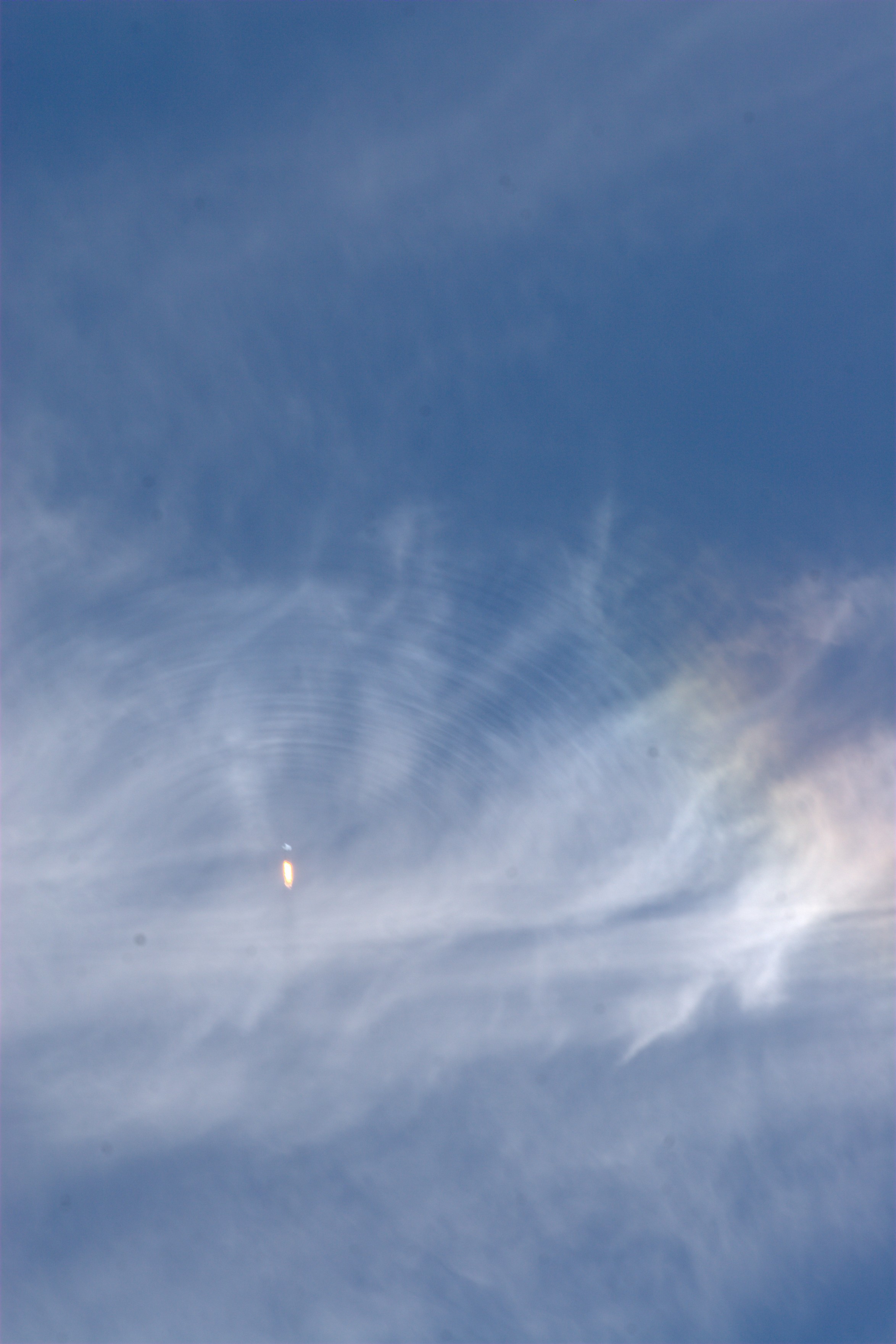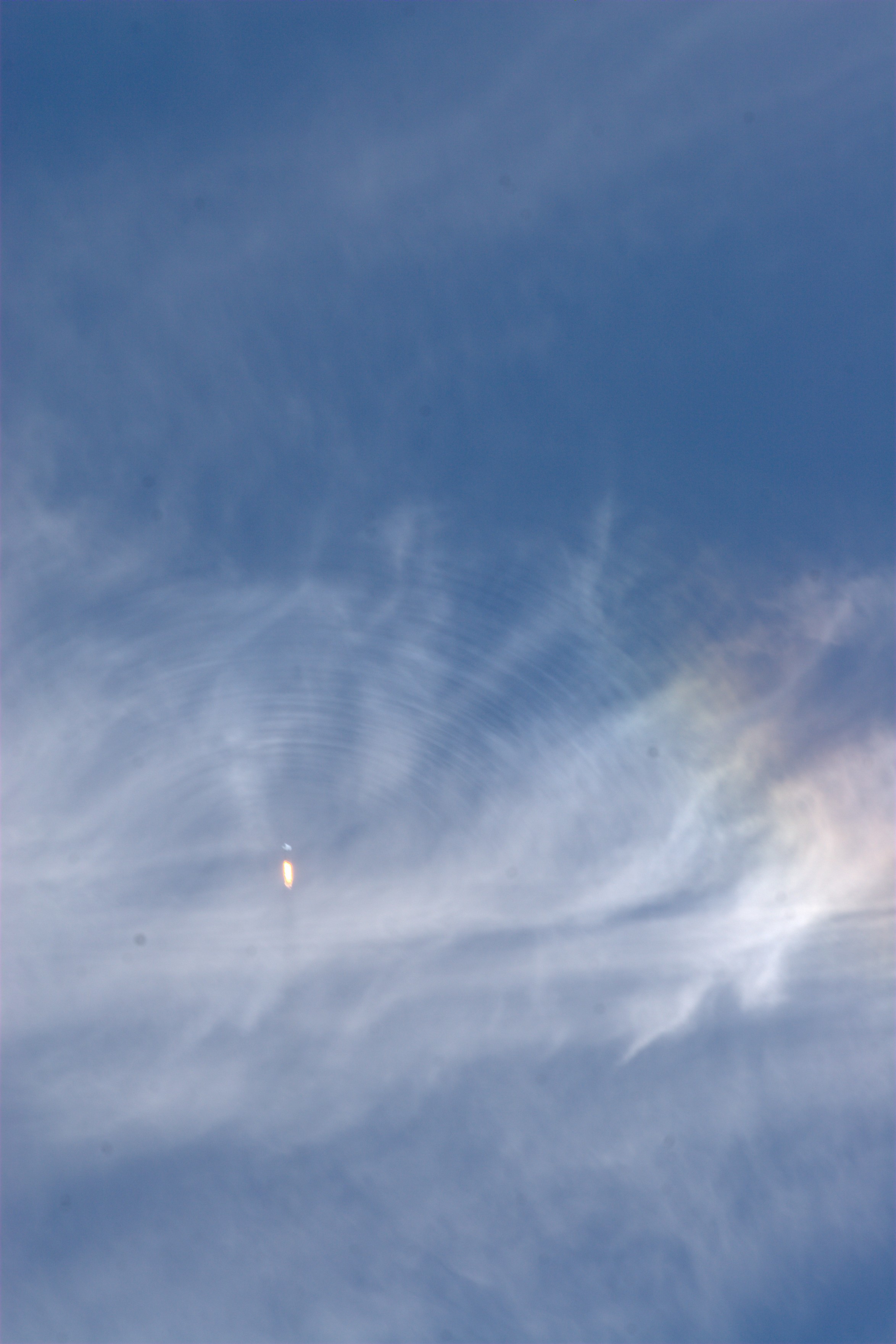
What created those rocket waves, and why did they destroy that sun dog? Close inspection of the above image shows not only a rocket rising near the center, but unusual air ripples around it and a colorful sundog to the far right. The rocket, carrying the Solar Dynamics Observatory (SDO), lifted off two weeks ago from Cape Canaveral, Florida, USA into a cold blue sky. The SDO is designed to observe the Sun continuously over the next several years, exploring the Sun's atmosphere at high resolution and fast time scales. The air ripples -- seen about one minute after launch -- were unexpected, as was the sudden disappearance of the sundog after the ripples passed. Noticed and recorded by several onlookers, there has been much speculation about the origin of the ripples. An ongoing discussion about them can be joined here in APOD's discussion board the Asterisk. A leading hypothesis holds that the ripples resulted from a sonic boom created as the rocket broke the sound barrier, which then jumbled a thin layer of ice crystals that were aligned to create the sundog. Lingering questions include why other rocket launches don't produce air ripples as noticeable, and why the ripples appeared more prominent above the rocket. If you know of images of any other aircraft or spacecraft that have produced similar air ripples, please post them to the discussion thread -- they may be help create a better understanding of the effect.
¿Qué creó esas ondas de cohetes y por qué destruyeron ese parhelio? Una inspección cercana de la imagen superior muestra no solo un cohete ascendiendo cerca del centro, sino también ondulaciones inusuales en el aire alrededor de él y un parhelio colorido a la derecha. El cohete, que transportaba la Solar Dynamics Observatory (SDO), despegó hace dos semanas desde el Cabo Cañaveral, Florida, EE.UU., hacia un cielo azul frío. La SDO está diseñada para observar continuamente al Sol durante los próximos años, explorando la atmósfera solar con alta resolución y a escalas de tiempo rápidas. Las ondulaciones del aire —visibles aproximadamente un minuto después del lanzamiento— fueron inesperadas, al igual que la desaparición repentina del parhelio después de que las ondulaciones pasaran. Varios observadores las notaron y registraron, generando muchas especulaciones sobre su origen. Una discusión en curso sobre ellas puede seguirse aquí en el foro de discusión de APOD, Asterisk. Una hipótesis principal sostiene que las ondulaciones resultaron de un boom sónico creado cuando el cohete rompió la barrera del sonido, lo que luego desordenó una fina capa de cristales de hielo alineados para crear el parhelio. Preguntas pendientes incluyen por qué otros lanzamientos de cohetes no producen ondulaciones en el aire tan notables, y por qué las ondulaciones aparecieron más prominentes sobre el cohete. Si conoces imágenes de cualquier otro avión o nave espacial que hayan producido ondulaciones similares en el aire, por favor compártelas en el hilo de discusión —podrían ayudar a crear una mejor comprensión del fenómeno.