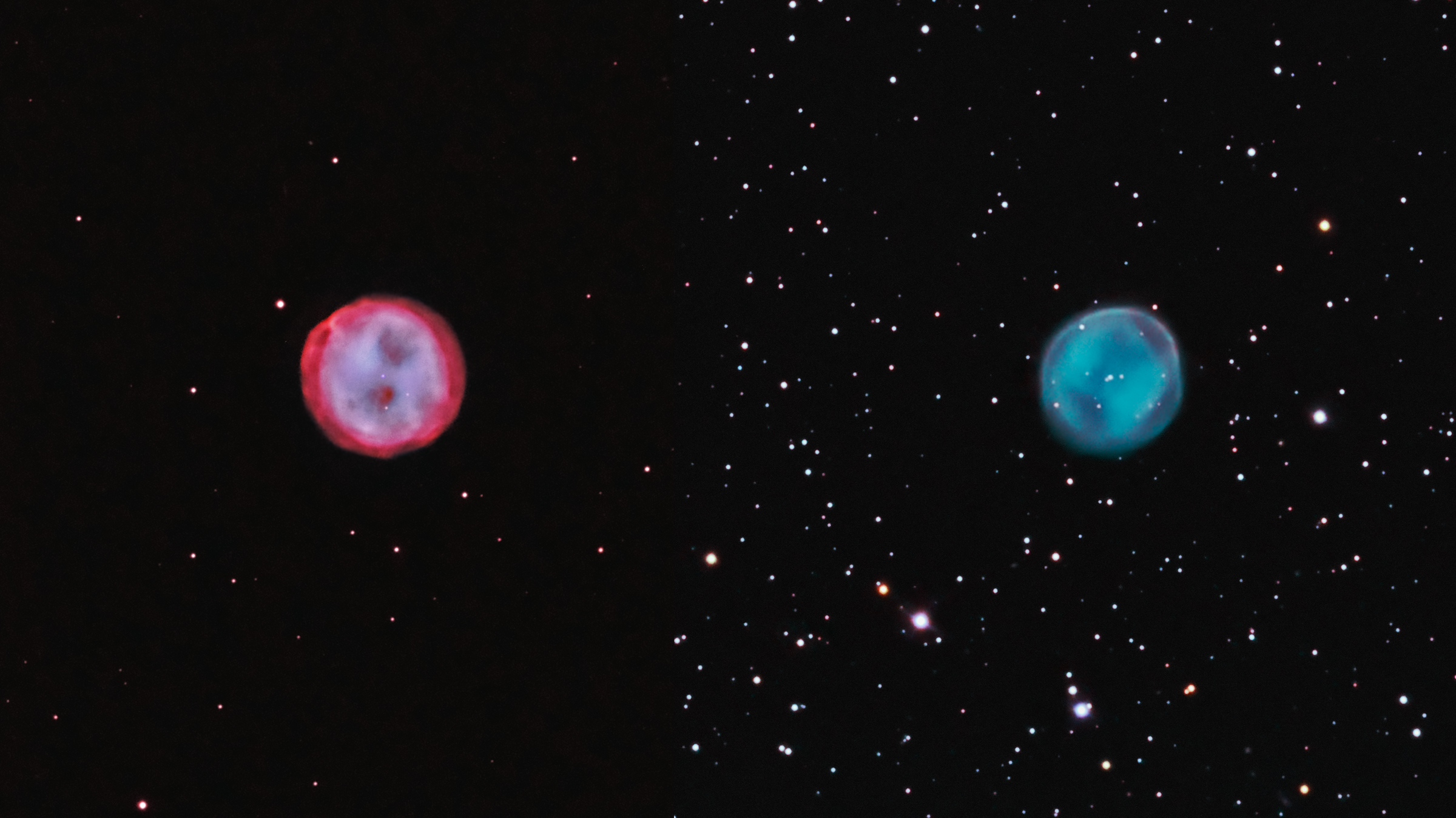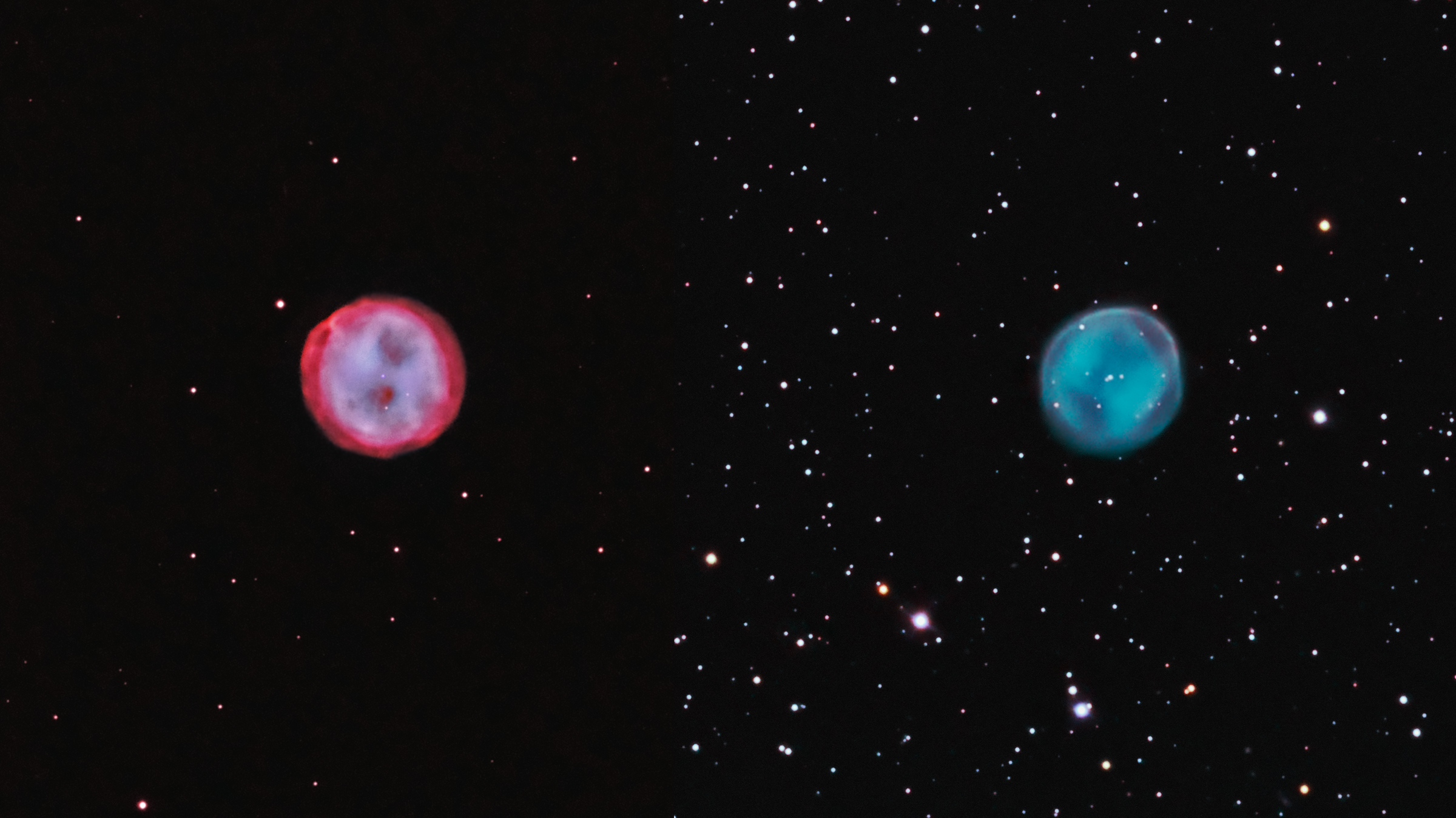
Captured in colorful telescopic portraits, two cosmic owls glare back toward planet Earth in this intriguing comparison of planetary nebulae. On the left is M97 in the constellation Ursa Major, also known in the northern hemisphere as the Owl Nebula. On the right is its visual counterpart, the southern Owl Nebula in the constellation Hydra, cataloged as PLN 283+25.1. Both nebulae are remarkably symmetric, round, and similar in size, some 2 light-years across or about 2,000 times the diameter of Neptune's orbit. Planetary nebulae are produced during a final phase in the life of a sun-like star, an example of the fate that awaits the Sun when it runs out of nuclear fuel in another 5 billion years. Both images were made using narrowband filters and different color mappings. The image of the southern Owl also includes broadband data, bringing out the surrounding star field.
Crédito: NASA, CGRO SSC Capturados en coloridas imágenes tomadas con telescopios, dos búhos cósmicos clavan su mirada hacia la Tierra en esta comparación intrigante de nebulosas planetarias. A la izquierda se encuentra la M97 en la constelación de Ursa Major, también conocida en el hemisferio norte como la Nebulosa del Búho. A la derecha está su contraparte visual, la Nebulosa del Búho del sur en la constelación de Hydra, catalogada como PLN 283+25.1. Ambas nebulosas son notablemente simétricas, redondas y similares en tamaño, con aproximadamente 2 años luz de diámetro o unos 2000 veces el diámetro de la órbita de Neptuno. Las nebulosas planetarias se forman durante una fase final en la vida de una estrella similar al Sol, un ejemplo del destino que espera al Sol cuando se agote su combustible nuclear dentro de otros 5 mil millones de años. Ambas imágenes fueron creadas utilizando filtros de banda estrecha y diferentes mapeos de color. La imagen del Búho del sur también incluye datos de banda ancha, resaltando el campo estelar circundante.