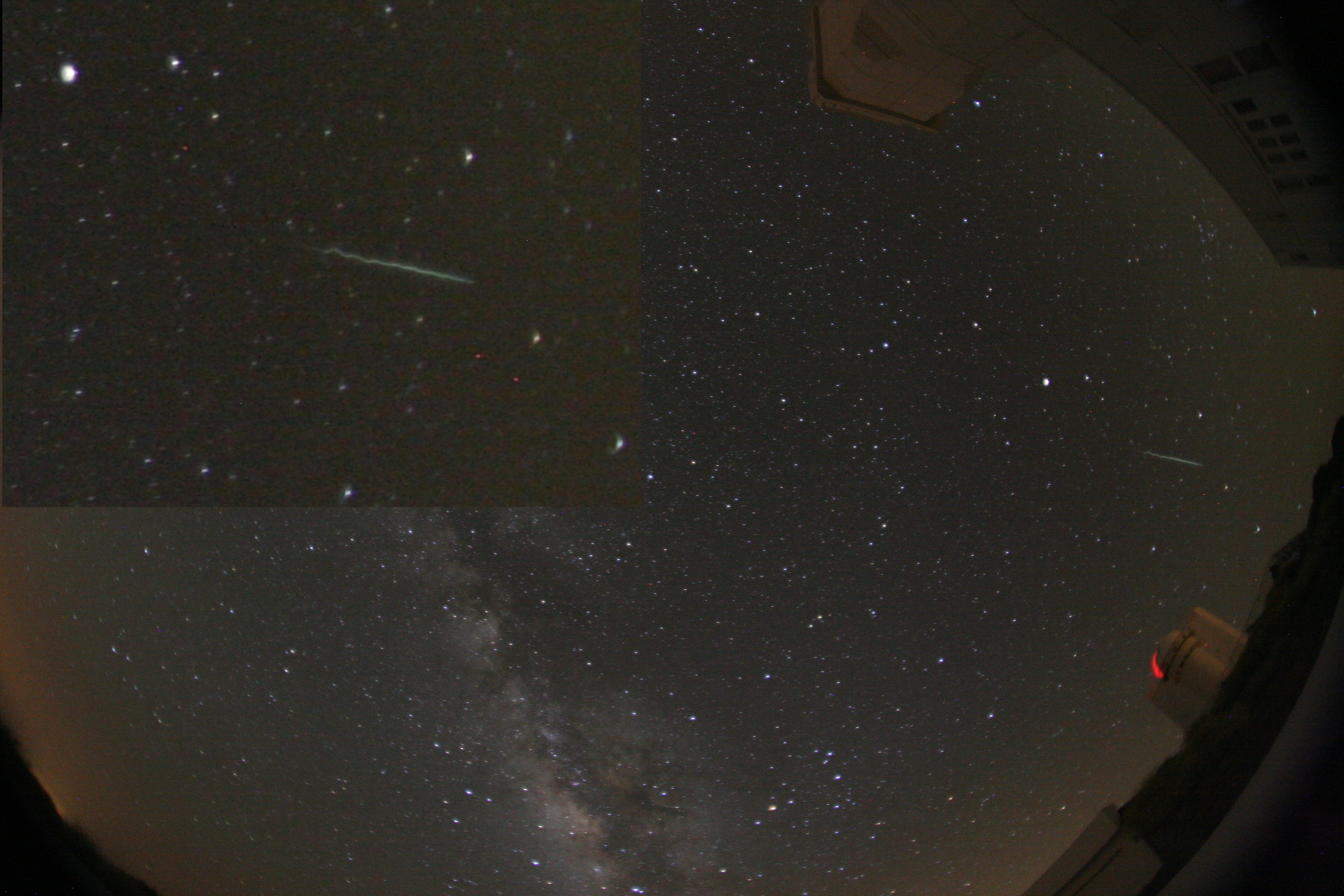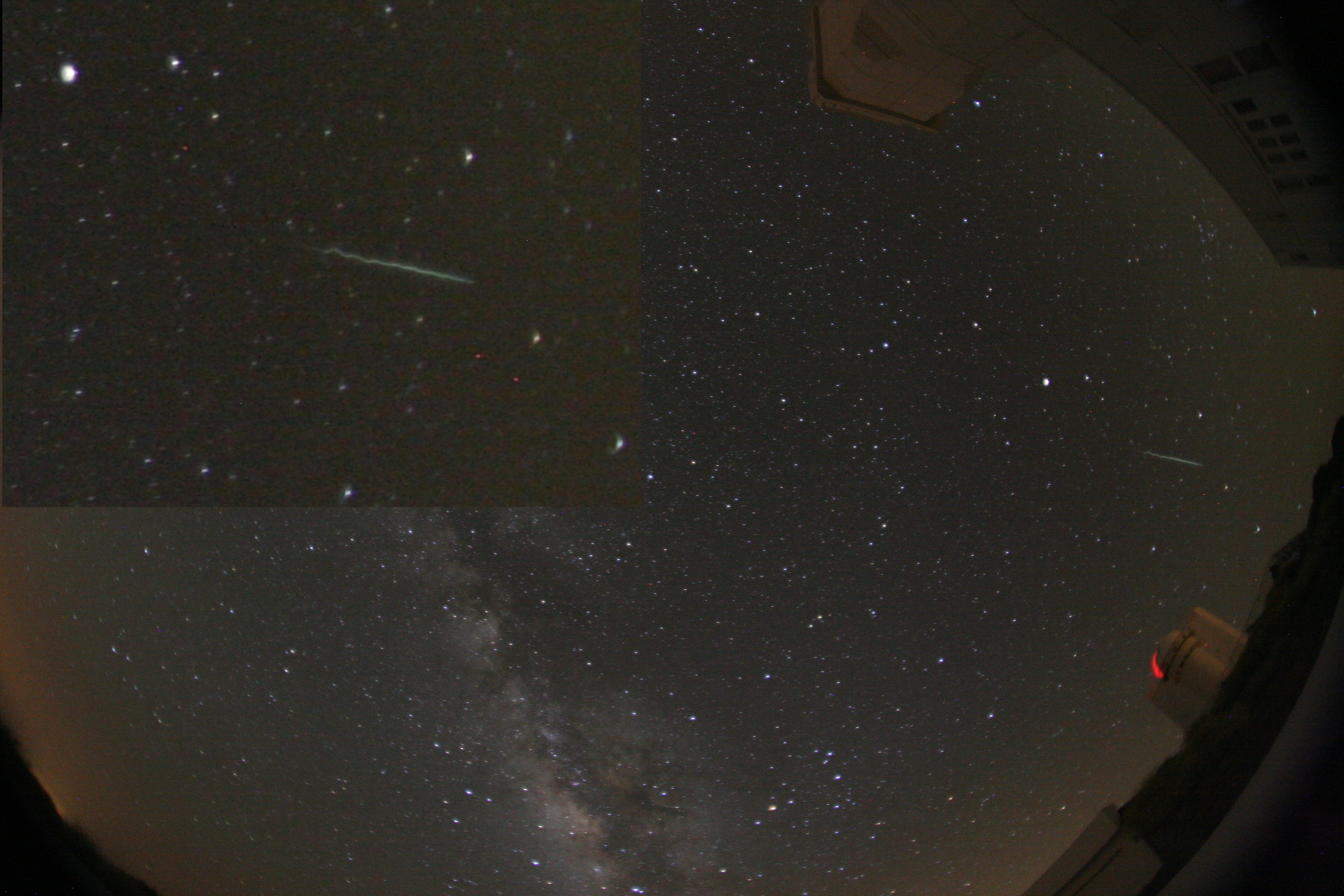
Did this meteor take a twisting path? No one is sure. Considered opinions are solicited. Meteors, usually sand sized grains that originate in comets, will typically disintegrate as they enter the Earth's atmosphere. A fast moving meteor ionizes molecules in the Earth's atmosphere that subsequently glow when they reacquire electrons. Meteor paths that twist noticeably have been noted before, and even photographed, but attributing such behavior to the motion of the meteor itself and neither the wind-blown meteor train nor the observer remains somewhat controversial. The above meteor, imaged two weeks ago streaking over the Teide Observatory in Tenerife, Canary Islands, appears to swagger as much as several minutes of arc, which the experienced astrophotographer did not think could be attributed to drifting of the resulting train or motion of the camera mount. If truly an indication of a twisted meteor path, an underlying reason could be the pictured meteor was markedly non-spherical in shape, non-uniform in composition, or electrically charged. Non-uniform meteors, for example, may evaporate more on one side than another, causing a rotating meteor to wobble. Understanding meteors is important partly because meteors are candidates to have seeded Earth with prebiotic molecules that allowed for the development of life.
¿Este meteorito siguió una trayectoria retorcida? Nadie está seguro. Se solicitan opiniones consideradas. Los meteoritos, generalmente granos del tamaño de la arena que provienen de cometas, suelen desintegrarse al entrar en la atmósfera terrestre. Un meteorito en movimiento rápido ioniza moléculas en la atmósfera terrestre, las cuales posteriormente brillan cuando recuperan electrones. Las trayectorias de meteoritos que se retuercen notablemente han sido observadas anteriormente, e incluso fotografiadas, pero atribuir dicho comportamiento al movimiento del meteorito en sí, y no al meteorito arrastrado por el viento ni al observador, sigue siendo algo controvertido. El meteorito mostrado en la imagen, capturado hace dos semanas cruzando el Observatorio del Teide en Tenerife, Islas Canarias, parece balancearse tanto como varios minutos de arco, lo cual el experimentado fotógrafo astronómico no creyó que pudiera atribuirse al desplazamiento del rastro resultante ni al movimiento del soporte de la cámara. Si realmente es una indicación de una trayectoria retorcida del meteorito, una razón subyacente podría ser que el meteorito mostrado tenía una forma claramente no esférica, una composición no uniforme o estaba cargado eléctricamente. Por ejemplo, meteoritos no uniformes pueden evaporarse más en un lado que en otro, causando que un meteorito que gira se tambalee. Comprender los meteoritos es importante en parte porque los meteoritos son candidatos para haber sembrado la Tierra con moléculas prebióticas que permitieron el desarrollo de la vida.