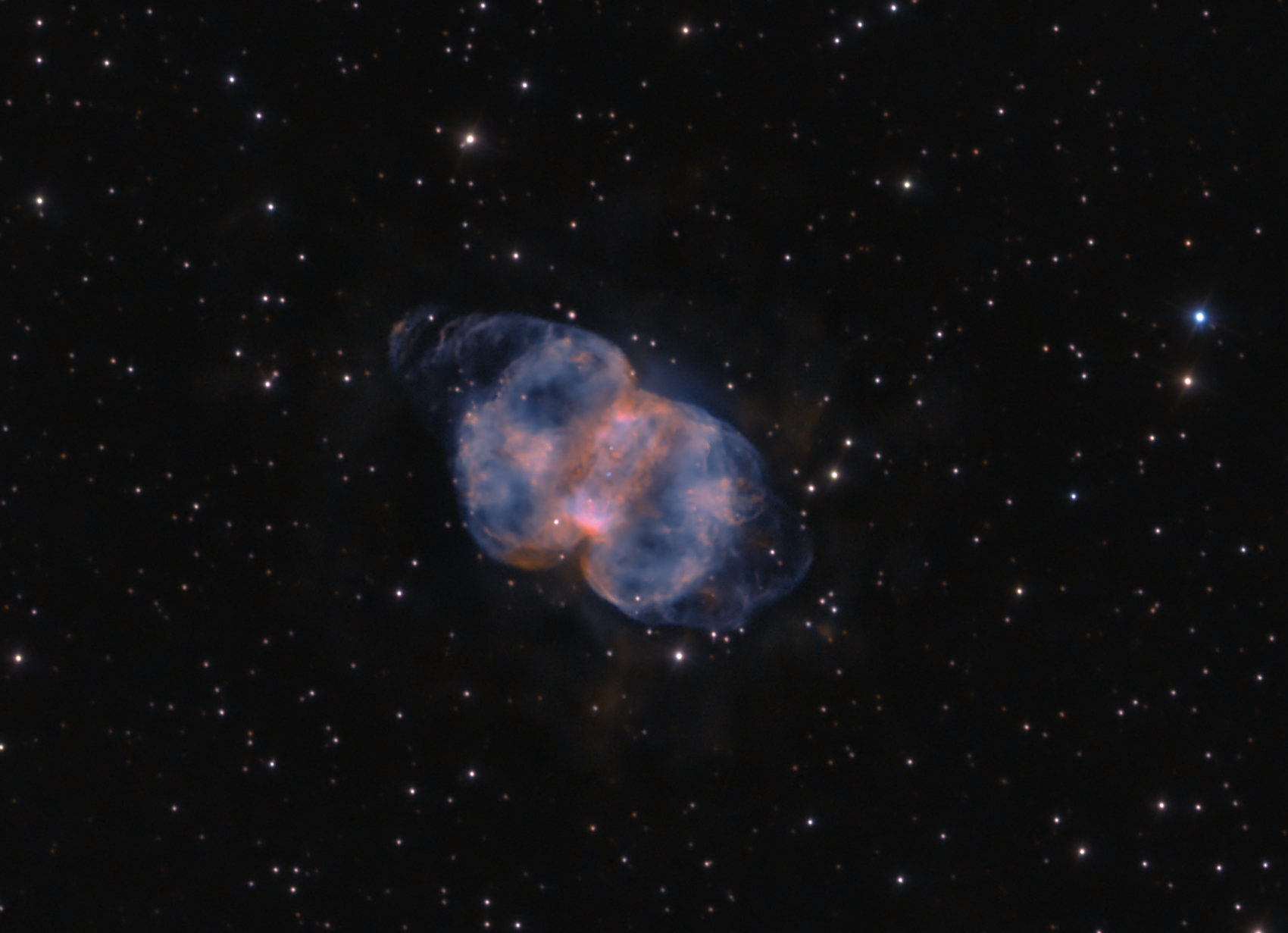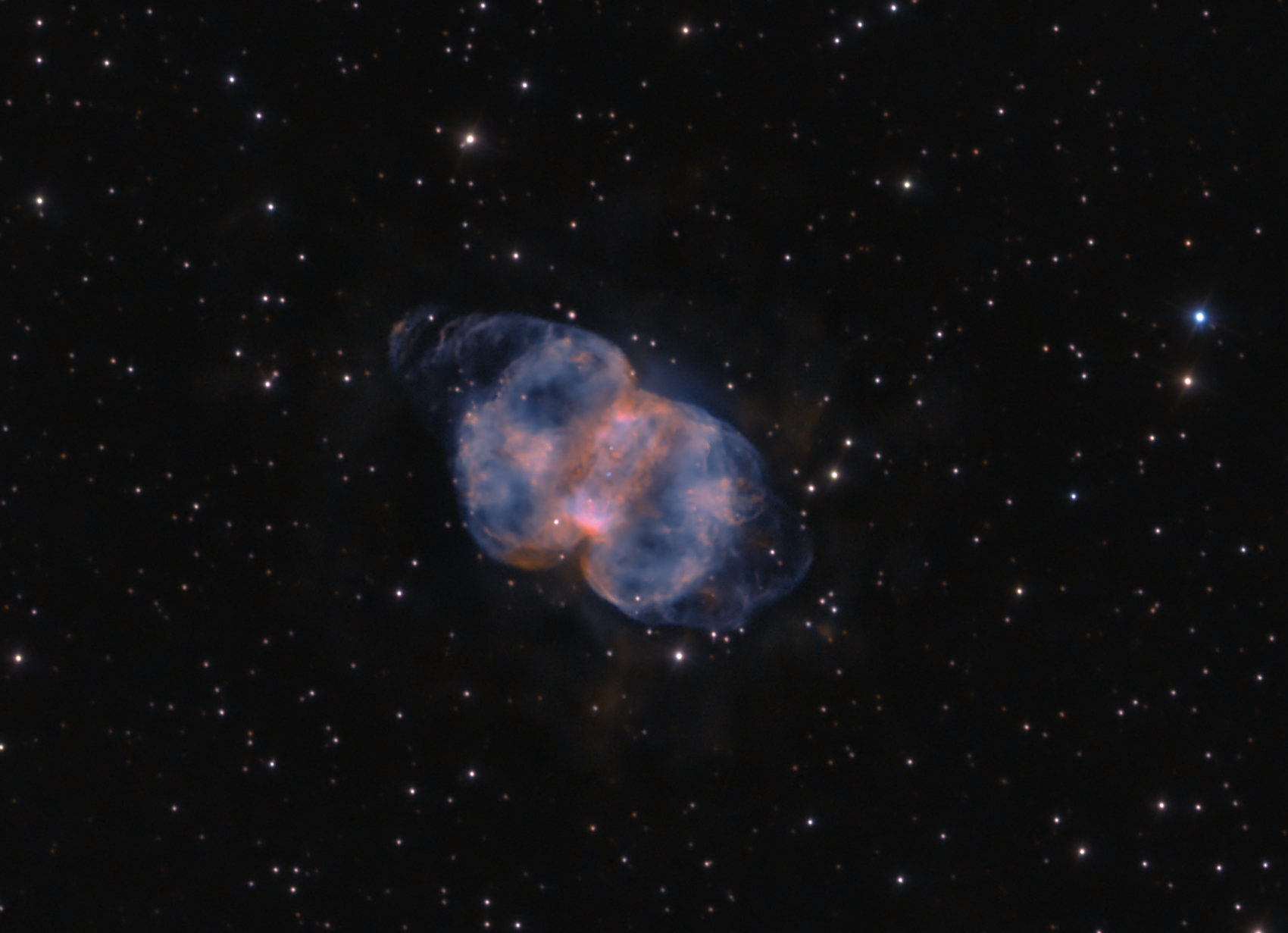
"Nebula at the right foot of Andromeda ... " begins the description for the 76th object in Charles Messier's 18th century Catalog of Nebulae and Star Clusters. In fact, M76 is one of the fainter objects on the Messier list and is also known by the popular name of the "Little Dumbbell Nebula". Like its brighter namesake M27 (the Dumbbell Nebula), M76 is recognized as a planetary nebula - a gaseous shroud cast off by a dying sunlike star. The nebula itself is thought to be shaped more like a donut, while the box-like appearance of its brighter central region is due to our nearly edge-on view. Gas expanding more rapidly away from the donut hole produces the fainter loops of far flung material. The fainter material is emphasized in this composite image, highlighted by showing emission from hydrogen atoms in orange and oxygen atoms in complementary blue hues. The nebula's dying star can be picked out in the sharp false-color image as the blue-tinted star near the center of the box-like shape. Distance estimates place M76 about 3 to 5 thousand light-years away, making the nebula over a light-year in diameter.
Crédito: NASA, CGRO SSC "Nebulosa en el pie derecho de Andrómeda..." comienza la descripción del 76º objeto en el Catálogo de Nebulosas y Agrupaciones Estelares del siglo XVIII de Charles Messier. De hecho, M76 es uno de los objetos más tenues de la lista de Messier y también es conocido por el nombre popular de la "Nebulosa del Pequeño Doble Cero". Al igual que su par más brillante, M27 (la Nebulosa del Doble Cero), M76 se reconoce como una nebulosa planetaria: una envoltura gaseosa expulsada por una estrella similar al Sol en sus últimos momentos. Se cree que la nebulosa tiene una forma más parecida a un donut, mientras que la apariencia cuadrada de su región central más brillante se debe a nuestra perspectiva casi de perfil. El gas que se expande más rápidamente desde el hueco del donut produce los bucles más tenues de material distante. El material más tenue se resalta en esta imagen compuesta, destacando la emisión de átomos de hidrógeno en tonos naranja y la de átomos de oxígeno en tonos azules complementarios. La estrella moribunda de la nebulosa se puede identificar en la imagen en color falso como la estrella teñida de azul cerca del centro de la forma cuadrada. Las estimaciones de distancia sitúan a M76 a unos 3 a 5 mil años luz de distancia, lo que hace que la nebulosa tenga un diámetro de más de un año luz.