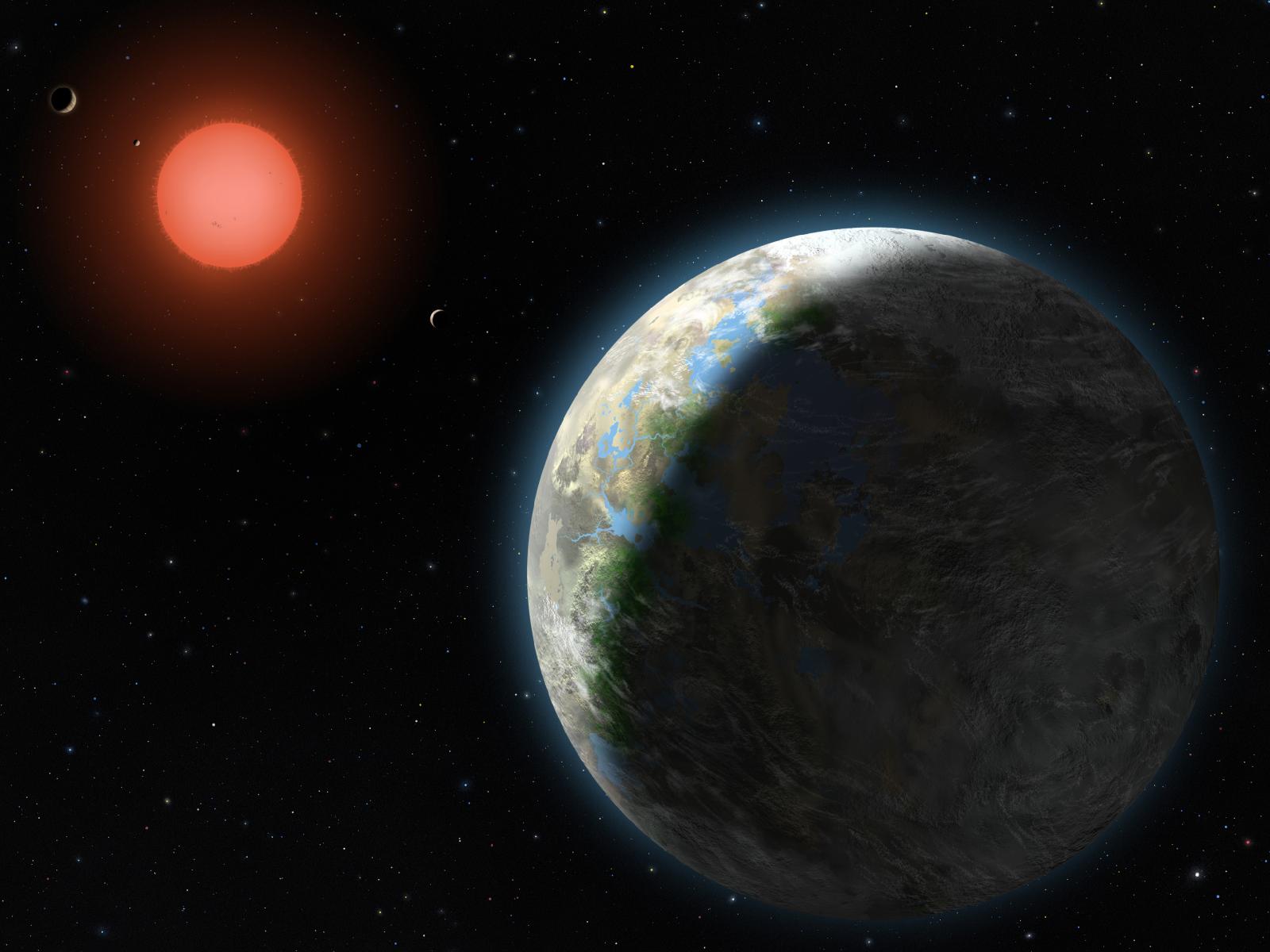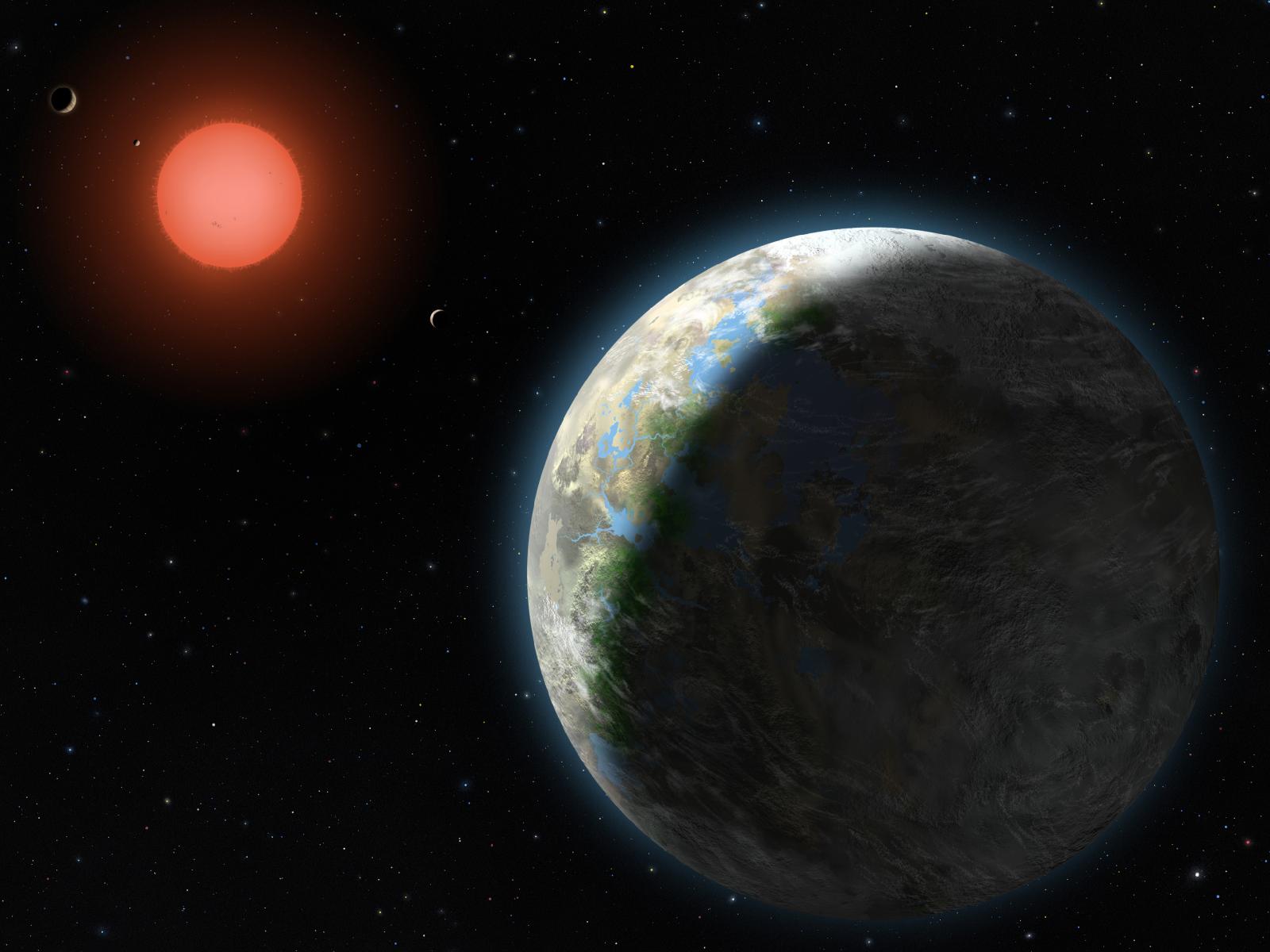
A mere 20 light-years away in the constellation Libra, red dwarf star Gliese 581 has received much scrutiny by astronomers in recent years. Earthbound telescopes had detected the signatures of multiple planets orbiting the cool sun, two at least close to the system's habitable zone -- the region where an Earth-like planet can have liquid water on its surface. Now a team headed by Steven Vogt (UCO Lick), and Paul Butler (DTM Carnagie Inst.) has announced the detection of another planet, this one squarely in the system's habitable zone. Based on 11 years of data, their work offers a very compelling case for the first potentially habitable planet found around a very nearby star. Shown in this artist's illustration of the inner part of the exoplanetary system, the planet is designated Gliese 581g, but Vogt's more personal name is Zarmina's World, after his wife. The best fit to the data indicates the planet has a circular 37 day orbit, an orbital radius of only 0.15 AU, and a mass 3.1 times the Earth's. Modeling includes estimates of a planet radius of 1.5, and gravity at the planet's surface of 1.1 to 1.7 in Earth units. Finding a habitable planet so close by suggests there are many others in our Milky Way galaxy.
A tan solo 20 años luz de distancia en la constelación de Libra, la enana roja Gliese 581 ha recibido mucha atención por parte de los astrónomos en los últimos años. Los telescopios terrestres habían detectado las firmas de múltiples planetas orbitando la estrella fría, al menos dos de ellos cerca de la zona habitable del sistema — la región en la que un planeta similar a la Tierra podría tener agua líquida en su superficie. Ahora, un equipo liderado por Steven Vogt (UCO Lick) y Paul Butler (DTM Carnegie Inst.) ha anunciado la detección de otro planeta, este situado claramente dentro de la zona habitable del sistema. Basándose en 11 años de datos, su trabajo ofrece un caso muy convincente para el primer planeta potencialmente habitable encontrado alrededor de una estrella muy cercana. En esta ilustración artística de la parte interior del sistema exoplanetario, el planeta se designa como Gliese 581g, pero el nombre más personal de Vogt es 'El Mundo de Zarmina', en honor a su esposa. El mejor ajuste a los datos indica que el planeta tiene una órbita circular de 37 días, un radio orbital de solo 0.15 UA y una masa 3.1 veces la de la Tierra. Los modelos incluyen estimaciones de un radio planetario de 1.5 y una gravedad en la superficie del planeta de 1.1 a 1.7 veces la de la Tierra. Encontrar un planeta habitable tan cerca sugiere que hay muchos otros en nuestra galaxia, la Vía Láctea.