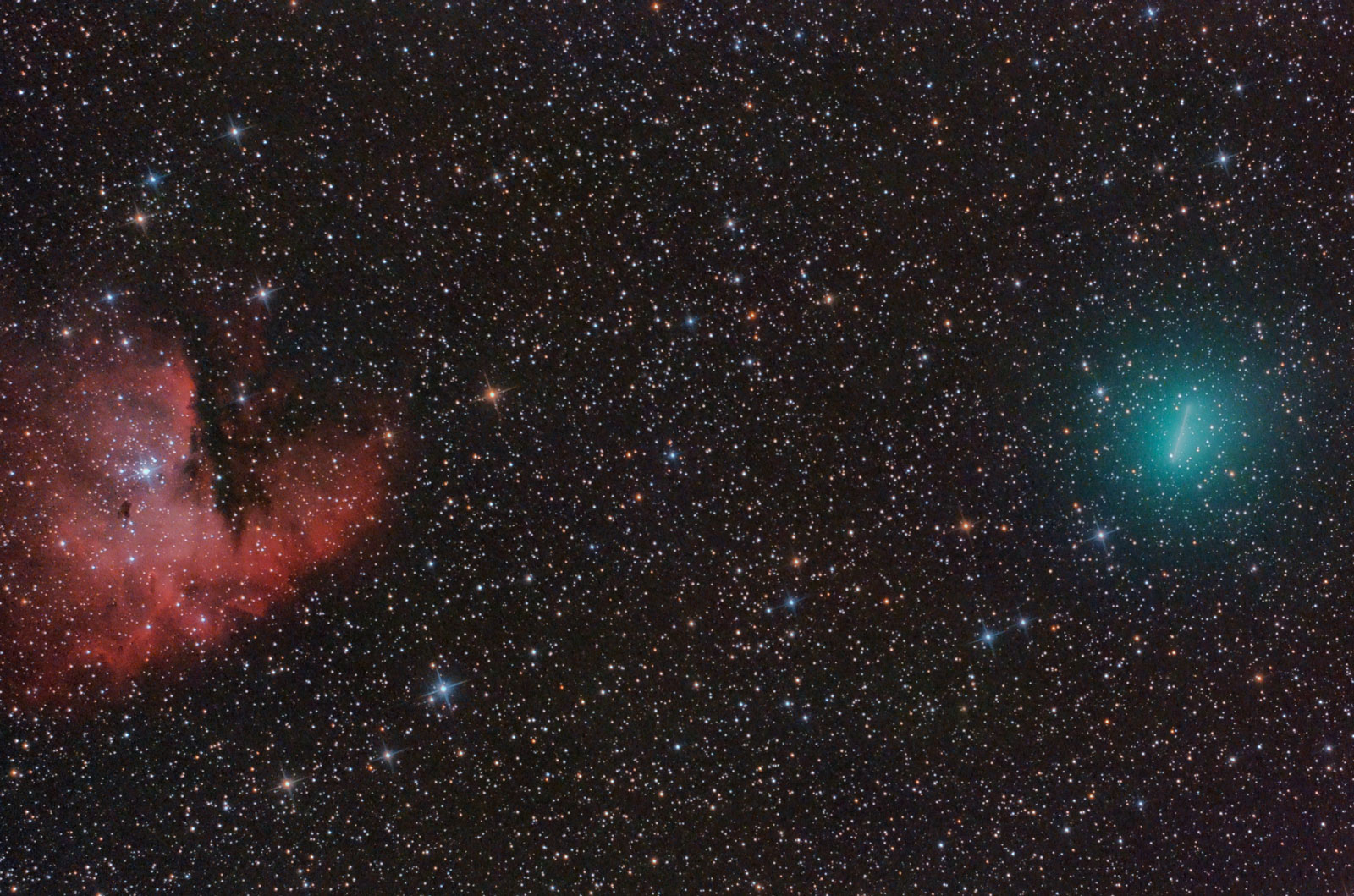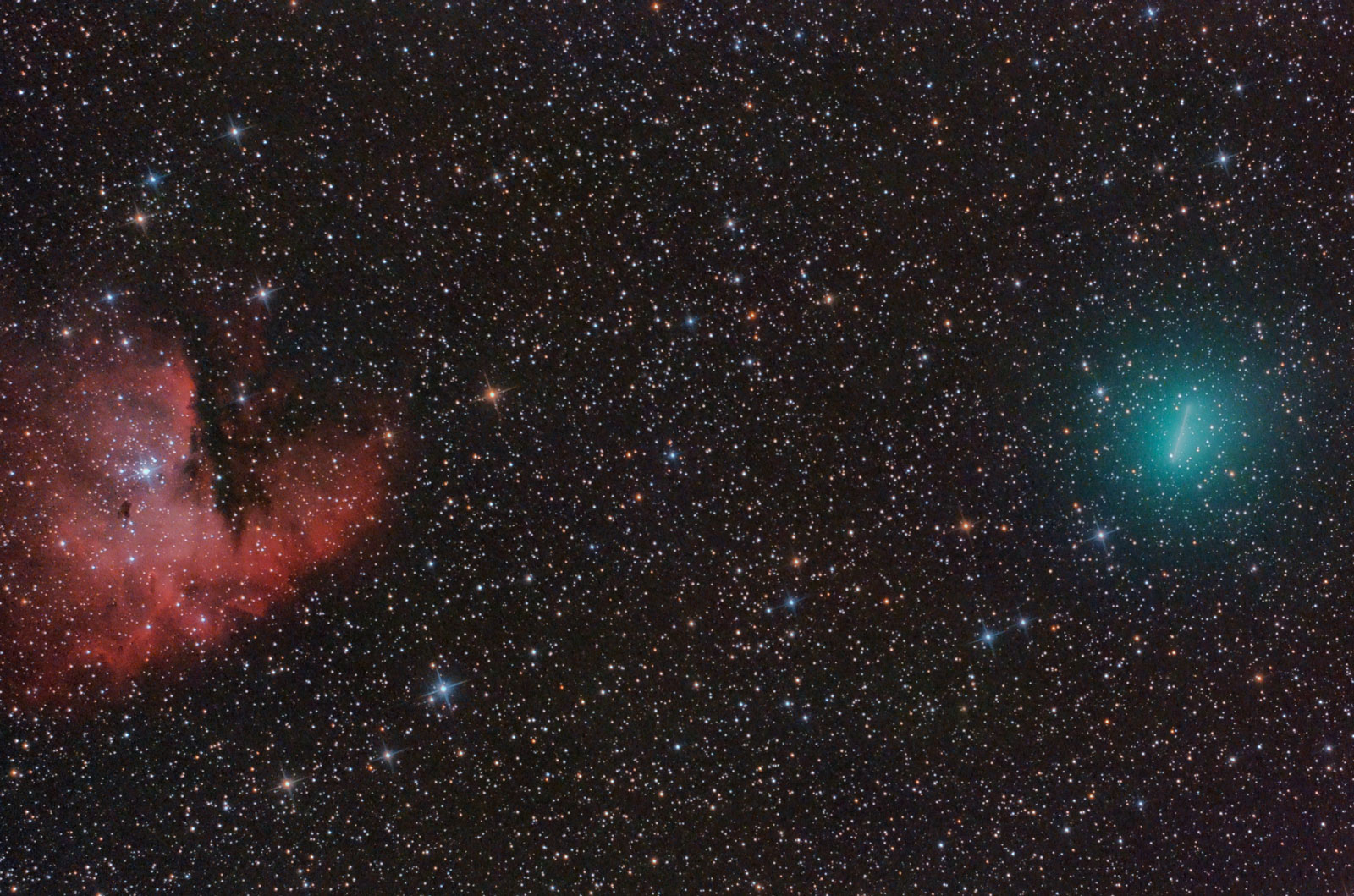
Touring the solar system with a 6 year orbital period, small comet Hartley 2 (103/P Hartley) will make its closest approach to planet Earth on October 20 and its closest approach to the Sun on October 28. It may become a naked-eye comet, just visible in clear, dark skies. Meanwhile the comet has been a tempting telescopic target, seen here with an alluring green coma as it shares the frame with emission nebula NGC 281 and stars of the constellation Cassiopeia on October 2. The nebula's gaping profile defined by dust clouds against the red glow suggests its more playful moniker, the Pacman Nebula. An apparent short bright streak shows the comet's motion against the background stars during the hour of accumulated exposure time. Over the next few days Comet Hartley 2's motion will also carry it across a field of view featuring the famous double star cluster in Perseus. On November 4 a spacecraft from planet Earth will actually fly within about 700 kilometers of the comet's nucleus. Now dubbed EPOXI, that spacecraft was formerly known as Deep Impact.
Recorriendo el sistema solar con un período orbital de 6 años, el pequeño cometa Hartley 2 (103/P Hartley) alcanzará su punto más cercano a la Tierra el 20 de octubre y su punto más cercano al Sol el 28 de octubre. Podría convertirse en un cometa visible a simple vista, apenas perceptible en cielos claros y oscuros. Mientras tanto, el cometa ha sido un objetivo tentador para telescopios, como se muestra aquí con su atractiva coma verde mientras comparte el marco con la nebulosa de emisión NGC 281 y estrellas de la constelación de Casiopea el 2 de octubre. El perfil de la nebulosa, con sus nubes de polvo frente al resplandor rojizo, sugiere su apodo más juguetón, la Nebulosa Pac-Man. Un breve y brillante rastro aparente muestra el movimiento del cometa frente a las estrellas de fondo durante la hora de tiempo de exposición acumulada. En los próximos días, el movimiento del cometa Hartley 2 lo llevará también a través de un campo de visión que incluye el famoso cúmulo estelar doble en Perseo. El 4 de noviembre, una nave espacial de la Tierra se acercará a unos 700 kilómetros del núcleo del cometa. Ahora llamada EPOXI, esa nave espacial anteriormente se conocía como Deep Impact.