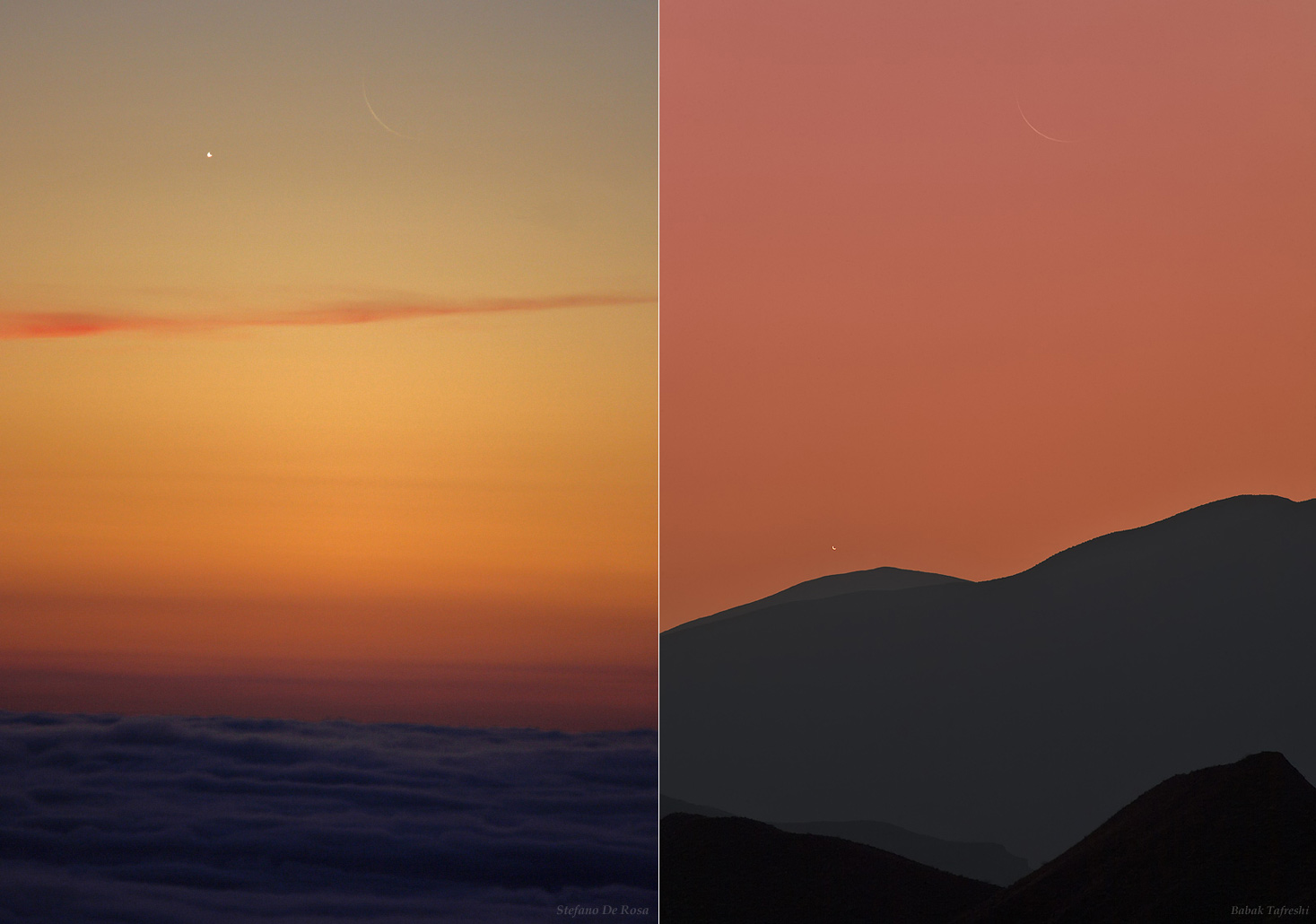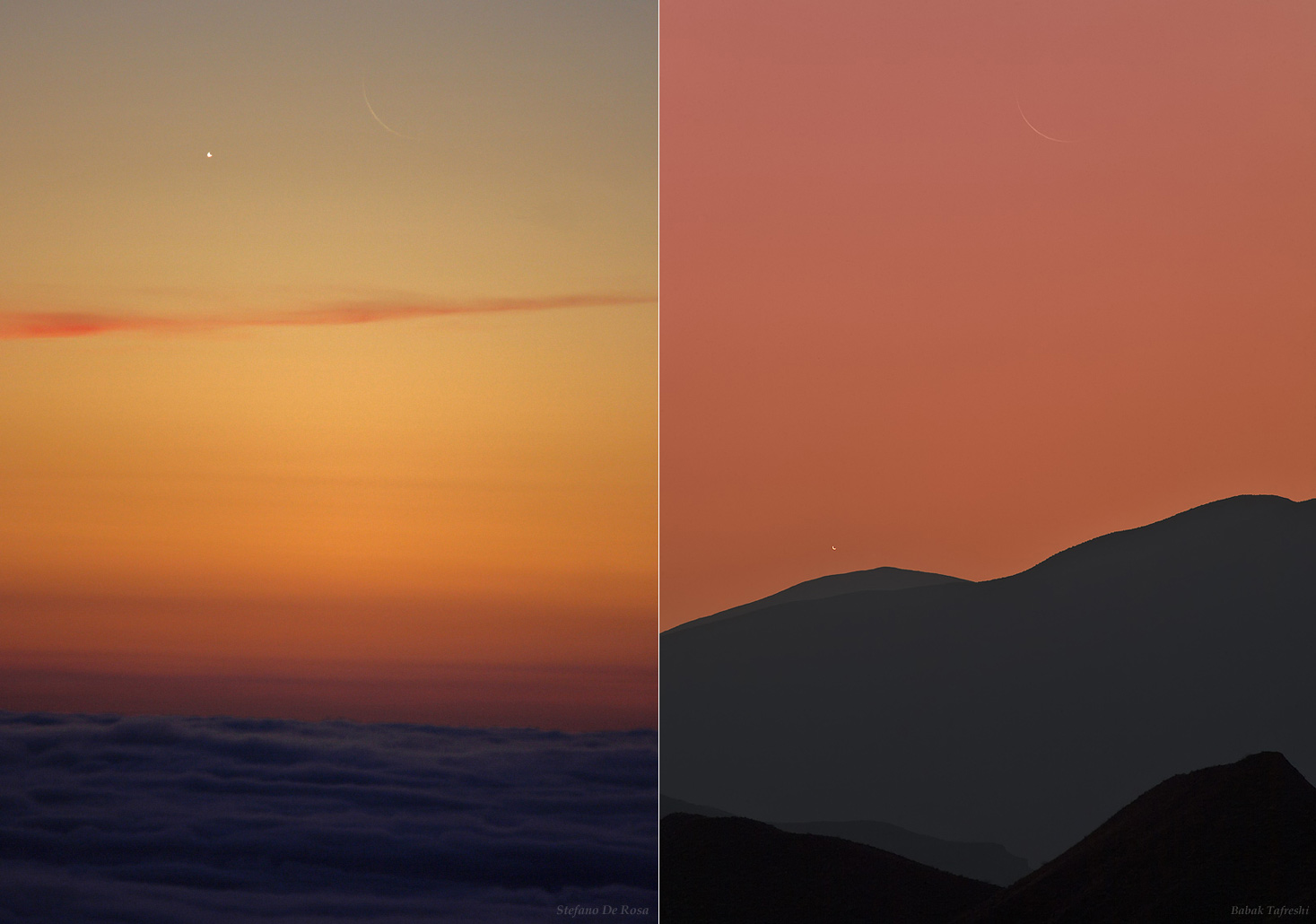
Venus rose in a glowing dawn sky on November 5th, just before the Sun. For early morning risers, its brilliant crescent phase was best appreciated with binoculars or a small telescope. On that day the crescent Venus also appeared in close conjunction with another lovely crescent that hugs the eastern horizon in planet Earth's morning skies, the waning crescent Moon. The celestial photo-op is captured here from two locations. Left, separated by less than a degree, the two crescents hover above a sea of clouds. The picture was recorded from an Alpine mountain pass not far from Turin, Italy. On the right is a sharp telephoto view taken before an earlier sunrise, farther east in the Alborz Mountains of Iran. In steady skies the slender Moon is still sliding toward Venus, the bright planet's compact crescent just clearing the mountainous horizon. For now, the crescent phase of Venus remains easy to enjoy with binoculars in November's dawn skies. The first observations of the phases of Venus, made by Galileo with his telescope in 1610, agreed with the predictions of the heliocentric Copernican model of the Solar System.
Venus apareció en un cielo crepuscular el 5 de noviembre, justo antes del amanecer. Para quienes se levantaron temprano, su fase creciente brillante fue mejor apreciada con binoculares o un pequeño telescopio. Ese día, Venus también apareció en conjunción cercana con otro hermoso cuarto creciente que abraza el horizonte oriental en los cielos matutinos de la Tierra, la luna menguante. Esta oportunidad fotográfica celeste fue capturada desde dos ubicaciones. A la izquierda, separados por menos de un grado, los dos cuartos crecientes flotan sobre una mar de nubes. La imagen fue registrada desde un paso montañoso alpino no muy lejos de Turín, Italia. A la derecha se muestra una imagen nítida tomada con teleobjetivo antes de un amanecer anterior, más al este en los Montes Alborz de Irán. En un cielo estable, la delgada luna aún se desliza hacia Venus, cuyo cuarto creciente compacto apenas supera el horizonte montañoso. Por ahora, la fase creciente de Venus sigue siendo fácil de disfrutar con binoculares en los cielos matutinos de noviembre. Las primeras observaciones de las fases de Venus, realizadas por Galileo con su telescopio en 1610, coincidieron con las predicciones del modelo copernicano heliocéntrico del Sistema Solar.