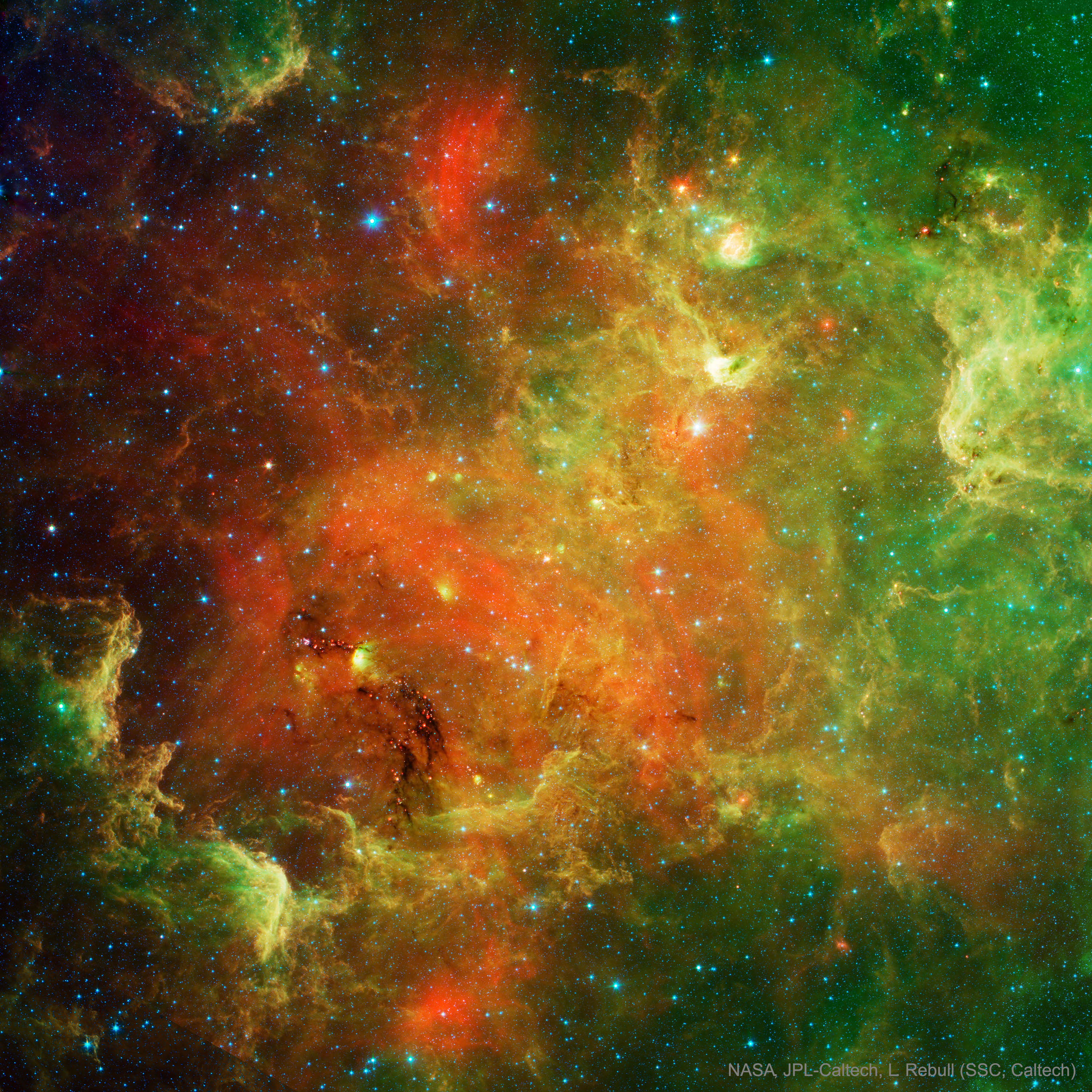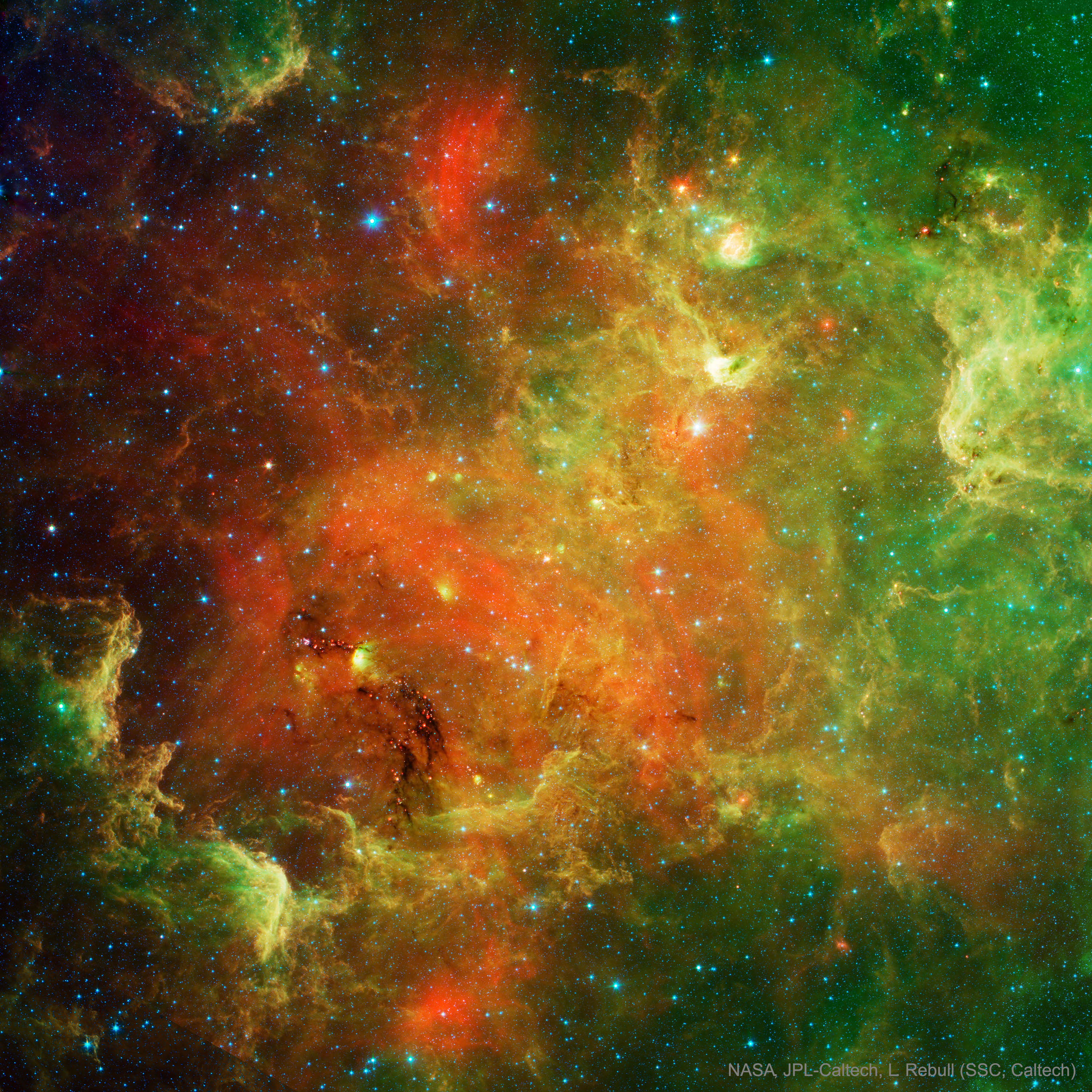
The North America Nebula can do what most North Americans cannot -- form stars. Precisely where in the nebula these stars are forming has been mostly obscured by some of the nebula's thick dust that is opaque to visible light. However, a new view of the North America Nebula in infrared light by the orbiting Spitzer Space Telescope has peered through much of the dust and uncovered thousands of newly formed stars. Rolling your cursor over the above scientifically-colored infrared image will bring up a corresponding optical image of the same region for comparison. The new infrared image neatly captures young stars in many stages of formation, from being imbedded in dense knots of gas and dust, to being surrounded by disks and emitted jets, to being clear of their birth cocoons. The North America Nebula (NGC 7000) spans about 50 light years and lies about 1,500 light years away toward the constellation of the Swan (Cygnus). Still, of all the stars known in the North America Nebula, which massive stars emit the energetic light that gives the ionized red glow is still debated. Images coming in: Stardust spacecraft's close pass of Comet Tempel 1 last night
La Nebulosa Norteamérica puede hacer algo que la mayoría de los norteamericanos no pueden: formar estrellas. Los lugares precisos dentro de la nebulosa donde se están formando estas estrellas han estado en gran medida ocultos por el denso polvo de la propia nebulosa, opaco a la luz visible. Sin embargo, una nueva imagen de la Nebulosa Norteamérica en luz infrarroja, obtenida por el Telescopio Espacial Spitzer en órbita, ha logrado atravesar gran parte de ese polvo y descubrir miles de estrellas recién formadas. Esta nueva imagen infrarroja, procesada con colores científicos, captura estrellas jóvenes en múltiples etapas de formación: desde estar inmersas en densos nódulos de gas y polvo, hasta estar rodeadas por discos y emitir chorros de materia, hasta haberse liberado completamente de sus capullos de nacimiento. La Nebulosa Norteamérica (NGC 7000) abarca aproximadamente 50 años luz y se encuentra a unos 1.500 años luz de distancia, en dirección a la constelación del Cisne (Cygnus). Aun así, entre todas las estrellas conocidas en la Nebulosa Norteamérica, cuáles son las estrellas masivas que emiten la radiación energética responsable del característico resplandor rojo de la región ionizada sigue siendo objeto de debate.