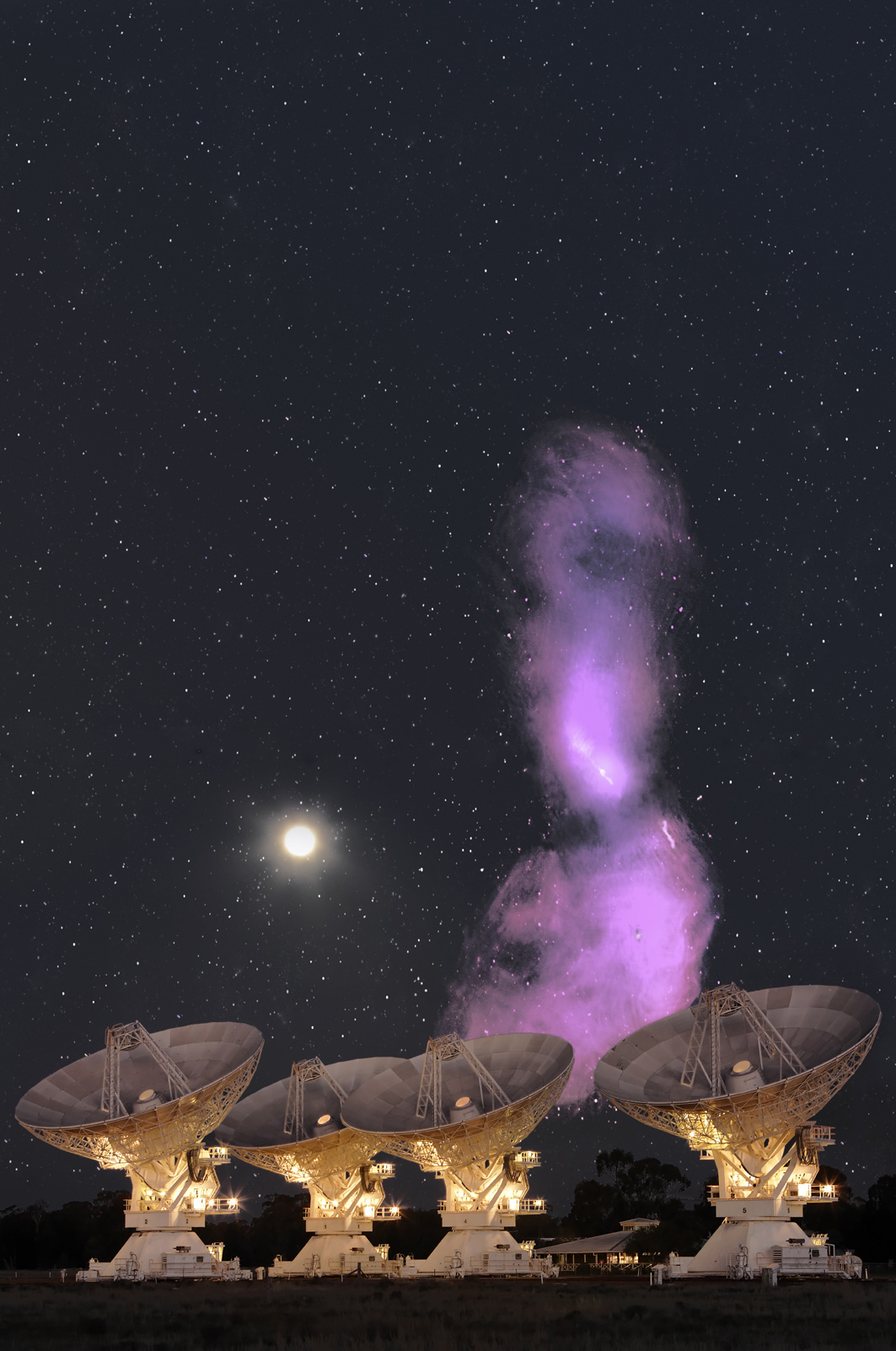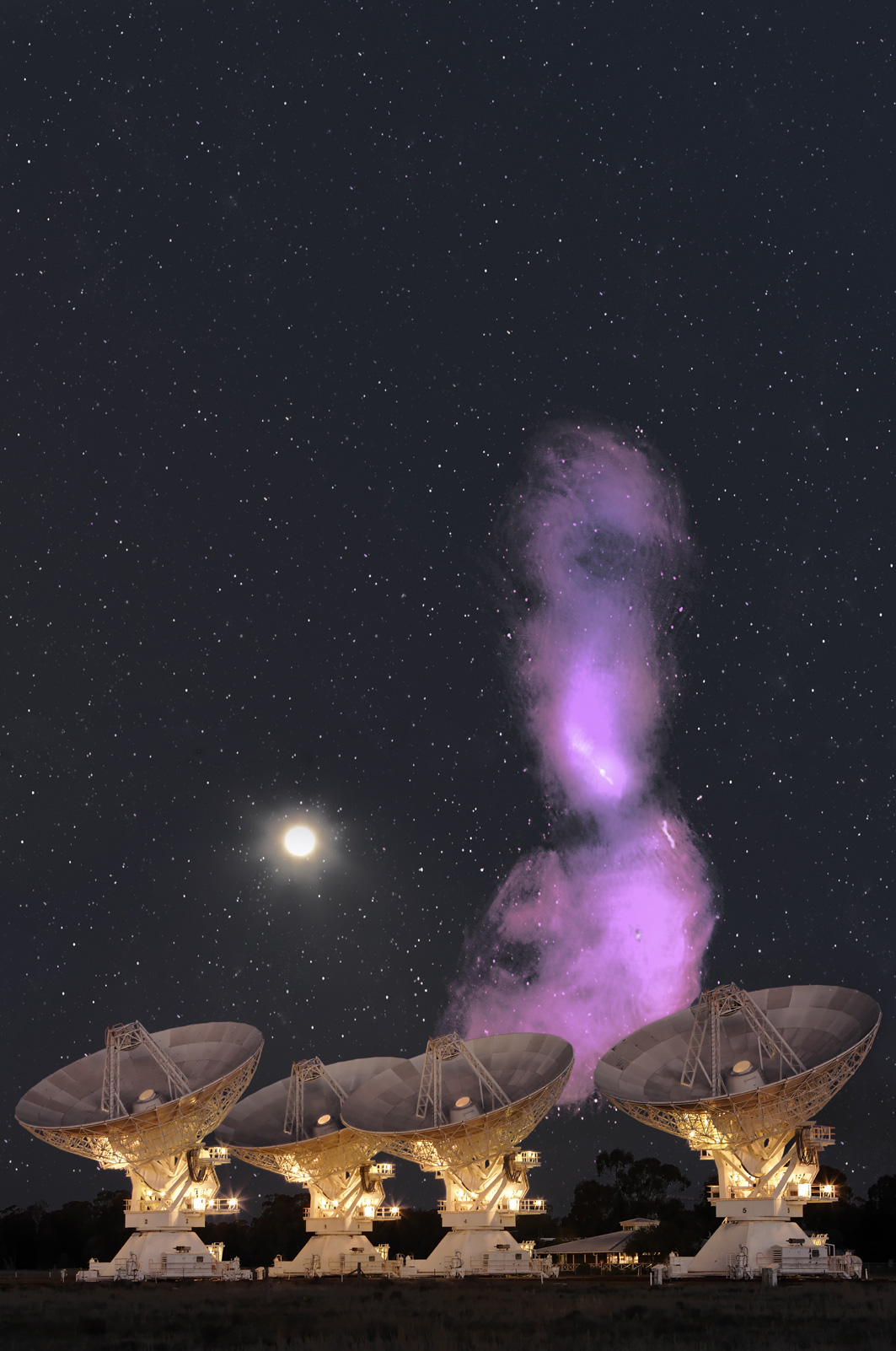
What if you could see the huge radio jets of Centaurus A rising? The Cen A radio jets are not only over a million light years long, they occupy an angular area over 200 times greater than the full Moon in Earth's sky. The jets are expelled by a violent black hole millions of times the mass of our Sun embedded deep in the center of nearby active galaxy Cen A. Somehow, the black hole creates the fast moving jets as other matter falls in. In this picture, radio telescopes from the Australian Telescope Compact Array (ATCA) near Narrabri, NSW, Australia, were captured in front of a full Moon, with a radio image of Cen A superposed at its real angular size in the background. The above picture includes the most detailed map yet of any galaxy-class radio jets in the universe, taking several years and over 1,000 hours exposure time to complete. Details in the photo may yield clues as to how radio jets interact with stars and intergalactic dust. The light dots in the image depict not stars, but typically other radio bright galaxies in the even more distant universe.
¿Qué pasaría si pudieras ver los enormes chorros de radio de Centaurus A elevándose sobre el horizonte? Los chorros de radio de Cen A no solo superan el millón de años luz de longitud, sino que ocupan un área angular más de 200 veces mayor que la de la Luna llena en el cielo terrestre. Estos chorros son expulsados por un violento agujero negro con una masa millones de veces superior a la de nuestro Sol, ubicado en lo profundo del centro de Cen A, una galaxia activa cercana. De alguna manera, el agujero negro genera estos chorros de alta velocidad mientras otra materia cae hacia él. En esta imagen, los radiotelescopios del Australian Telescope Compact Array (ATCA), situado cerca de Narrabri, en Nueva Gales del Sur, Australia, fueron captados frente a una Luna llena, con una imagen de radio de Cen A superpuesta a su tamaño angular real en el fondo. La imagen incluye el mapa más detallado jamás obtenido de chorros de radio de escala galáctica en el universo, cuya elaboración requirió varios años y más de 1.000 horas de tiempo de exposición. Los detalles de la fotografía pueden ofrecer pistas sobre cómo los chorros de radio interactúan con las estrellas y el polvo intergaláctico. Los puntos luminosos en la imagen no representan estrellas, sino típicamente otras galaxias brillantes en radio, pertenecientes a regiones aún más distantes del universo.