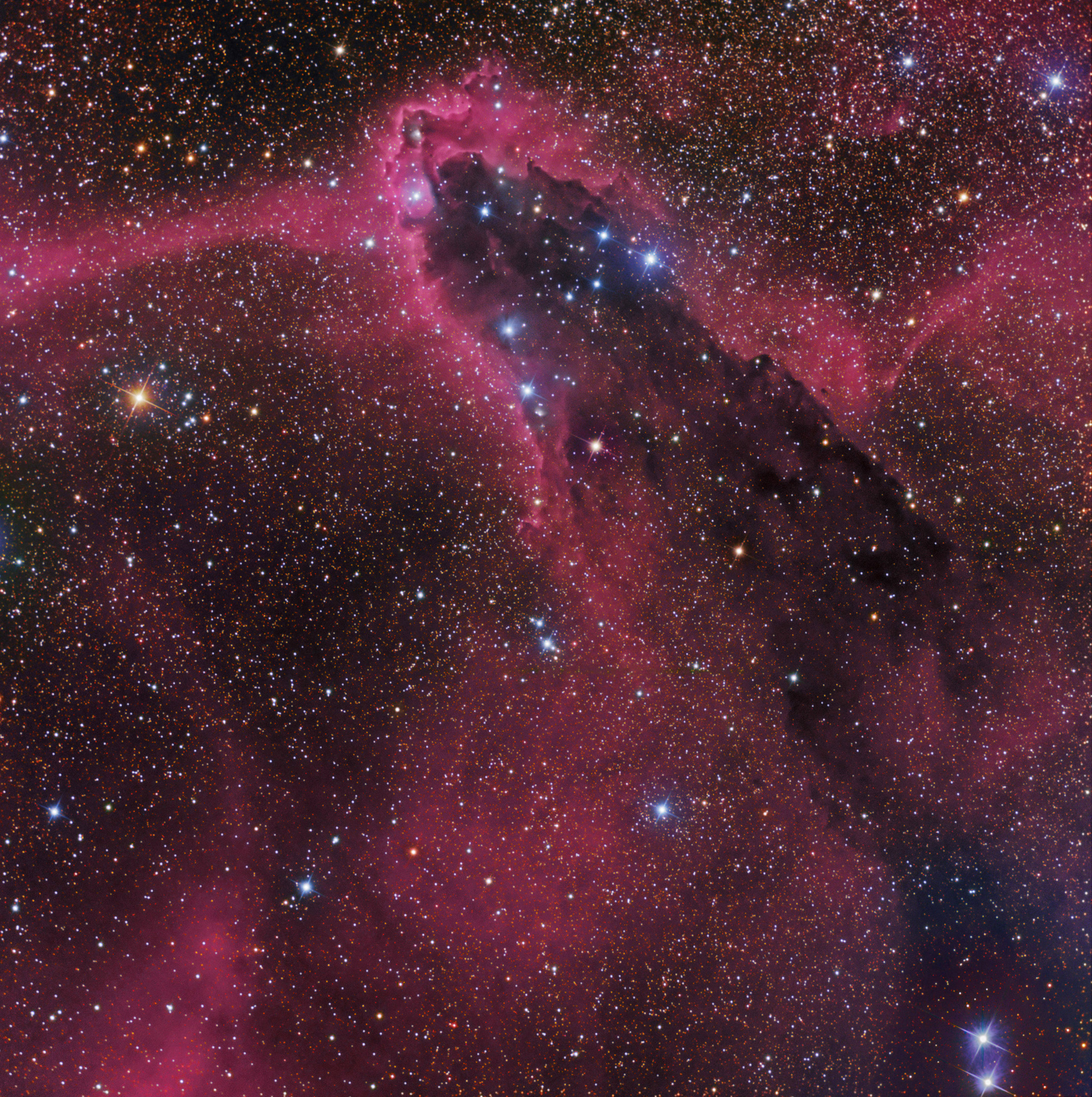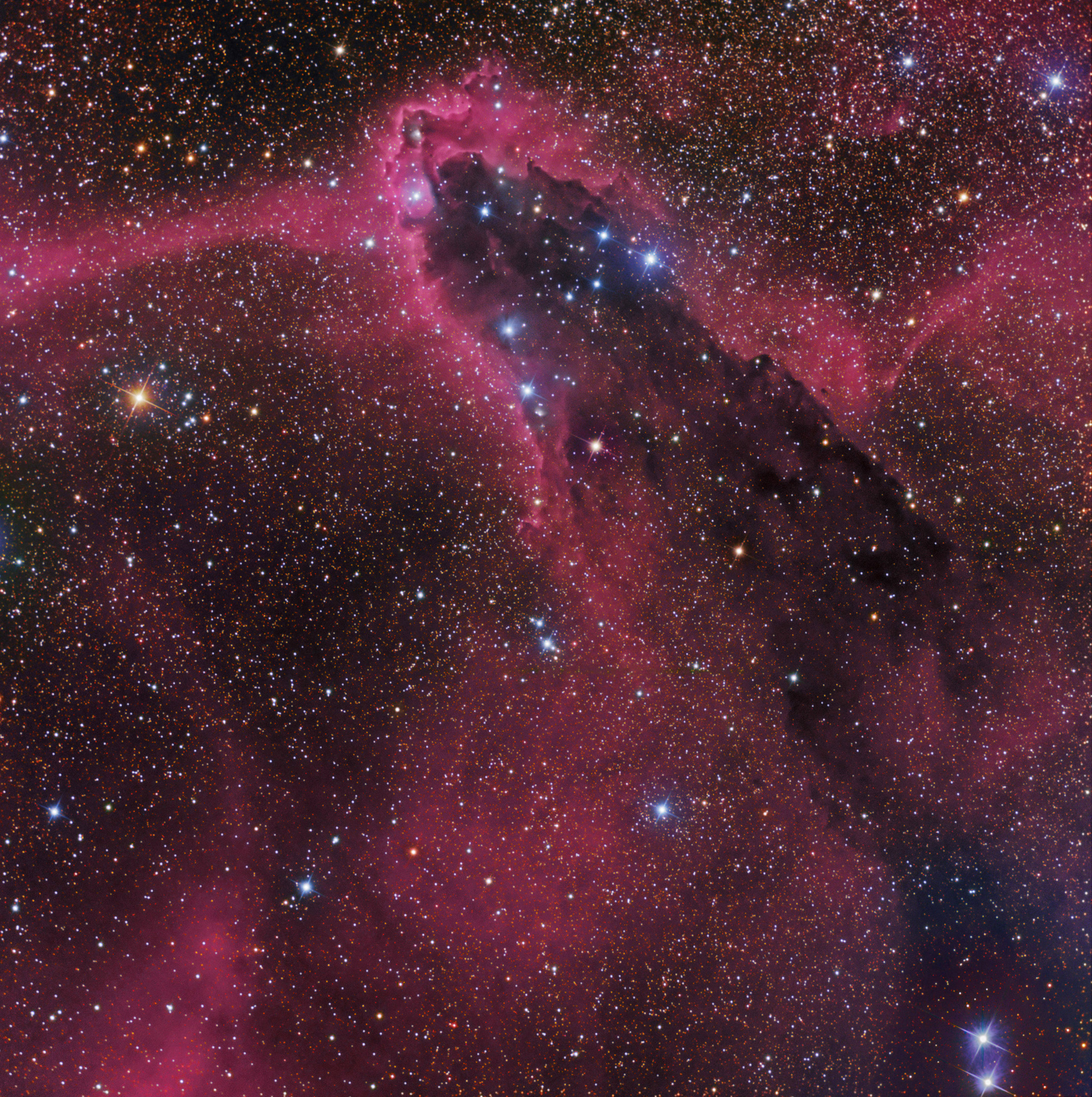
In silhouette against a crowded star field toward the constellation Scorpius, this dusty cosmic cloud evokes for some the image of an ominous dark tower. In fact, clumps of dust and molecular gas collapsing to form stars may well lurk within the dark nebula, a structure that spans almost 40 light-years across this gorgeous telescopic portrait. Known as a cometary globule, the swept-back cloud, extending from the lower right to the head (top of the tower) left and above center, is shaped by intense ultraviolet radiation from the OB association of very hot stars in NGC 6231, off the upper edge of the scene. That energetic ultraviolet light also powers the globule's bordering reddish glow of hydrogen gas. Hot stars embedded in the dust can be seen as bluish reflection nebulae. This dark tower, NGC 6231, and associated nebulae are about 5,000 light-years away.
En silueta contra un campo estelar repleto de estrellas hacia la constelación de Escorpio, esta nube cósmica de polvo evoca en algunos la imagen de una siniestra torre oscura. De hecho, en el interior de esta nebulosa oscura podrían estar formándose estrellas a partir de cúmulos de polvo y gas molecular en colapso, en una estructura que abarca casi 40 años-luz en este magnífico retrato telescópico. Conocida como glóbulo cometario, la nube arqueada hacia atrás, que se extiende desde la parte inferior derecha hasta la cabeza (la cima de la torre) en la parte superior izquierda y central, adquiere su forma por la intensa radiación ultravioleta proveniente de la asociación OB de estrellas muy calientes en NGC 6231, fuera del borde superior de la imagen. Esa energética luz ultravioleta también alimenta el rojizo resplandor de gas hidrógeno que bordea el glóbulo. Las estrellas calientes embebidas en el polvo pueden observarse como nebulosas de reflexión azuladas. Esta torre oscura, NGC 6231 y las nebulosas asociadas se encuentran a unos 5.000 años-luz de distancia.