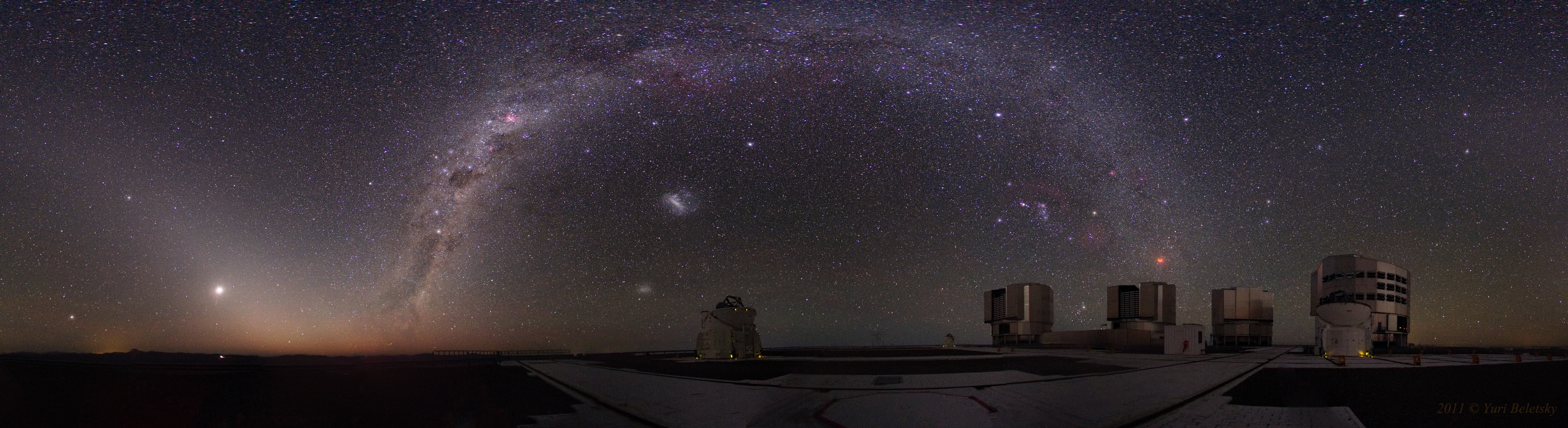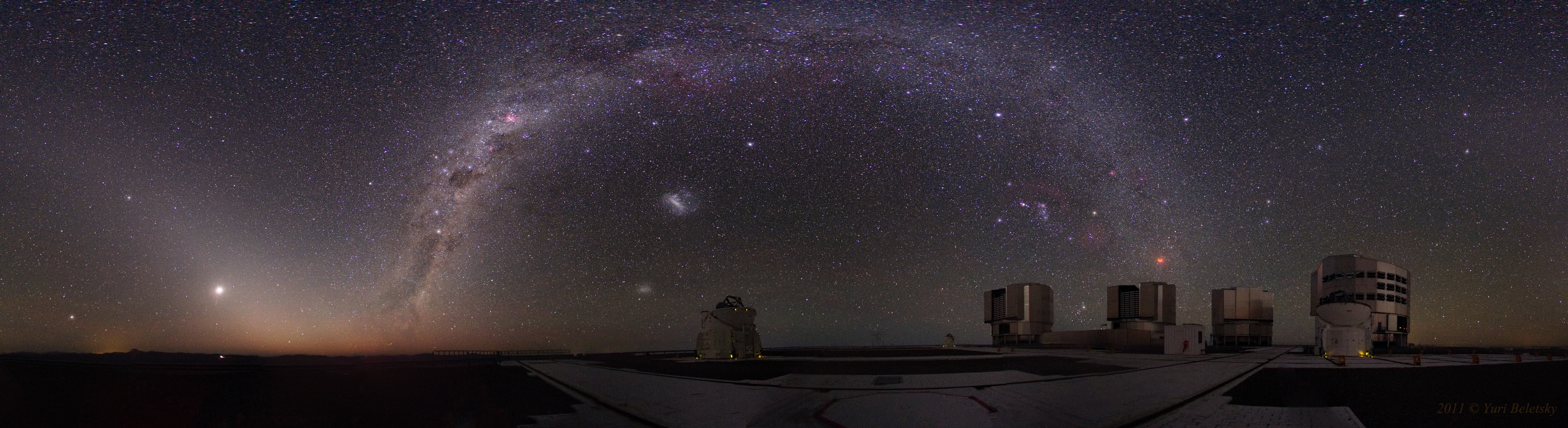
What's that bright orange dot above the large telescope on the right? Even seasoned sky enthusiasts might ponder the origin of the orange orb seen by scrolling across this panoramic image, taken last December. Perhaps identifying known objects will help. To start, on the far left is a diagonal band of light known as zodiacal light, sunlight reflected off of dust orbiting in the inner Solar System. The bright white spot on the left, just above the horizon, is Venus, which also glows by reflected sunlight. Rising diagonally from the ground to the right of Venus is the band of our Milky Way Galaxy. In the image, the band, which usually stretches dramatically overhead, appears to arch above the elevated Chilean landscape. Under the Milky Way arch, toward the left, lie both the Large and Small Magellanic Cloud galaxies, while toward the right lies the constellation of Orion surrounded by the red ring of Barnard's Loop. On the ground, each of the four Very Large Telescopes is busy keeping an eye on the distant universe. The orange spot -- it's the Moon. The image was taken during a total lunar eclipse when the normally bright full moon turned into a faint orb tinted orange by the intervening Earth's atmosphere.
¿Qué es ese brillante punto naranja que aparece sobre el gran telescopio de la derecha? Incluso los aficionados más experimentados al cielo podrían preguntarse sobre el origen del orbe anaranjado que se observa al desplazarse por esta imagen panorámica, tomada el pasado diciembre. Quizás identificar los objetos conocidos ayude a resolver el misterio. Para comenzar, en el extremo izquierdo se aprecia una banda diagonal de luz conocida como luz zodiacal, luz solar reflejada por el polvo que orbita en el Sistema Solar interior. El punto blanco y brillante a la izquierda, justo sobre el horizonte, es Venus, que también resplandece gracias a la luz solar reflejada. Ascendiendo diagonalmente desde el suelo, a la derecha de Venus, se extiende la banda de nuestra Galaxia Vía Láctea. En la imagen, dicha banda, que habitualmente se despliega de manera espectacular sobre nuestras cabezas, parece arquearse sobre el elevado paisaje chileno. Bajo el arco de la Vía Láctea, hacia la izquierda, se encuentran tanto la Gran Nube de Magallanes como la Pequeña Nube de Magallanes, mientras que hacia la derecha se halla la constelación de Orión rodeada por el anillo rojo conocido como el Bucle de Barnard. En tierra firme, cada uno de los cuatro Telescopios Muy Grandes está ocupado vigilando el universo distante. El punto naranja... es la Luna. La imagen fue tomada durante un eclipse lunar total, cuando la habitualmente brillante luna llena se transformó en un tenue orbe teñido de naranja por la atmósfera terrestre interpuesta.