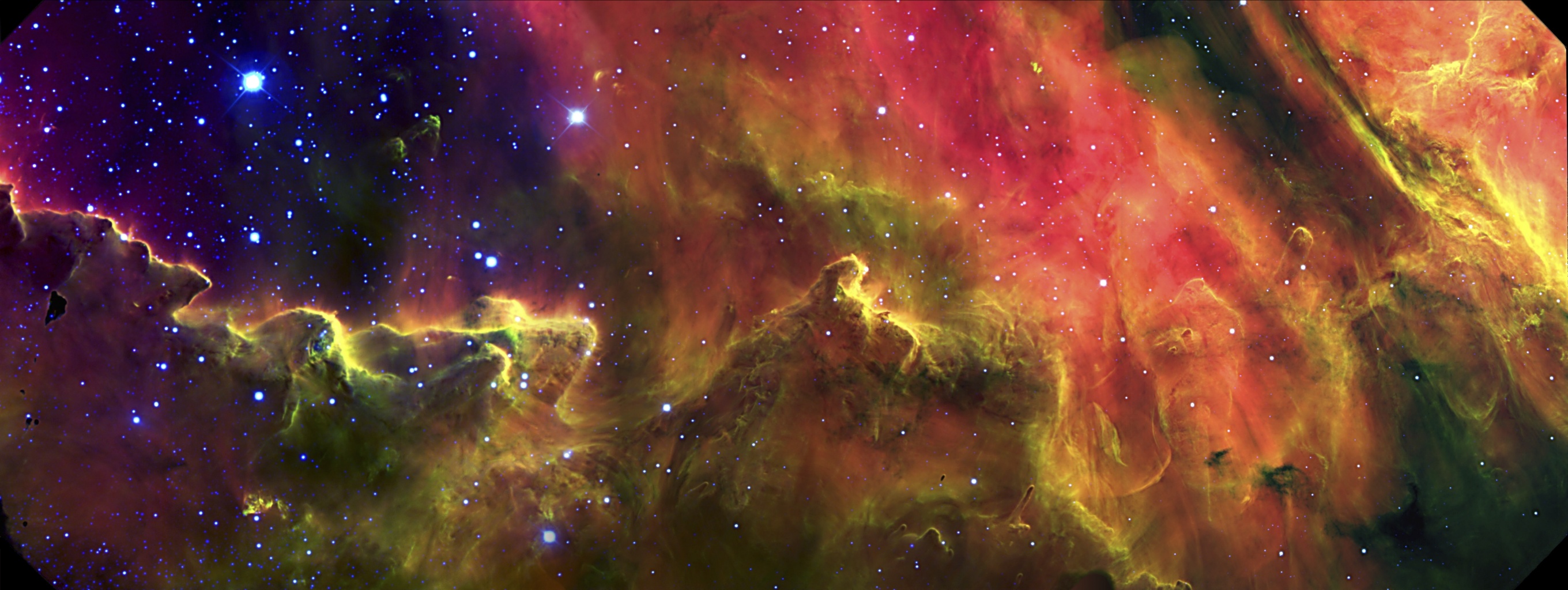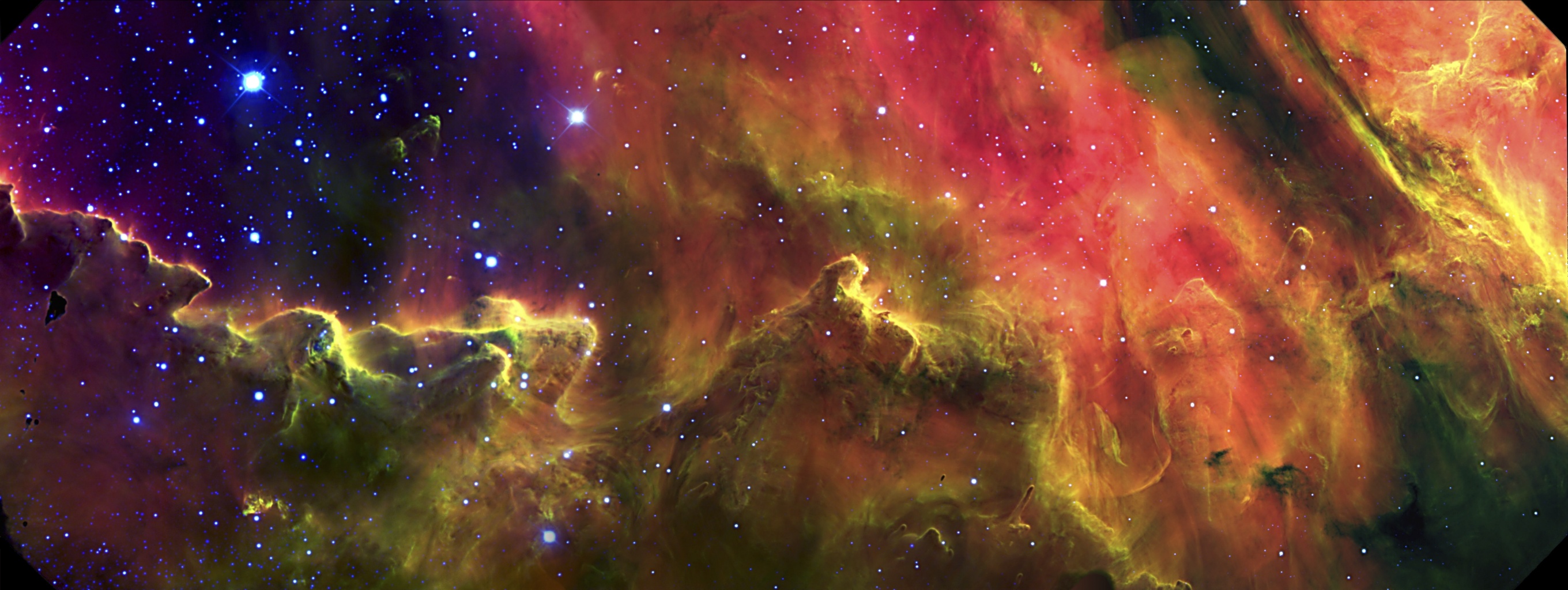
Undulating bright ridges and dusty clouds cross this close-up of the nearby star forming region M8, also known as the Lagoon Nebula. A sharp, false-color composite of narrow band visible and broad band near-infrared data from the 8-meter Gemini South Telescope, the entire view spans about 20 light-years through a region of the nebula sometimes called the Southern Cliff. The highly detailed image explores the association of many newborn stars imbedded in the tips of the bright-rimmed clouds and Herbig-Haro objects. Abundant in star-forming regions, Herbig-Haro objects are produced as powerful jets emitted by young stars in the process of formation heat the surrounding clouds of gas and dust. The cosmic Lagoon is found some 5,000 light-years away toward constellation Sagittarius and the center of our Milky Way Galaxy. (Editor's Note: For location and scale, check out this image superimposing the close-up region shown in today's APOD on the larger Lagoon Nebula. Scale image is courtesy R. Barbá.)
Crestas brillantes ondulantes y nubes de polvo atraviesan este primer plano de la región de formación estelar M8, también conocida como la Nebulosa de la Laguna. Este detallado compuesto en falso color, que combina datos de banda estrecha en el visible y de banda ancha en el infrarrojo cercano obtenidos con el telescopio Gemini Sur de 8 metros, abarca aproximadamente 20 años-luz a través de una región de la nebulosa denominada en ocasiones el Acantilado Sur. La imagen de gran resolución permite explorar la asociación de numerosas estrellas recién nacidas embebidas en los extremos de las nubes de bordes brillantes y de objetos Herbig-Haro. Abundantes en las regiones de formación estelar, los objetos Herbig-Haro se producen cuando potentes chorros emitidos por estrellas jóvenes en proceso de formación calientan las nubes circundantes de gas y polvo. La Laguna cósmica se encuentra a unos 5.000 años-luz de distancia, en dirección a la constelación de Sagitario y hacia el centro de nuestra galaxia, la Vía Láctea.